
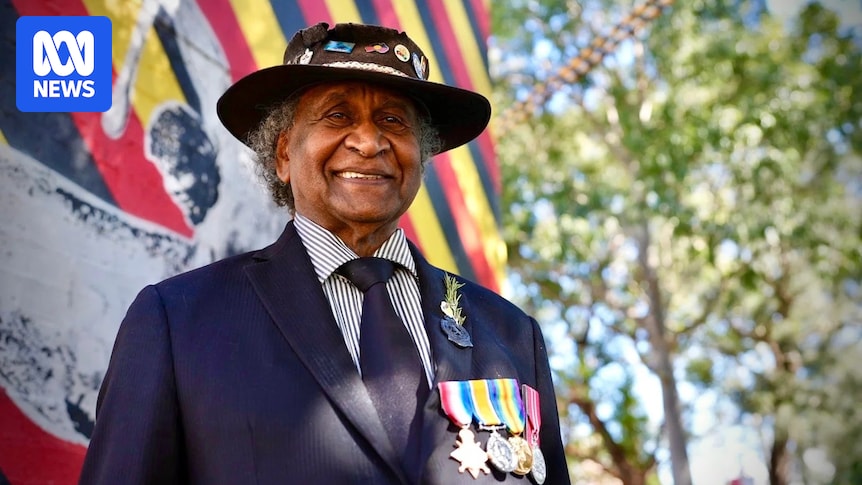
Uncle Ray Minniecon appreciates that Anzac Day comes with powerful emotions, especially when remembering conflict and loss.
The actions of those who chose to boo and disrupt Welcome to Country addresses on Anzac Day was “not beyond our imagination,” he says, adding he didn’t understand their actions, but he would not be deterred.
“What crime did we commit?,” he said. “What are we doing to incite that kind of rage and that kind of hatred? I can’t fathom that… I often say it’s not my problem, it’s a white fella problem.”
The booing directed at Uncle Ray in Sydney as he acknowledged country at the cenotaph in Martin Place was not the only racist action on Anzac Day.
Boos also rang out in Melbourne, where Bunurong and Gunditjmarra Uncle Mark Brown was interrupted. In Perth, Whadjuk Noongar Aunty Di Ryder a veteran, had her ceremony heckled.
The disruptions of a small few have been described by WA Premier Roger Cook as “disgusting and disrespectful”, the NSW premier Chris Minns was “disappointed”, while the Victorian premier Jacinta Allen called it “bastardry”.
‘Stand strong, stand tall’
While condemnation has been swift, solutions to this type of racism seem harder to pin down. Elders shared some advice after the Dawn Service.
“Just to stand strong, stand tall. Know who we are, where we come from, and that this is Aboriginal land,” Uncle Ray said. “Always was and always will be Aboriginal land. We stand on the truth, and truth can’t be shaken. That kind of truth will never be destroyed.”
Anzac Day booing a legacy of failed Voice referendum
In the face of the being booed, Uncle Ray never stopped. His staunch character stood out for everyone to see as he finished delivering the acknowledgement and received a warm round of applause.
Uncle Ray, a Kabi-Kabi and Gurang-Gurang, man with connection to the South Sea Islands, comes from a family with a long history of military service to this country.
Uncle Ray served with the 51st Battalion of the Royal Queensland Regiment in the Citizens Military Forces.
His grandfather, Private James Lingwood, fought in World War I with the 11th Light Horse Brigade. His two brothers, Sonny and Phillip, served in Vietnam.
‘I was really proud of him’
Uncle Ray’s wife, Aunty Sharon Minniecon, wasn’t surprised by the way her husband handled himself.
“I was really proud of him. He knows how to navigate through any adversary”, Aunty Sharon said.
Her husband knew his duty was to deliver a respectful Acknowledgement of Country for Indigenous servicemen and women, including veterans from his own family.
“It says so much about his character and the strength of the man, doesn’t it?” she said.
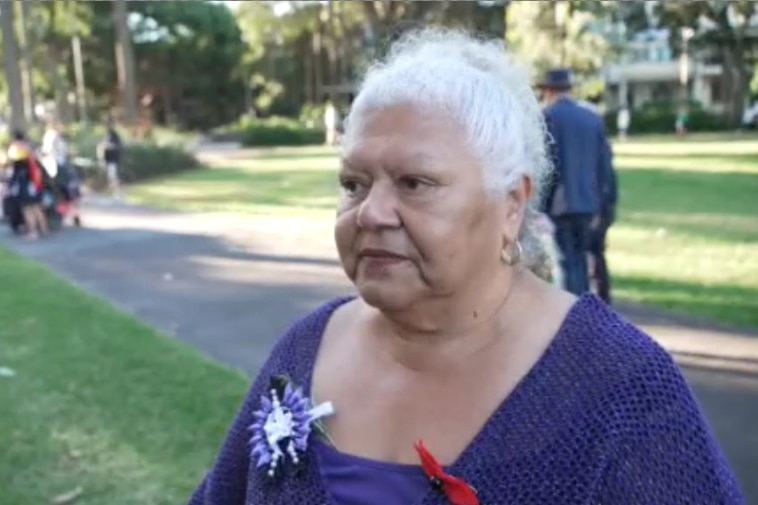
Uncle Ray’s wife, Aunty Sharon, said her husband knew it was his duty to deliver a respectful Acknowledgement of Country. (ABC News)
Uncle Ray’s good friend, Uncle Col Watego tried to process the disruption at the Dawn Service with compassion.
“To be honest, hurting people [go on to] hurt people. It doesn’t excuse anything, but for me, it just explains how much help, and how much we need to keep working towards this better future for all of us,” he said.
Uncle Ray’s service goes even further than his military contribution.
He is a pastor and founder of the Sacred Tree Ministries in inner city Sydney.
And the two Uncles are founders of The Coloured Diggers March, first held in 2007 to celebrate Aboriginal and Torres Strait Islander servicemen and women who have fought to protect Australia in all major conflicts.
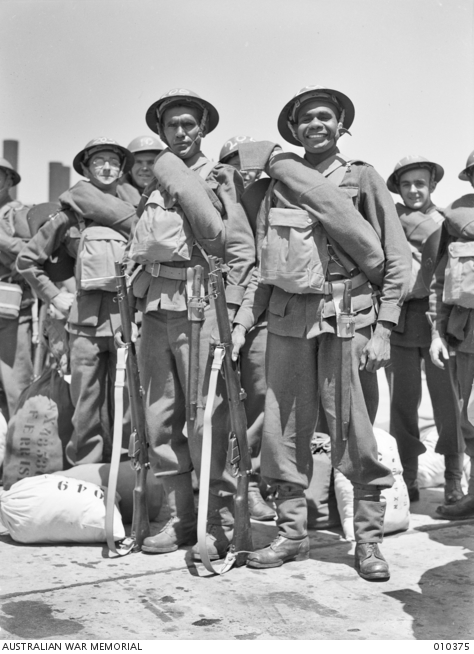
Two best mates, Murrawarri men Private George Leonard (right) and Private Harold West (left), 14th Reinforcements to the 2/1st Battalion taken in 1941. (Source AWM copyright expired https://www.awm.gov.au/collection/C30929)
The name of the march was inspired by a poem penned during the Second World War by Combat Engineer, Bert Beros, a non-Indigenous serviceman who fought on the Kokoda Trail in Papua New Guinea.
The poem was written about Private Harold West, a Murruwari man from Goodooga in NSW who enlisted with his best friend and fellow Murruwari man George Leonard. Leonard was killed in action in 1942.
Private West tried to avenge the death of his friend. The Australian War Memorial writes that West engaged in one-man attacks on the Japanese machine-gun posts, moving stealthily behind enemy lines before throwing grenades.
Sadly, West, died in hospital in Papua New Guinea after breaking his leg and contracting scrub typhus. Both men are buried in Port Moresby’s Bomana War Cemetery.
Uncle Col Watego was the Parade Commander for the Coloured Diggers March. The Bundjalung man has served more than 40 years as a Corps Regimental Sergeant Major in the Royal Regiment of Australian Artillery. He spent time serving in East Timor and his father, grandfather and great uncles all served as well.
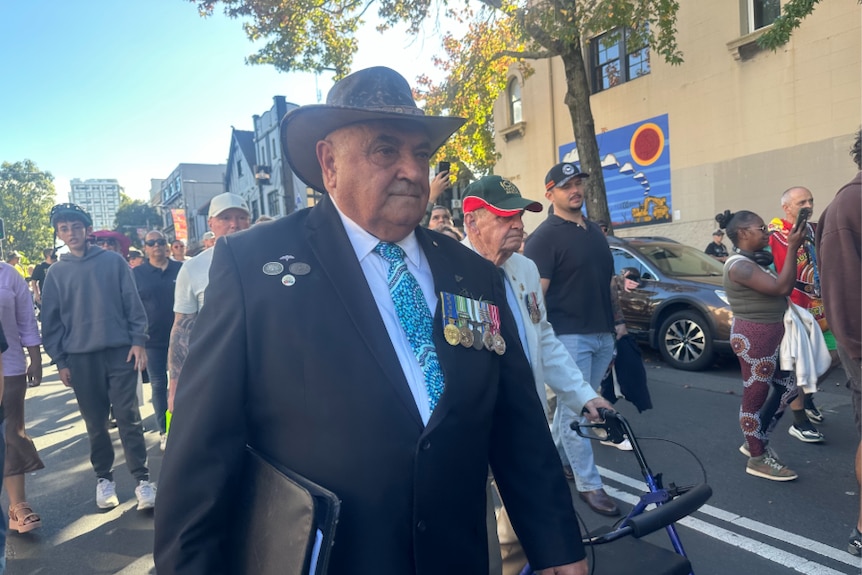
Uncle Col Watego proudly striding out on the Coloured Diggers March through the streets of Redfern. (ABC News: Kris Flanders)
Around about the time hundreds started gathering at the Community Centre in Redfern for the Coloured Diggers ceremony and march, Uncle Ray Minniecon and his stance against the booing, became a social media sensation on Facebook with “I Stand with Uncle Ray” a common theme.
Supporters of Uncle Ray at the Coloured Diggers March backed him and stood by him.
Uncle Col said the treatment of Ray Minniecon and other elders on ANZAC Day “should never have happened”.
However, Uncle Col, also saw the good in people on Saturday and what he describes as the “warrior spirit”.
“What I observed at Anzac Day Dawn Service, [in the Sydney suburb of Oatley] were many young children. I’m talking five-and six-year-olds with their families standing out in the cold, but that’s warrior spirit. That’s the sort of education and teachings we need to keep putting forward to our young fellas and our older people.” Uncle Col said.
“People ask me often, what’s Warrior Spirit? I spent 43 years in the Australian Defence Force, not 43 years on the Australian Attack Force.
“Warrior Spirit to me is about protection, protecting people, particularly those who can’t protect themselves.
“Now I believe everybody has innate, warrior spirit …. but after today perhaps some people need to find their warrior spirit, someone needs to help them find that spirit as well.”