
A community food network operating across New South Wales and Victoria says its smaller footprint means it will be less exposed to rising costs in the weeks to come.Higher diesel prices, rising fertiliser costs and increased transport charges as a result of the Middle East war have affected farmers’ margins, and although fuel prices have fallen from their peak in March, the flow-on impacts of the crisis are about to strike.
Farmers and retailers have warned that the price of fresh food could climb 20 per cent due to pressures on the supply chain.
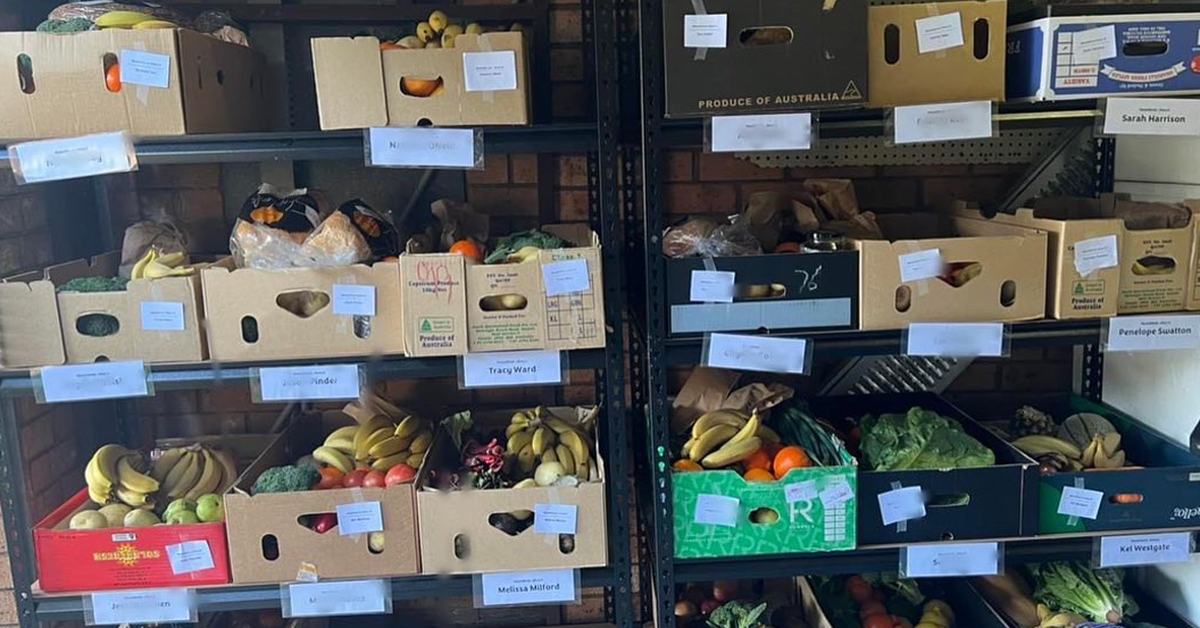
 Orders at a Box Divvy hub ready for pick-up by members. (Supplied)
Leigh Lind, from Sydney’s inner west, said being a member of his local Box Divvy hub was helping with the uncertainty of the shock to come.
“We’ve definitely been thinking more about what we buy each week,” Lind said.
“I feel glad we’re part of a system that’s a bit closer to where food is coming from – it just feels more stable week to week.”
Box Divvy is a community-driven food co-op that connects households with fresh, seasonal produce from hubs supplied by local growers, both direct and via the company’s warehouse in Granville.
There may be between 15 and 40 members in a hub, made up of strangers or family and friend groups, who browse available produce and pantry items and place their orders via an app.
The “hubster” is paid to operate the hub, either from their garage or a community space, receiving the weekly bulk delivery and “divvying” it up between members.
There are 350 hubs across NSW, the ACT and Victoria, with plans to launch into Queensland in the coming months.
 A Box Divvy hubster managing a produce delivery. (Supplied)
Co-founder Anton van den Berg said about half their produce was sourced locally, largely from growers within the Sydney basin.
“When fuel prices rise, distance matters,” he said.
“The fuel that they’re using, obviously, is more costly but what they don’t have is the transport costs to Sydney because they’re literally within 40 or 50km from our warehouse, so that’s definitely put a lid on pricing.”
The hubs have also started experimenting with buying produce from their own members, dubbed “backyard growers”.
“It could be herbs, it could be lemons, or indeed backyard chooks, and they’re able to then sell this into their local hubs and make that food ultra, ultra local,” van den Berg said.
His ambition is to have more small and backyard growers supplying directly into hubs, with less reliance on the warehouse.
“There’s a lot of small growers, especially in regional areas that rely on a single farmer’s market,” he said.
“What we’re trying to do is to basically provide an alternative channel in addition to where they currently sell their fruit and veg to make that business also more resilient.”
He said currently, Box Divvy was paying local growers between 5 per cent and 10 per cent more at the farm gate, to cover the higher costs.
“In many cases, that increase covers most of the cost pressure growers are facing,” he said.
“These pressures are real, and over time they do flow through.
“What we’re seeing now is the early stage of that.
“The next few weeks will be telling in terms of how much of this starts to show up more clearly in prices.”
 Sydney lettuce growers Daniel and Jason Vella are among a number of local growers who sell to Box Divvy. (Supplied)
Where shoppers don’t notice price rises, he said, they may notice unpredictability in the supply and availability of seasonal produce at the supermarket.
“These are structural pressures,” van den Berg said.
“They don’t hit all at once, but they do build.
“What it shows is how exposed the food system can be to fuel and global disruption.
“There’s a growing need to build more resilient, locally connected systems so communities are better prepared when these kinds of shocks occur.”
“Even if it ended today, there has been impacts on supply chains that will be with us for weeks and months ahead,” energy minister Chris Bowen said earlier this month.
NEVER MISS A STORY: Get your breaking news and exclusive stories first by following us across all platforms.