
The unpredictable is becoming all too predictable.
When the US markets (and the ASX futures trading) closed on Saturday morning AEST, US envoys Steve Witkoff and Jared Kushner were supposedly packing their bags about to head back to Pakistan for peace talks with Iranian officials.
By Sunday, the envoys were unpacking their bags back in Washington after US President Donald Trump scrapped the mission with the Strait of Hormuz still closed, global energy supplies getting even tighter and oil prices climbing higher.
The on-again/off-again Gulf peace hopes of the past couple of days reprise the previous few weekends, where the trading week closed in short-lived optimism.
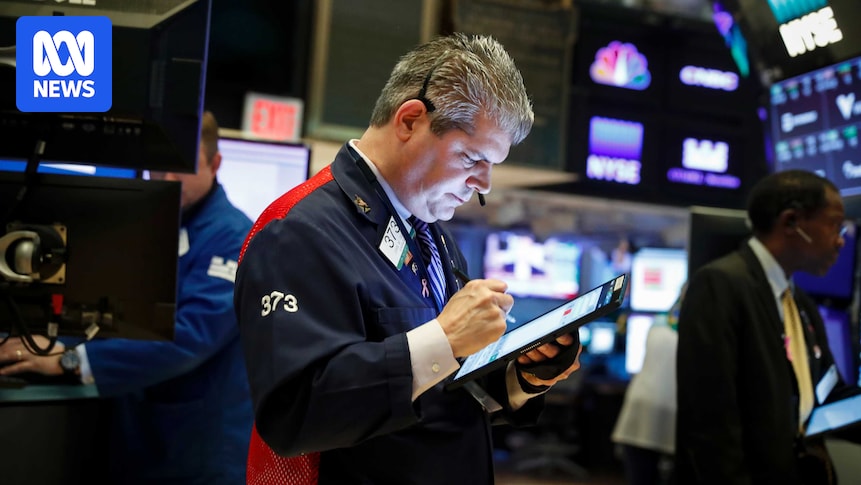
Nonetheless, Wall Street traders ended the week with their ears pinned back, bidding both the S&P 500 and tech-centric Nasdaq indexes up to new record highs.
The blue-chip Dow slipped a tad, as did European stocks.
S&P500: +0.8%Dow: -0.2%Nasdaq: +2.0%Eurostoxx 600: -0.6%
Whether abandoning the peace talks before the markets’ close would have made any difference is debatable.
Investors seem much more focused on surging Q1 profits and renewed optimism about the prospects for AI-related stocks than worries about the war entering its ninth week.
The semiconductor sector and chip makers had a big session.
The Philadelphia SE Semiconductor Index rose another 4.3% to extend its record run of gains to 18 consecutive sessions.
Intel surged 23.7% to close at a record, the best performer on the benchmark S&P index, following a better-than-expected revenue forecast for the second quarter.
“All the doubts and fears about the (return on investment) on the AI CapEx from the big tech companies — Amazon and Google and Microsoft and Meta — those concerns are fading real fast, and that’s propelling the chip stocks and the contractors and all the industrial companies,” Argent Capital Management portfolio manager Jed Ellerbroek, told Reuters.
Fellow chipmakers AMD and ARM both shot higher by about 14%.
Megacap Nvidia climbed 4.3% and also closed at a record as it neared the $US5 trillion market valuation again.
Locally, the ASX 200 futures point to an indecisive and flat opening.
Wall Street traders are discounting the negative impacts of the war, preferring to accentuate the positives of strong earnings growth in the first-quarter results.
So far, more than 80% of the S&P 500 companies that have reported have beaten expectations, with overall earnings up around 16% according to LSEG analysis.
A big test awaits, though, with about one-third of the S&P 500 due to release Q1 results this week, including the mega-caps Microsoft, Alphabet, Meta,and Apple.
The US Federal Reserve also meets this week and is expected to keep rates on hold.
European stocks retreated, with the Eurostoxx 600 down 0.6%, dropping around 2.5% over the week, a significant underperformance compared to the 0.6% gain in US stocks.
The ASX fell 1.8% over the week, while China gained 0.9% and Japan outpaced the lot, picking up 2.1%.
The US dollar slipped a tad on Friday; however, the Aussie dollar wasn’t given a leg up and is marginally softer this morning.
On commodity markets, oil had a volatile session, with the global benchmark, Brent crude futures, heading higher, up 0.3% to $US105.33/barrel, while the US benchmark, West Texas Intermediate crude futures, slipped 1.5% to $US94.40/barrel.
Gold edged higher (+0.3% to $4,709/ounce) but was down 2% over the week.
Copper was marginally lower as was iron ore.