
There’s a few things I wasn’t expecting to write about by the end of April 2026. One of them would have been the Wests Tigers sitting second on the ladder, but I ran the Eye Test audit on that one last week and thankfully they didn’t make me look stupid. Well, any more stupid than usual.
The next was Matt Dufty tearing up the Melbourne Storm. The 2021esque rule set and game pace suit his speed, even as he turns 30, but the way he carved up their defensive line was almost too easy.
And writing a eulogy for the Storm themselves was another thing that was definitely not on my list.
Yet here we are. After eight Rounds Craig Bellamy’s side sits 16th on the ladder and are only surpassed in futility by the Dragons.
Of course this happened to Penrith last season, where they sat dead last after eight games after conceding 30 points per game, yet still made the grand final.
It’s not with the ball that has been Melbourne’s issue, although holding it hasn’t been their forte of late, it’s defending it.
Before that though, since it’s the end of the month we’re going to have a quick run down of the state of the league before dissecting the Storm’s performances. First up, as usual for my monthly efficiency updates, we’ll take a look at the league by actual points per game scored versus points per game conceded.
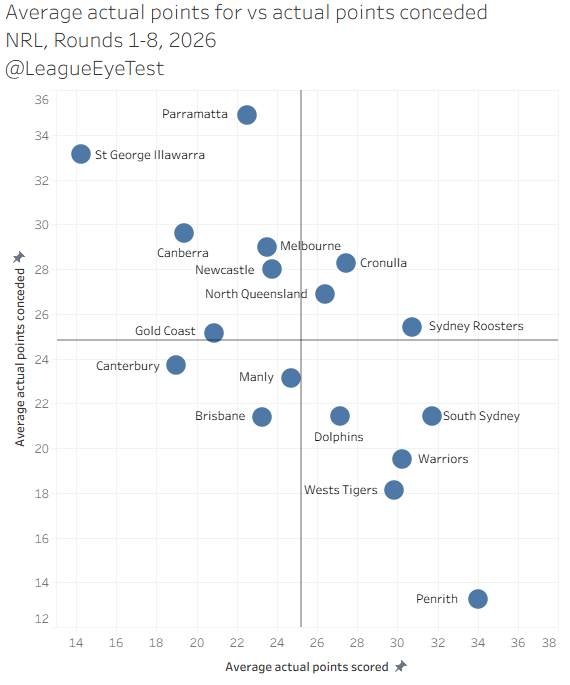
Nothing remarkably out of the ordinary here. Penrith are still on their own defensively, although the Tigers are making grounds. The Dragons are woeful at both ends of the field and Parramatta couldn’t defend a closed door with the number of players injured.
Souths and the Roosters have also been able to post a lot of points, but the latter has a defensive record similar to the Gold Coast. Canterbury is again struggling to score and you’re never sure which version of team is going to show up.
Now we’ll move on to the expected points per game versus expected points per game conceded, using this site’s Expected Points model (ETXP). The elevator pitch is that it gives a value for field position based on the probability of scoring a try from the location of a play start, with factors for minutes elapsed, tackle number and scoreboard margin. Keep in mind this is what an average team would score given the same situation, not what each team should be scoring.
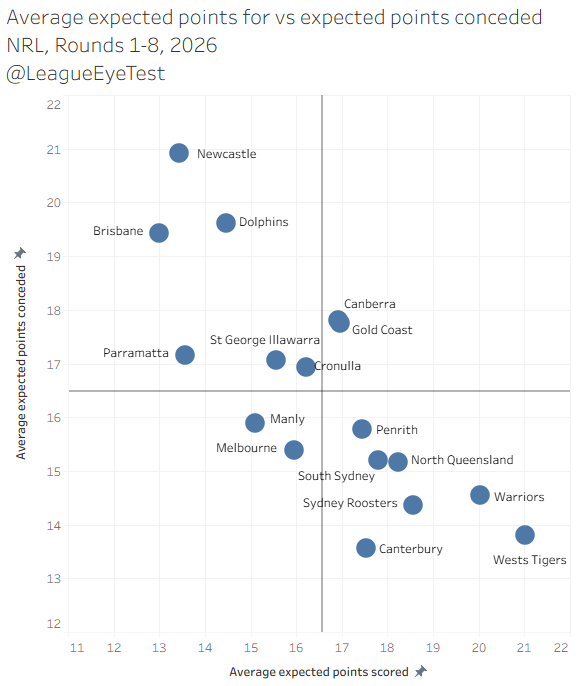
There’s some interesting results here. The Wests Tigers not only have the best field position value in the league, but also give up the lowest volume of high value field position. Defensively they profile closer to the Bulldogs than the Warriors, but with their field position better than Andrew Webster’s side. If you read last weeks post on how Benji Marshall has improved the side you’ll recognise this.
Despite their paucity of points allowed, Penrith are very much mid for field position in defense and attack. Brisbane, Newcastle and the Dolphins are conceding the most high value field position this season, and along with Parramatta they’re the bottom four sides in accumulating high value field position. Basically the ball is more often than not in the wrong part of the field for them.
Now we’ll layer both of these plots over each other, starting with the attacking side of things – actual points per game scored against expected points per game. This will allow us to see who is making the most out of their field position, who is scoring from low value parts of the pitch and who can’t score regardless of field position.
Thank you for reading The Rugby League Eye Test. Subscribe below to receive new posts in your inbox and support independent rugby league content.
I also label the quadrants of the charts based on Dominant, Efficient/Lucky, Inefficient/Lucky and Incompetent based on whether or not they’re above or below league average in actual points and expected points per game. Think of it as systems versus results. High quality field position and a lot of points is good. High quality field position and not a lot of points is less good, but better than low quality field position and no points.
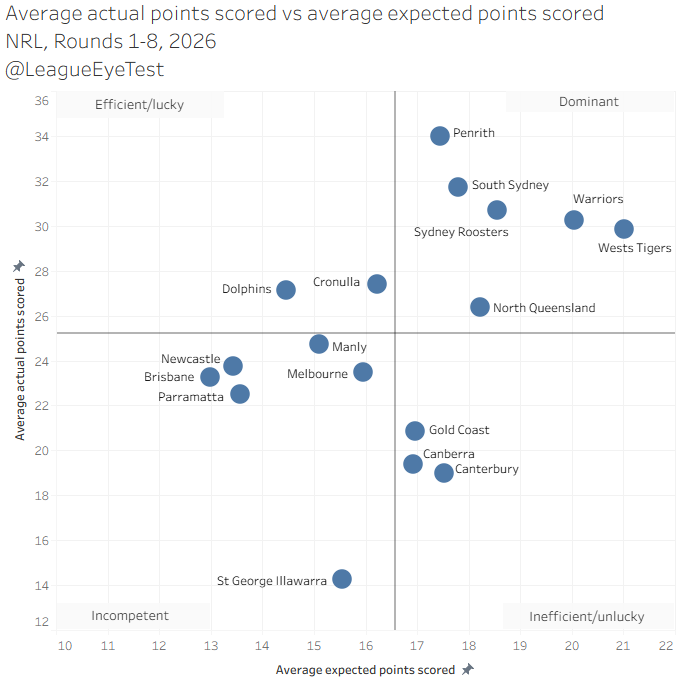
There’s some real clustering of teams here. Five teams can claim to have firmly dominant attacks this year, led by the Panthers of course. But they’re joined by the Warriors, Tigers, Rabbitohs and Roosters. A sixth in North Queensland occupies this quadrant as well, after moving out of the Inefficient/Unlucky space thanks to their 46 points against the Sharks.
The Roosters sitting here is unusual as they’ve usually been a long range try scoring team that didn’t need to accumulate possession to score. That could be similarly said of the Cowboys who also fit that scoring profile.
Gold Coast, Canberra and Canterbury also share similar attacking profiles, slightly above league average for field position value but well below league average scoring. I’m sure this isn’t where the Bulldogs want to sit as they were a Dominant quadrant team after eight rounds in 2025.
The Dolphins and Sharks are Efficient/Lucky, scoring better than league average from lower than league average field position. Melbourne and Manly also share similar numbers, while the Eels, Broncos and Knights may want to form a field position working group.
St George Illawarra are a basket case all on their own. I don’t know how much more can be said about this, but at least they’re adding some attacking players for 2027.
Next up is the same chart but for defense this time. Again, think of this as defensive systems versus results. Are you keeping teams where you want them to be, and are you able to limit points from those places?
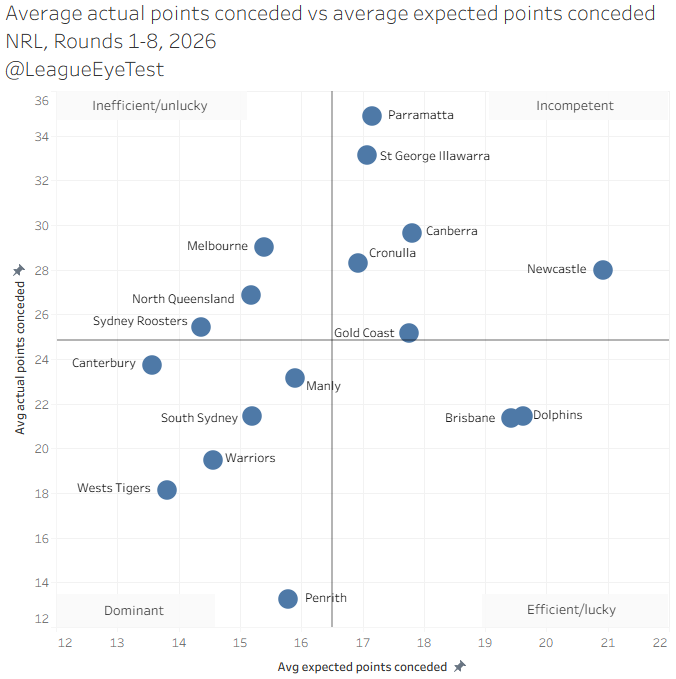
As you’d expect it’s mostly Penrith here. Only once have they sat outside the Dominant quadrant under Ivan Cleary after eight games, and that was last season. Brisbane and the Dolphins are the only two efficient defenses this year.
The rest of the Dominant residents are the Bulldogs, Tigers and Warriors, with Manly South Sydney creeping in after the Melbourne victory (not that one). Manly were at the top right corner of incompetent after three rounds, which should give you an indication of how much Kieran Foran has turned around the dumpster fire that Anthony Siebold left him.
I’m still on the fence as to whether or not to trust Manly’s form, as you couldn’t ask for a better four game opening stretch. Their next three are up against the Panthers, Tigers and Broncos which will give us a much better indicator of where they’re at. Regardless, Foran has them headed in the right direction.
The incompetent defensive crew are joined by the Sharks this month, who have flipped from a Dominant side at the same point last season. And for all the good things Justin Holbrook has done this season, the Knights are still allowing far too much quality ball for their opponents.
And then we have the inefficient/unlucky teams, with the Cowboys and Roosters joined by Melbourne. Like Penrith, Melbourne have never sat outside the Dominant quadrant after a full season, let alone eight games. That record looks like it will be broken this season.
The next step for my monthly efficiency updates is to look at the percentage of points scored or conceded above expected. Keep in mind that this is relative to the volume of expected points a team concedes.
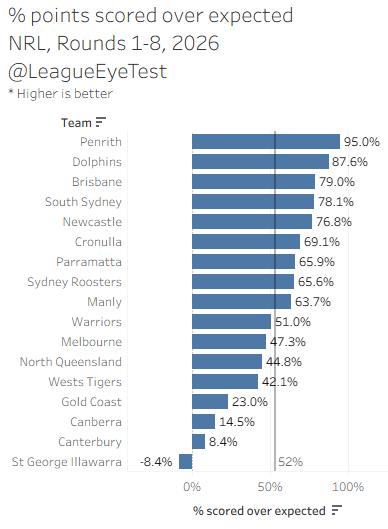
League wide we’re seeing 50% more points scored above expected, which isn’t shocking considering the ruleset, pace and “quality” of defenses on show. Previous seasons ended up in the 22-30% range if you want to gauge just how much extra attack is being produced this season.
Penrith leads the way at +95% points over expected, which is very different to prior seasons. As noted last month, they’re scoring more long range tries than previous years, where they’d sit at low single digit positives here. They’re still potent when you give them too much ball, but they’re also lethal from long range now. Pick your poison.
The Dolphins, Broncos and Rabbitohs are extremely efficient here, as is Newcastle. This is where most of Holbrooks’ work is evident, as the Knights were -20% a year ago. Canberra, Gold Coast and Canterbury are the lowest of the rest of the league, if you ignore the only negative side in St George Illawarra. Which everyone should be doing, even their fans.
Defensively there’s some similar trends.
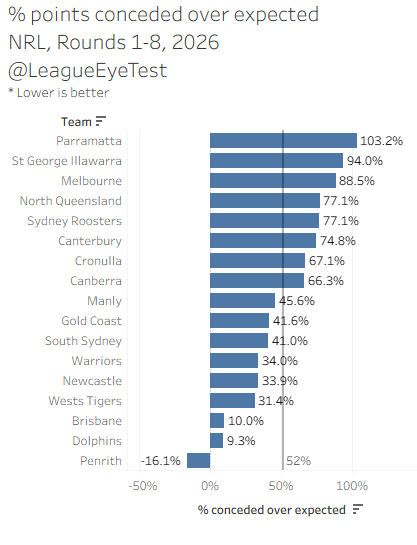
Parramatta are allowing triple digit scores above expected, which probably isn’t that bad given the injury crisis they’re suffering.
And here’s where the rot can bee seen for Melbourne. This year they are +88.5% in a metric where they’ve never been higher than 12.8% (2025) after eight rounds, and never higher than 30% in a full season (2020).
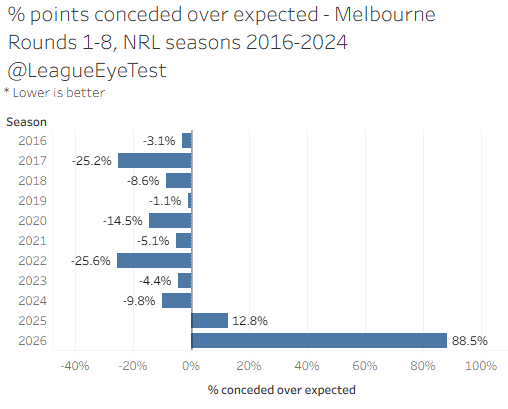
The wheels have fallen off defensively and I’ll get into some of that shortly. Perhaps we were seeing signs of it last season.
THE Dolphins number looks quite good here, but when you consider how much field position they allow, it’s not that impressive. +9% over a lot is still a lot. It’s the reverse of the Bulldogs situation, where they give up 78% more points, but from a low base of quality field position. The Dolphins let you walk up to their line and score, while the Dogs rarely let you close to theirs but still occasionally let a few through. Neither are particularly good but the Canterbury situation is less bad and shows their systems are largely working even if they’re not producing the right results.
So what is the problem with Melbourne this season? Like most things in rugby league, it’s a combination of factors and pinning it down to one single thing is impossible.
I’ve seen a lot of talk about how they’re limited now because “the wrestle” has been eliminated. Which would be a great excuse if the same situation hadn’t happened in 2021, you know when had a +500 point difference and lost just three games.
This season they’re giving away the third most set restarts per game in the league, and when combined with traditional penalties they’re also third worst.
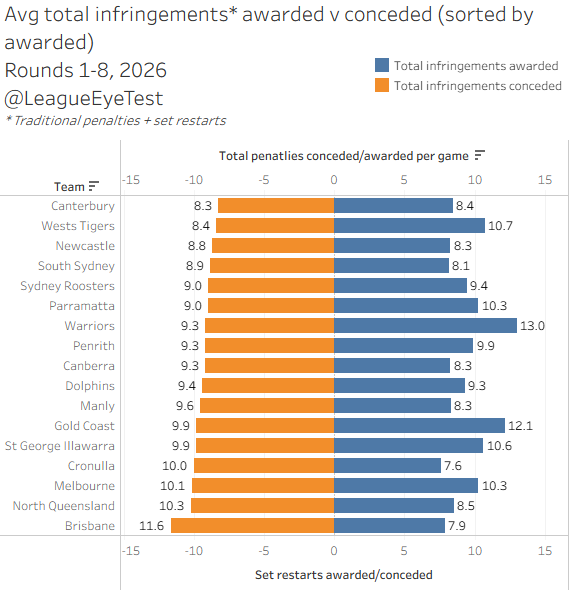
But they’re also fourth in set restarts awarded and fifth when you combine penalties, and in 2021 they were gave away the second most set restarts in the league. In 2026, their net set restarts are -0.4 per game, down from -0.7 last year and -1.5 per game in 2021.
And Despite there being 50% more restarts this year, Melbourne are conceding fewer penalties and set restarts combined than last year, whilst receiving 1.3 more than they’re penalised for.
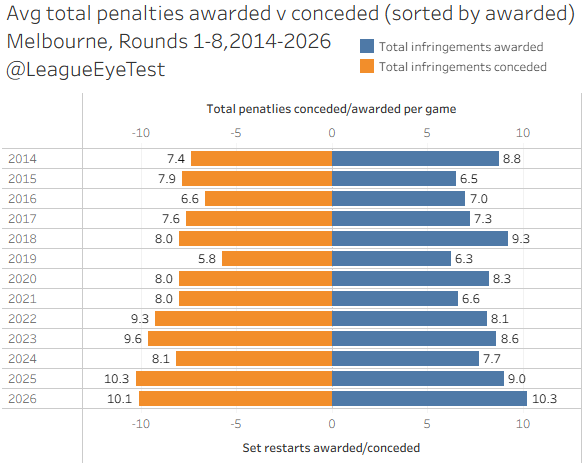
They’re still giving away more of them than most teams though. Of course these are only the restarts that are being called, so there is the possibility that the threat of conceding them is reducing their ruck shenanigans as a whole. The point is that these sort of rules used to favour Melbourne. Even if this is true, I don’t buy it as the sole reason for their struggles, and it’s reductive to do so. But it could be part of it.
What is a bigger issue is their edge combinations where they are littered with inexperienced players whose roles aren’t gelling. Compared with 2025, the Storm are missing over one third of the total minutes played from last season, with big minute players like Eli Katoa, Xavier Coates, Ryan Papenhuyzen and Grant Anderson no longer present, along with Bronson Garlick, Nelson Asofa-Solomona and Kane Bradley also absent.
Melbourne’s holdovers are missing more time as well, with another 10 regular players from 2025 down on minutes this season, by a combined 27%. Shawn Blore has played less than 1% of minutes after playing over 7% last season. Most of their middles are down considerably in share of minutes as well, which is the opposite of what you’d want given the depth problems.
Of their edge players, Nick Meaney is down to under 7% of minutes from 9% last year, and has been moved to the wing for the first time since 2023. The replacements for Katoa, Coates, Anderson and Blore are mostly inexperienced. Joe Chan played 4% of minutes last year but is over 7% with the injuries and turnover. Cooper Clarke, Moses Leo and Manaia Waitere are taking up most of the available minutes, and had a combined 200 minutes or so of NRL experience prior to this season. Things were so bad that Bellamy experimented with Alec McDonald on an edge, which ended as well as you’d think it would.
This isn’t like the Broncos, who are missing 20% of minutes from their top players yet can have experienced replacements like Ezra Mam, Corey Paix, Jesse Arthars, and the former Storm back Anderson, or players with extensive Cup experience in Ben Talty. There’s a reason why the Broncos haven’t regressed much defensively with their slew of injuries.
Storm Machine made note of the issues with these new combinations as well in their game review:
“That lack of confidence has permeated through the entirety of Melbourne’s collective id. It shows itself in a number of ways too — whether it is with the ball and the disconnected choices being made on every tackle, as well as the strangers playing in the same postcode, but not street on defence.“
Fitness may also be an issue, which sounds unthinkable for a Bellamy coached side. They had time to prepare for Katoa missing the season early , but other injuries have pushed low volume minute players into bigger roles, and as noted above the experienced starters are all down on minutes other than Chan and Jack Howarth. The Storm Machine recap also noted how “Clarke to my eye was gassed after 25 minutes and should have been spelled then“. Decision making under fatigue is challenging for even the fittest players.
These issues are leading to significantly more broken defensive lines and bad reads. In prior years, the right side of the field defensively was probably the Storm’s main weakness. This season, both edges are leaking an inordinate amount of points as both sides are playing inexperienced combinations. Looking at the location of their line breaks this season compared with last season shows just where teams are finding space.
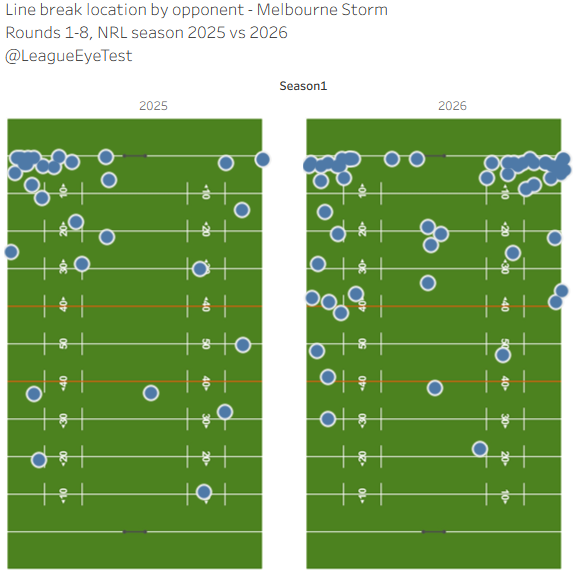
In the past two seasons, their left edge defensively had only allowed 16 line breaks. This year alone that has jumped to 25. In total their line breaks have almost doubled year on year, and are one fewer than 2024 & 2025 combined after eight rounds.
The other change is that more of these line breaks conceded are coming from further away. 51% of line breaks down their right edge defensively are 20 metres or more away from the line, up from 31% last season. Given the increase in total line breaks that’s not an inconsequential increase. On a positive side, Melbourne are still keeping a relatively clean sheet through the middle of the field.
Even though there’s more line breaks coming from further away, the tries they’re allowing aren’t from long range. At just 15.3 metres per score they’re second best in the NRL, only below the Wests Tigers.
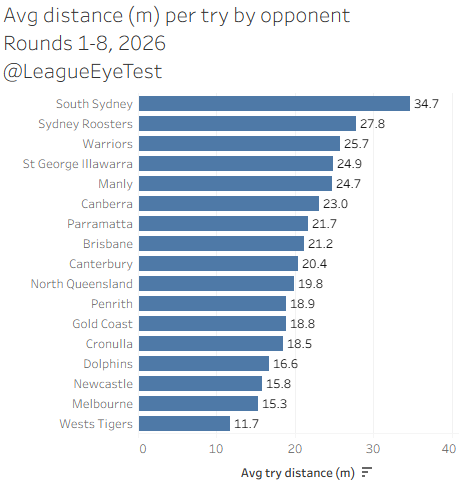
The positive is that they’ve only allowed three tries from the wrong side of halfway, something only two sides are better than. The negative is that they are allowing is an unfathomable amount of tries inside 20 metres. Over the first eight rounds in 2024 and 2025 they let in 30 tries starting inside the red zone. In 2026 they have let in 33 in total, the most in the NRL. Yes, even more than the Dragons or Eels. And as we saw above from the line breaks, most of these are down the edges of the field.
The issue is what I’ve noted previously this season, in that they cannot defend long strings of possession. I have Melbourne down for conceding 16 tries this season from at least eight consecutive play the balls, which is the highest in the NRL. Next closest are THE Dolphins at 12 and even Parramatta have only let in 11 of them. Cronulla is the only other team in double figures.
All three of those teams are facing more consecutive play the balls of eight or higher than Melbourne though.
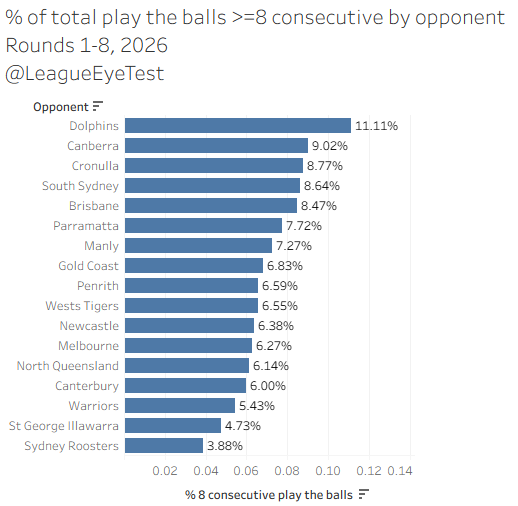
Melbourne have the 6th lowest percentage of eight or more consecutive play the balls, yet allow the most tries from those situations. The conversion rate of a play the ball above eight against Melbourne is over 20%, and no other team is worse than 15% (no prizes for guessing it’s the Dragons). Their ability to stop tries from a traditional set length isn’t bad, they’re 10th worst by that metric at about 2% of consecutive play the balls less than eight.
Again it points to those edge defense combinations not working, especially as players become fatiged. Once you string more than seven together, the lack of cohesion and understanding of roles is exacerbated. Good teams will look to exploit these combinations early as Souths did on Saturday. The Storm gave up tries off a scrum play and a single play the ball in the first half of that match.
And the longer their opponents have the ball, the likelihood of conceding jumps dramatically, even against even the poor attacking sides. All four tries scored by the Dragons against Melbourne in Round 2 came from eight or more play the balls. Keep in mind they’ve only scored 19 in total across eight games, or 2.4 per contest, and Melbourne gave up four of them in eighty minutes. Not good.
It’s not coming from set starting points. Teams playing Melbourne are starting their first play the ball 36.4 metres from the try line this year, down from 40.2 after eight rounds last year. That four metre delta exists whether or not you take out sets started inside 20 metres as well.
They are having issues for the first time starting off yardage sets though. Over the past five seasons, the Storm have been a top two side for metres past the play the ball on the second tackle. This season they’re 17th, another sign that the replacements on their edges aren’t doing part of their job correctly. This flows on to the subsequent tackles, where they rank 11th and 17th on third and fourth plays, despite never sitting lower than 10th previously this decade.
Changes clearly need to be made, but unlike prior seasons, Melbourne no longer have the depth to cover for these injuries and absences and it’s showing in the complete collapse of their edge defense. Their coach lamented this lack of depth in the post match press conference, and also noted it’s not the rules that are affecting them (although even if it was it’s unlikely that would be admitted).
“We haven’t got a whole lot of depth there or first grade experience, but we’ll find a couple of guys that want to go out there and have a go.
The game hasn’t changed that much. We’ve got a problem whether it was the same rules as last year or whatever. It’s not the rules.”
Hat tip to the essential Rugby League Writers for the above quote. Everyone should be subscribing to them.
The Melbourne situation isn’t unsolvable, as teams like the Bulldogs and Tigers have shown that a lot of a teams’ defensive ability comes down to attitude and commitment rather than ability, but it’s extremely hard to do mid season. Penrith came back from a horror start in 2026, but they’re younger and more talented than this Storm team, and Ivan Cleary has shown he’s surpassed Bellamy as the sport’s top coach.
But it’s clear that there’s no quick fix to this situation, and I’m not sure that Zac Lomax would have made much difference if he was available. There’s a substantial chance Melbourne misses the finals for the first time outside of 2010. Thirteen wins is usually the cut off point for the top eight, and with six losses already they’re only leaving themselves five more from their remaining sixteen games.
Can they really go 11-5 to finish the season after this start? That’s a tall ask even for a Bellamy coached team with few additional resources at his command.
—
The Rugby League Eye Test produces artisan small batch rugby league analysis that you can’t get anywhere else. In an era of low effort AI slop, the Eye Test offers hand crafted data and independent analysis that you can trust came from a human brain.
This sort of quality workmanship takes time and effort. Quality independent, ad-free rugby league content doesn’t exist without support from readers and the community. The Rugby League Eye Test operates under a value for value model.
If you’ve enjoyed this post, and are in a position to do so, then you can donate an amount of your choice through the PayPal link below, the Kofi page, or through the support page on the site’s menu. You can decide the level of contribution based on the value you believe the Eye Test provides to you.
Support The Rugby League Eye Test
For those of you in areas (such as New Zealand) where there’s issues with PayPal donations for some reason, I’ve set up a Kofi page as well for donations.
If you’re not in a position to donate financially, you can still support the site by sharing this post with others who might enjoy it. Support and promote independent rugby league content.