
Even just a few years ago, you wouldn’t dare leave a static image on an OLED display for hours at a time. Samsung certainly isn’t worried about OLED burn-in. If anything, it wants you to keep its TVs on when not in use.
Once upon a time, graphics like news tickers or sports scorebugs, or any visual element that stayed in one place on a screen, could leave a remnant behind on an OLED screen. Commonly known as burn-in, it was seen as one of the weaknesses of early OLED technology.
Fast-forward to now, modern OLEDs use various tricks, like pixel-shifting, to prevent burn-in. Pixel-shift — or whichever brand-specific name for a TV’s version of the feature — slightly moves the positioning of an image every so often. It periodically changes which pixels get illuminated to prevent burn-in from occurring.
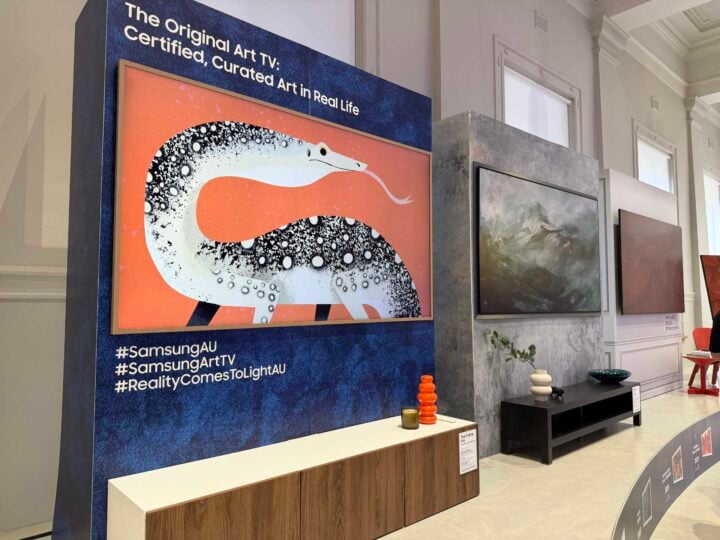 Samsung strove to make art a big focus with its 2026 TVs. Image: Chris Button.
When Samsung announced that its flagship S95H TV would be its first OLED to support the brand’s art store, I didn’t fully appreciate at the time that it represented a watershed moment for OLED technology. LG’s TVs have supported the brand’s Gallery+ service for a while, but Samsung’s OLED-specific support of gallery art felt like a very considered move to demonstrate the technology’s progression.
Samsung says Aussies love art on TVs
According to Samsung, nearly half of Australians want to have more art around the home. The company also claims that it sells more of its art gallery-centric The Frame TVs in Australia per capita than anywhere else in the world. From there, you can follow the logic behind Samsung’s push to make art more widely available on more screens.
I’ve already waxed lyrical about Samsung’s ‘Glare Free’ technology, which is now available on more of the brand’s TVs than in previous years. This year’s The Frame and The Frame Pro — which have customisable bezels that look like picture frames — are among those glare-reducing screens. But equally remarkable is the brand’s focus on displaying artwork on more of its TVs.
At a recent launch event, the vibe from Samsung was that people want functional technology that’s also aesthetically pleasing. Rather than be left with a big glass slab on the wall, there’s an increasing push for TVs to look nice when not in use. It’s also a guiding philosophy behind Samsung’s new Music Studio speakers.
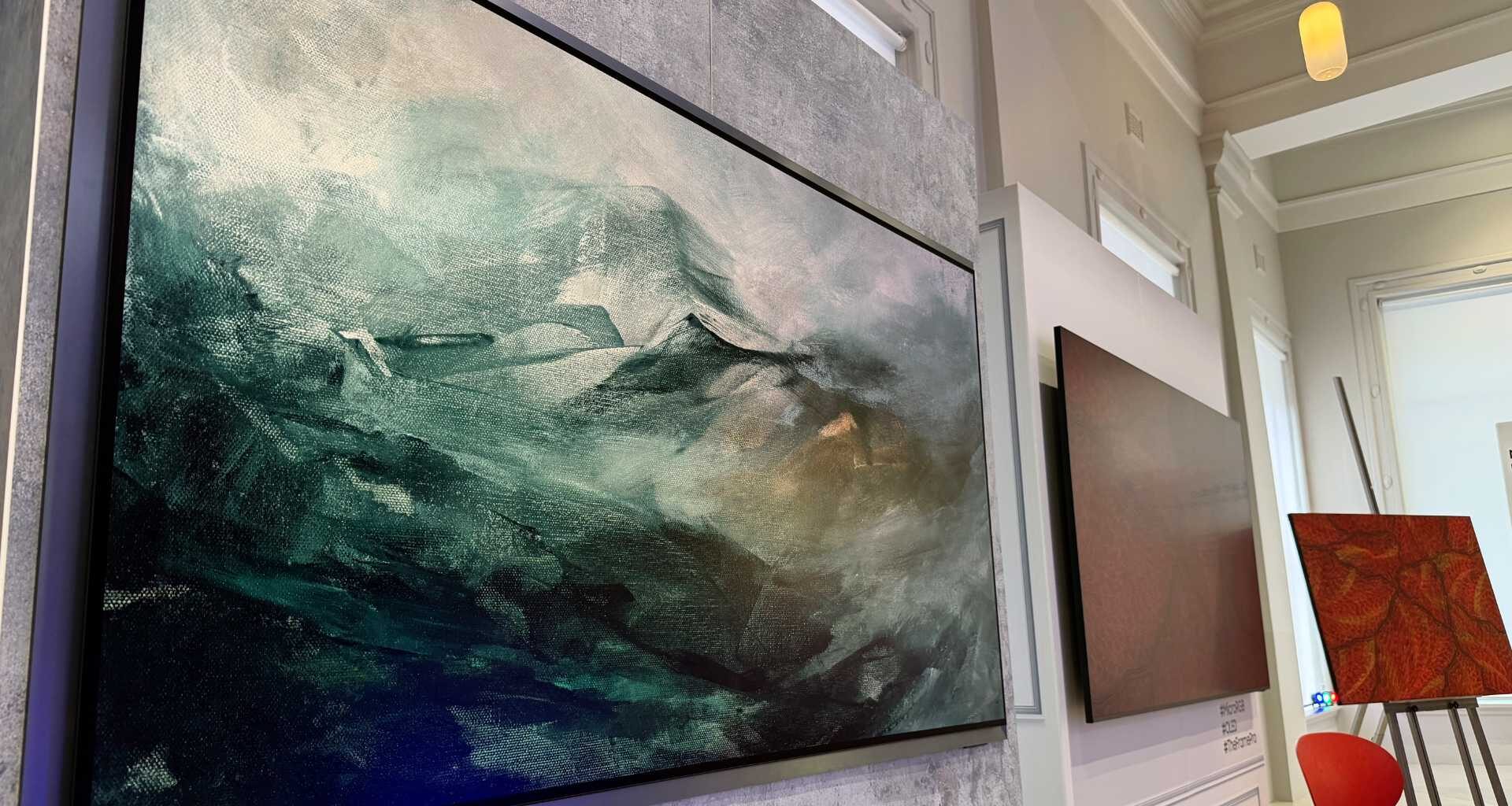
 Look closely, and you can see minuscule details of the art. Image: Chris Button.
I was surprised to see OLED TVs included in that discussion. Given the technology’s legacy issues, I didn’t expect Samsung to encourage leaving artworks on the screen indefinitely.
When I asked a product expert in attendance why potential customers should feel confident displaying art on a TV all afternoon, they described how much smarter pixel-shifting technology has become. In modern TVs like the S95H, the technology changes how pixels illuminate, while also imperceptibly shifting colours around ever-so-slightly.
You’d only notice this if you picked a spot and stared at it unblinkingly for a long time. It’s unnoticeable on content with motion, and it’s unlikely you’d stare at one image for too long anyway.
Bringing the gallery to your home
Samsung’s goal is to give Australians more choice. Be it OLED, Mini LED, or Micro RGB LED, it wants people to choose whichever preferred technology they can afford. For the most authentic art gallery look, there’s The Frame series. OLED represents the best contrast and viewing angles. And Micro RGB depicts the widest colour spectrum of the lot.
Seeing the TVs in person, particularly those with anti-reflective screens, it’s near-impossible to tell that the art is being shown on a TV. Even up close, you can make out individual brushstrokes and other small details of the artists’ original medium.
On hand to demonstrate Samsung’s Micro RGB technology was Sarrita King, a Gurindji Waanyi artist whose work is among several Australians on the Samsung Art Store. Next to a wall-mounted Micro RGB MR95F TV was one of King’s original works.
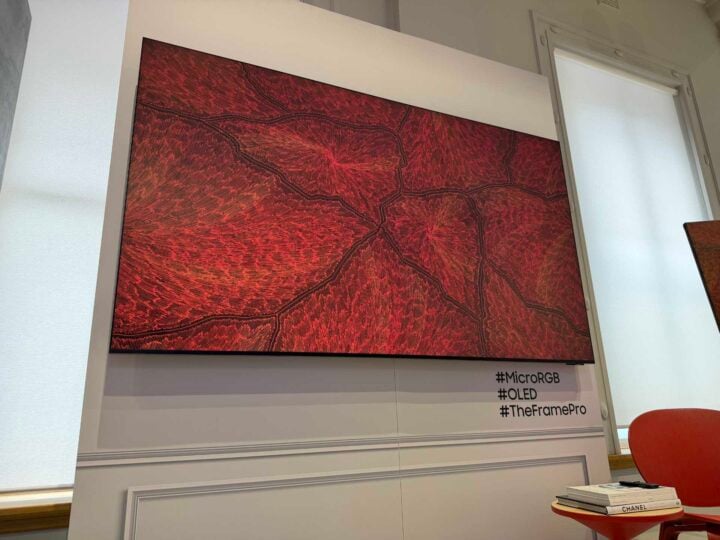
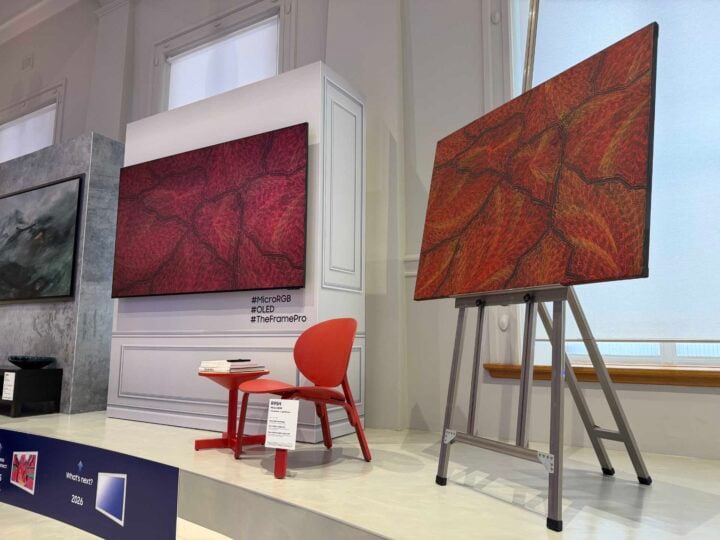 Images: Chris Button.
Although my phone camera shows a stark difference between the TV and the artwork (taking photos of screens is frustratingly tricky), in person was a different story. From side-on, you could see some colour differences, but it was obviously a high-quality reproduction of King’s art.
Enjoying fine art may historically be seen as a pursuit for the wealthy, but these TVs make a strong case for experiencing gorgeous works in your living room.
Chris Button attended a launch event in Sydney with flights provided by Samsung Australia.