
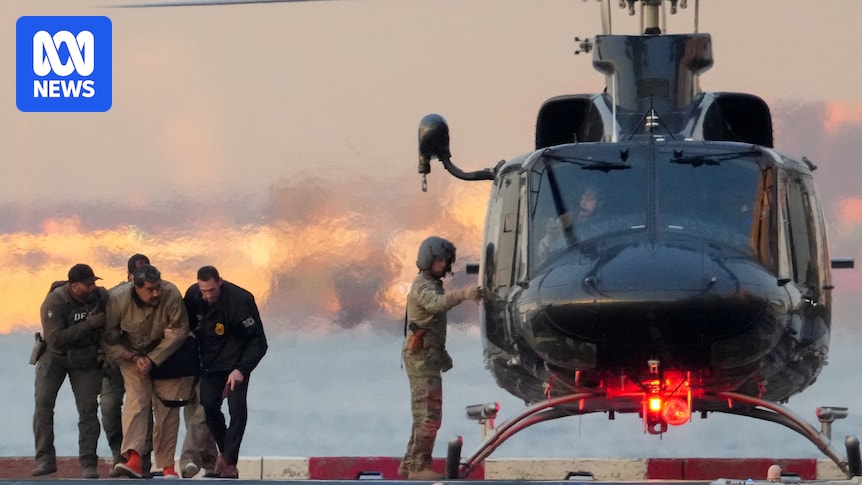
What if you could bet on a secret military raid and win big because you knew the outcome?
That’s at the centre of a growing scandal in the United States, where a special forces soldier has been charged with using classified intelligence to place bets on the capture of Venezuela’s former president, Nicolás Maduro.
Prosecutors allege the soldier — who took part in the January operation — turned a modest wager into more than $US400,000 ($560,000) on the prediction platform Polymarket.
US soldier made $560k on Maduro removal bets
The New York-based company, which counts Donald Trump Jr among its investors, says it flagged the suspicious trades and alerted authorities, insisting insider trading has “no place” on its platform.
But the case is fuelling bigger questions about prediction markets — fast-growing platforms where users can bet on the outcome of everything from sports and elections to crypto and armed conflicts.
Recent wagers tied to geopolitical flashpoints, including the fate of the US–Israel war against Iran, have only intensified scrutiny.
Last month, researchers at Harvard University estimated that $US143 million in profits on Polymarket may have come from users with insider knowledge — based on public blockchain data tracking bets on events ranging from Taylor Swift’s engagement to last year’s Nobel Peace Prize.
Meanwhile, the Trump business behind Truth Social is also planning its own prediction market, Truth Predict.
While banned in Australia, these platforms operate in a legal grey zone in the US — caught somewhere between finance and gambling — and now face mounting pressure in Washington over how, or whether, they should be regulated.
Here’s what we know about the murky world of speculative, 24/7 transactions now filling the internet.
What are prediction markets?
Prediction markets let users trade on the likelihood of future events, and the scope of topics is vast.
On Polymarket there’s even a category devoted to the US president’s decisions, including when Donald Trump might lift the Strait of Hormuz blockade or even the colour of his tie on a given day.
Instead of traditional bets, users buy “event contracts”, usually framed as a Yes or No question.
The price sits between $0 and $1, effectively reflecting the market’s view of the probability. A contract trading at 70 cents, for example, suggests a 70 per cent chance the event will happen.
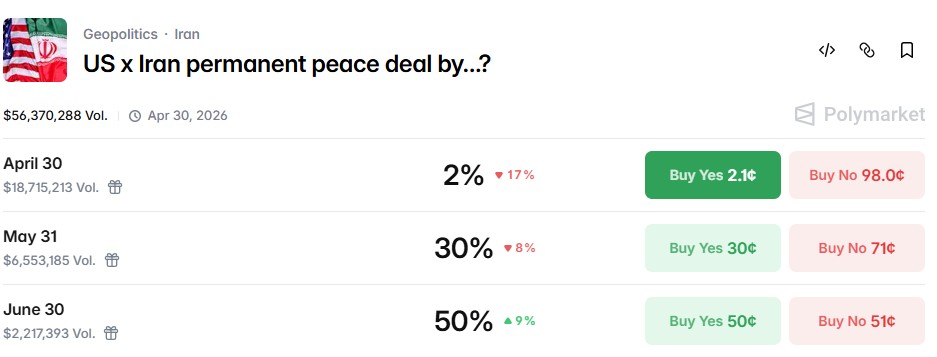
The Polymarket prediction platform allows users to bet on the outcome of real-world events, often framed as Yes or No questions. (Supplied: Polymarket)
Users can hold the contract until the outcome is known, or trade in and out as the odds change over time.
Proponents of prediction markets argue putting money on the line leads to more accurate forecasts.
Meanwhile, critics warn it can just as easily reward guesswork — or worse, privileged information.
Why this case matters
The Maduro case marks the first time the US Justice Department has brought insider trading charges involving a prediction market platform.
And it has amplified concerns that people with inside knowledge could exploit these markets.
There have already been signs of suspiciously well-timed bets on geopolitical events.
Kalshi is another major player in the prediction market industry. (AP Photo: Erin Hooley)
Earlier this month, the Associated Press reported that a cluster of new accounts on Polymarket placed large wagers on a US–Iran ceasefire in the hours — even minutes — before Donald Trump announced one.
In the lead-up to the outbreak of the Iran war in February, another account reportedly made about $US550,000 betting the US would strike Iran and that Supreme Leader Ali Khamenei would be removed from office.
“What is the statistical likelihood of anyone other than an insider trader placing a winning bet 12 minutes before a market-moving presidential announcement?” Democratic Representative Ritchie Torres said in an AP interview.
“There are two answers: God, or an insider trader. And something tells me that God is not placing bets around Donald Trump’s posts on Truth Social.”
Meanwhile, rival platform Kalshi last week fined and suspended three congressional candidates for wagering on their own elections.
Who is placing these bets is often unclear. While platforms verify users behind the scenes, traders typically operate under pseudonyms.
That lack of transparency, combined with the speed and scale of trading, has regulators on edge.
A fast-growing, lightly regulated space
Prediction markets sit in a legal grey area in the US.
Because they’re structured as financial “event contracts”, they fall under federal oversight — rather than by individual states, as with traditional gambling.
That’s helped fuel rapid growth, with platforms expanding into politics, sport and global events.
Major players include Polymarket and Kalshi, alongside new entrants backed by sports betting companies and crypto firms.
Should gambling on war be allowed?
In Australia, regulators have taken a harder line.
The Australian Communications and Media Authority (ACMA) deems platforms like Polymarket to be illegal, unlicensed gambling services.
An ACMA investigation found nearly 1.9 million visits to the platform came from Australia in a six-month period beginning in November 2024.
In August 2025, the site was added to Australia’s growing blacklist of blocked gambling websites, which now numbers close to 1,300.
What happens next?
The surge in popularity — and cases like the Maduro bets — are driving calls for reform in the US.
Some politicians in the country want stricter oversight, including bans on markets tied to war, assassinations or terrorism.
Democratic senator Richard Blumenthal has demanded Polymarket explain why it allows trades on war and violence, and what it is doing to prevent insider trading.
“Polymarket has become an illicit market to sell and exploit national security secrets unlike any in history,” he wrote.
Republicans have also called for restrictions, with bipartisan bills now before Congress.
“We don’t want to imagine a world where America’s adversaries use prediction markets to anticipate our next move,” said Republican Representative Blake Moore.
There are also concerns about consumer harm, with critics warning the always-on nature of these platforms can lead to heavy losses.
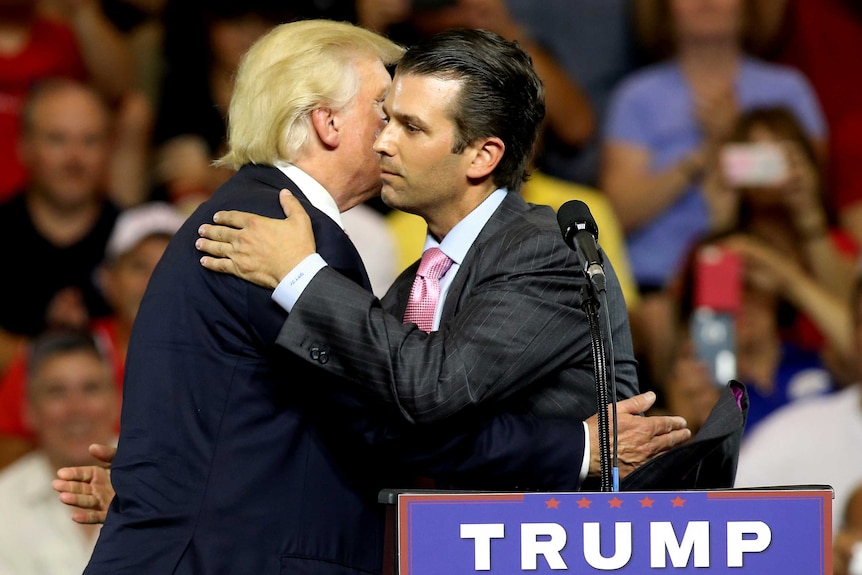
Donald Trump Jr has a stake in Polymarket through a venture capital fund. (Reuters: Aaron Josefczyk, file)
Meanwhile, Trump’s family could stand to benefit if the industry grows — another potential conflict in a presidency already facing scrutiny.
The president’s eldest son, Donald Trump Jr, has a stake in Polymarket through a venture capital fund and serves as an adviser to both Polymarket and Kalshi.
As for the president himself, his position remains unclear, though he recently struck a sceptical note.
“I was never much in favour, and I don’t like it conceptually, but it is what it is,” he said.
“Now, I think that I’m not happy with any of that stuff.”
The Trump administration has so far resisted broader intervention, arguing the Commodity Futures Trading Commission should remain the sole regulator.
But with rules still evolving, prediction markets are likely to remain under intense scrutiny — especially as the stakes move beyond sport and elections into war and geopolitics.