

Magnets are powerful, but they’re also noisy. Not in the way speakers are, but in the way they leak invisible magnetic fields that interfere with anything nearby. This is a serious problem if you’re trying to shrink electronics and pack more functions into tiny spaces.
Now, a team of international researchers at the Technical University of Denmark (DTU) has built something that almost sounds impossible: a magnet that is strong on the inside but nearly invisible on the outside—and it keeps this behavior even above room temperature.
“We now have a material with a very well-ordered magnetic structure, but without the magnetic field that usually causes problems in electronics,” Kasper Steen Pedersen, one of the researchers and a professor at DTU, said.
This unusual combination could change how future electronics are designed, especially in spintronics, where information is carried by the spin of electrons instead of electric charge.
Creating a magnet that cancels itself out
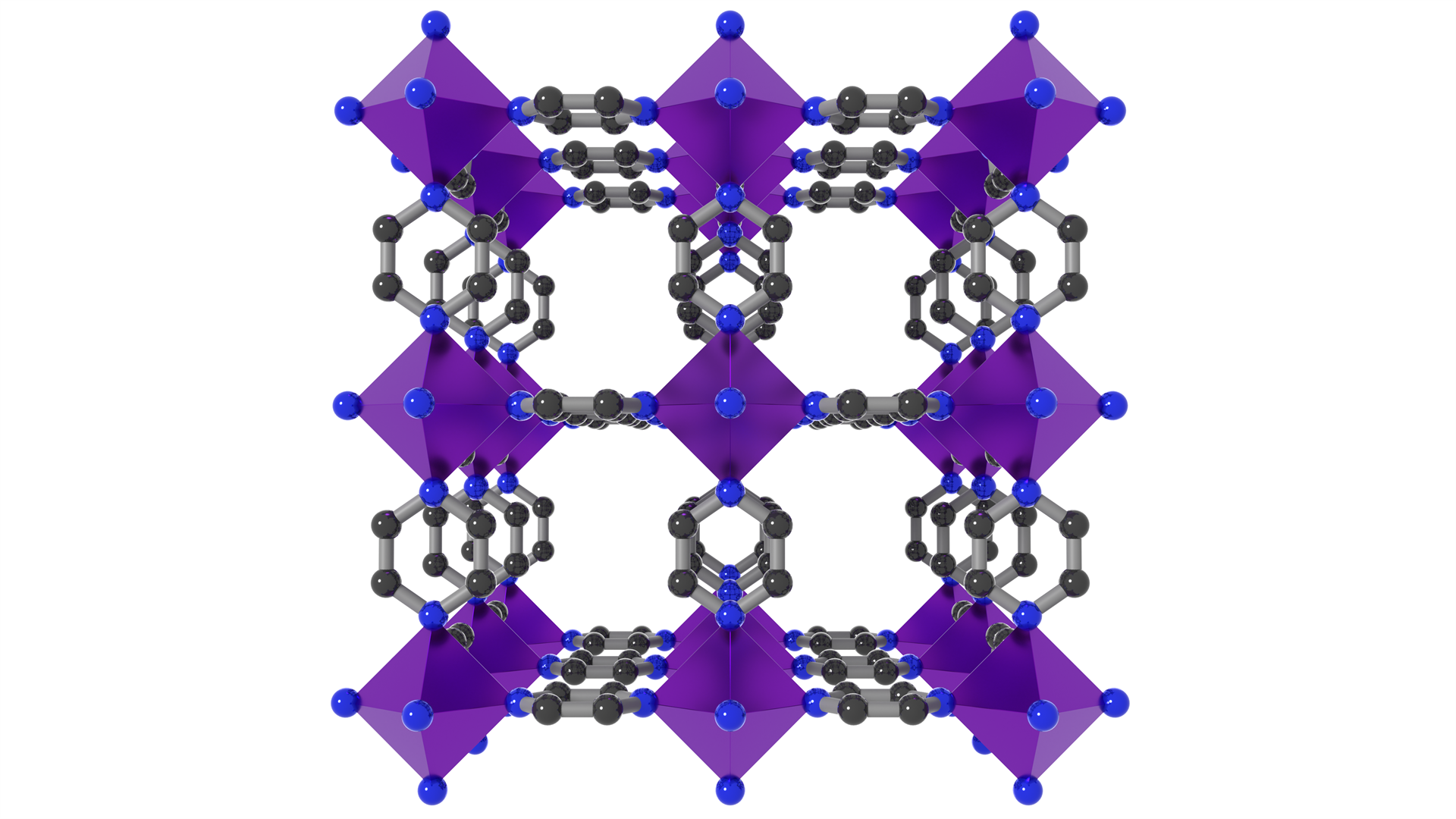 The structure of the chromium pyrazine magnet. Source: DTU
At the heart of the work is a rare type of material called a compensated ferrimagnet. In a typical magnet, countless tiny magnetic moments all point in the same direction, adding up to a clear external field. In this material, those moments are arranged in opposing directions.
They don’t disappear—in fact, the internal magnetism remains strong and highly ordered—but because they nearly cancel each other out, very little magnetic field escapes.
Scientists have been chasing this balance for years, but most materials only achieve it at very specific temperatures. As soon as conditions change, the balance breaks down, which limits practical use.
The researchers tackled this problem by abandoning conventional magnetic materials like metal alloys and oxides. Instead, they built a molecular structure—a metal–organic network, where magnetic atoms are connected by organic linkers. This gave them far more control.
“This opens an entirely new level of control. When magnetism is embedded in a molecular material, we can use chemistry to tune both magnetic and electronic properties,” Pederson said.
The material is made from chromium atoms linked together by pyrazine molecules. What makes pyrazine special here is that it exists as a radical, meaning it carries an unpaired electron. This electron doesn’t just sit there, it actively contributes to the magnetic behavior of the entire structure.
By carefully arranging chromium and pyrazine, the team created a system where opposing magnetic moments almost perfectly cancel out externally while staying robust internally.
Also, to verify this delicate arrangement, the researchers used powerful experimental tools, including neutron scattering and synchrotron radiation, which can probe magnetic structures at the atomic level.
These measurements showed that the near-perfect compensation is not a fragile effect. It remains stable across a wide range of temperatures and, importantly, continues well above room temperature. That stability is what sets this material apart from earlier attempts.
Implications, limitations, and next steps
The result is not a ready-made technology yet, but it points to a path forward. For instance, materials that don’t emit disruptive magnetic fields could allow electronic components to be placed much closer together without interference.
This is a key requirement for spin-based devices that aim to be faster and more energy-efficient than today’s electronics.
“We have not created a finished technology, but we have shown that it is possible to achieve a combination of properties that many researchers have been looking for over many years. That makes the material interesting as a platform for future development,” Pederson added.
At the same time, the work is still at a fundamental stage. The material’s electrical properties need to be further explored, and researchers will have to find ways to turn it into thin films that can be integrated into real circuits.
The study is published in the journal Nature Chemistry.