
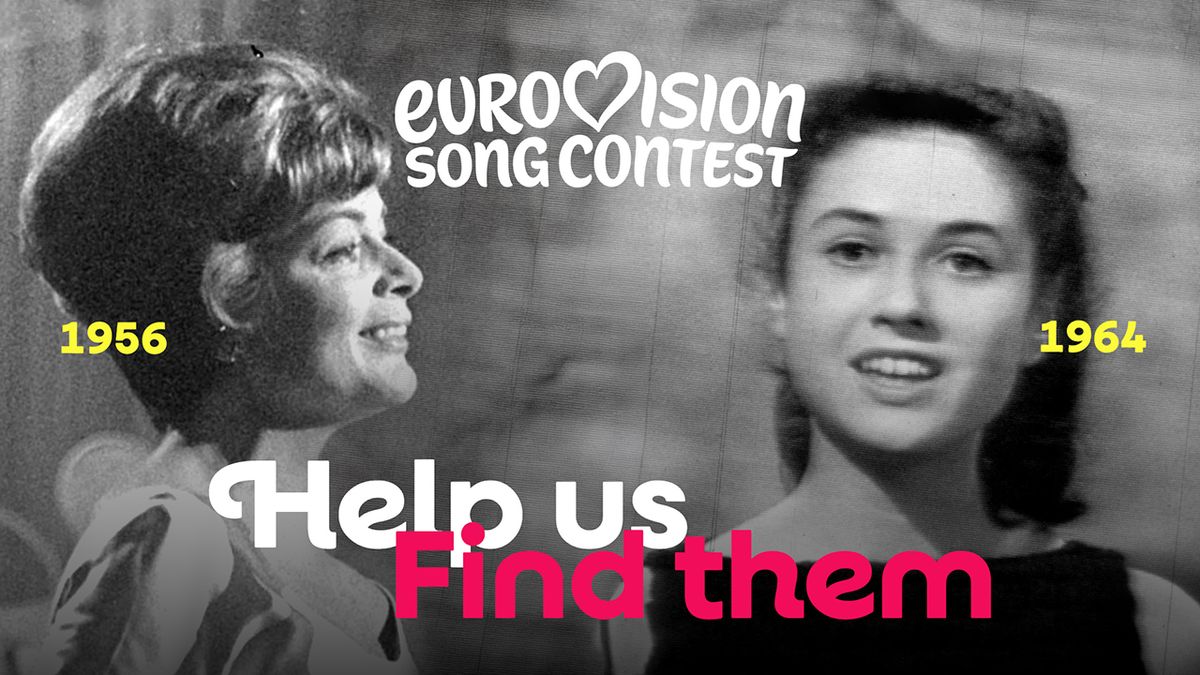
Help us find Lugano 1956 and Copenhagen 1964
As the Eurovision Song Contest celebrates its 70th anniversary, we’re turning to our greatest resource – our fans – to help solve one of television’s most intriguing mysteries.
We’re launching a worldwide search to uncover missing recordings of two of the Contest’s earliest editions: the 1956 and 1964 Eurovision Song Contests.
Despite decades of archiving, no complete recordings of these shows exist in the archives of their original host broadcasters, SRG SSR in Switzerland (1956) and DR in Denmark (1964). Now, the hunt is on to find them – wherever in the world they may be hiding.
Lost… but not forgotten
The Eurovision Song Contest has been broadcast every year since 1956 (except during the 2020 global pandemic), growing into the world’s largest live music event. But in its earliest years, television technology was still evolving, and recordings were often not preserved. Because tape was expensive, recordings were also often wiped and the tape reused.
As a result, two editions have passed into Eurovision legend! The very first Contest in Lugano in 1956 and the 1964 Contest in Copenhagen remain missing in full, with only audio of the Contests, video fragments and memories surviving.
But there is hope…
Thanks to the work of Yle in Finland, previously lost footage from the 1964 winning performance by Italy’s Gigliola Cinquetti has been rediscovered and is now part of the official Eurovision archive – and available to fans worldwide on the Eurovision YouTube channel thanks to rights holders DR, alongside every winning performance in the Contest’s history.
Somewhere out there…
We believe that copies – or fragments – of these shows could still exist.
In private collections. In broadcaster vaults. On old film reels. Or even tucked away in an attic, long forgotten.
The search is open to anything that could help rebuild the missing pieces:
· Full recordings
· Partial footage
· Home recordings
· Photographic or film material
Even the smallest clip could help bring these historic broadcasts back to life.
A global Eurovision effort
As part of the 70th anniversary celebrations, we’ll be working with Member broadcasters, archivists and restoration specialists to identify, restore and preserve any material that is uncovered.
Every discovery will help complete the story of the Eurovision Song Contest – not just for historians, but for the millions of fans who have made the Contest what it is today.
Martin Green CBE, Director of the Eurovision Song Contest, said:
“As we celebrate 70 years of the Eurovision Song Contest, we’re looking back at an incredible history – but we know there are still some chapters missing.
The idea that somewhere in the world there could be unseen footage from 1956 or 1964 is genuinely exciting. It’s a bit like a global treasure hunt.
The Eurovision Song Contest has always been about people coming together, and this is a chance for fans to play a part in preserving that shared history.
We’ve already seen, thanks to Yle in Finland, that lost moments can be found. Now we’re hoping the Eurovision community will help us uncover even more – and maybe, just maybe, complete the story.”
Join the search
Anyone who believes they may have relevant material is encouraged to contact the EBU via press@eurovision.com with as much detail as possible.
Because after 70 years, you never know what might still be out there.