
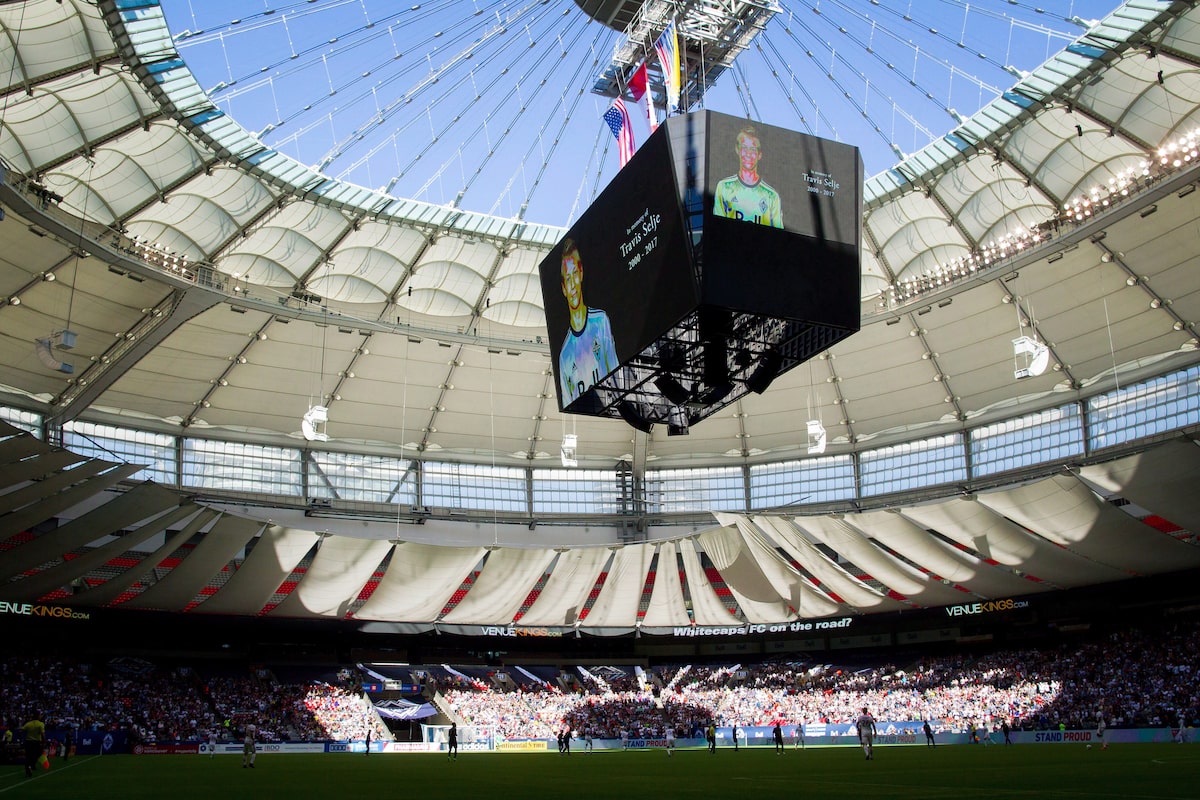
Vancouver’s mayor says he will bring forward a motion aimed at exploring a Major League Baseball expansion bid, though the stadium’s current configuration presents challenges for the sport.DARRYL DYCK/The Canadian Press
Imagine a grand baseball stadium on a prime piece of waterfront property near downtown Vancouver surrounded by a thriving purpose-built entertainment district.
Envision, too, this being the home of a new Major League Baseball franchise.
That is the dream of the group behind the MLB expansion bid recently revealed by Vancouver Mayor Ken Sim. Last week, city council approved a motion directing staff to initiate a formal procurement process for the unsolicited bid proposal.
To this point, everything about that proposal, including the identity of those behind it, has been shrouded in secrecy. All the mayor has said to this point is the group is credible. It is.
After The Globe and Mail talked to three sources with direct knowledge not only of who is leading this project, but what it might involve, a clearer picture has emerged of just how far along plans are in terms of making this MLB fantasy a reality. That said, this goal is far from a sure thing.
The Globe is not naming the three sources because they were not authorized to discuss the plan’s details.
The person leading the project is Zack Ross, president of the Cape Group, a Vancouver-based residential and commercial real estate company, according to the three sources. Ross is a relatively low-key figure in the city’s establishment firmament. He did not respond to e-mail and phone messages sent and left by The Globe requesting an interview.
Mr. Sim’s office also declined an invitation to talk about the project.
It’s understood that Mr. Ross’s interest in pursuing an MLB franchise began several years ago when he was asked by the then-owners of the Vancouver Canadians minor-league baseball team to find a site for a potential new stadium for the team to play in. That process apparently sparked the idea in Mr. Ross of pursuing an MLB franchise, according to one of the sources. (The Canadians never did move from their existing stadium.)
Here are some of the things we now know about the bid and some of the people involved in it.
Two of the sources said that Mr. Ross has employed the services of Jac Sperling to help recruit potential investors and put together a credible MLB pitch.
There may not be a better-connected sports executive in the U.S. than Mr. Sperling, founder of Grit Rock Ventures. He’s been involved at the highest levels in all the major professional sports leagues in the U.S. He was instrumental in helping Seattle land its NHL team. Especially key is the fact that he knows the people who have the kind of money in America that might be interested in investing in an MLB franchise in Vancouver.
Among the groups that have apparently expressed an interest are the owners of the San Francisco 49ers, said one of the sources. An investment arm of the team called 49ers Enterprises already owns English soccer team Leeds United and has a controlling stake in the Scottish soccer giant Rangers FC.
The owners of the Seattle Kraken is another group linked to the bid, the source said. The NHL club is owned by One Roof Sports, and led by majority owner and chair, Samantha Holloway.
Others who have apparently expressed enthusiasm in becoming part of the endeavour include Vancouver-born movie star Ryan Reynolds, according to the source. His publicist did not respond to a request from The Globe for comment.
There is at least one rendering of what a new stadium would look like that was conceived by the same architecture firm – Populous – behind the Las Vegas Sphere, two of the sources who saw the rendering said. Populous is also a world leader in baseball-stadium design and has either created, helped create or overseen the renovation of at least 20 MLB ballparks.
The bid group has come up with a design for an open-air stadium. The rationale? The minor-league Canadians had only a handful of rainouts in 2025. The rain-day counts in Vancouver over the months MLB plays compare favourably to other cities that currently have major-league teams that play in stadiums with no roof, including San Francisco. The Seattle Mariners, however, do have a retractable roof on their stadium that they closed for 10 games in 2025.
And where would the stadium go? One of the sources said the site that the bid group has zeroed in on is an almost nine-hectare (20 acres) plot of city-owned land on the south shore of False Creek, just east of the Cambie Bridge. By MLB standards, it is certainly sufficient space.
Asked to comment on the future status of this land, the City of Vancouver issued the following statement to the Globe: “The City has existing lease obligations and is also considering future civic requirements for the lands. At this stage, we’re not in a position to share specific details.
“As a general practice, the City does not disclose ongoing discussions related to land use. Information is shared publicly once decisions have been made.”
A couple of years ago, the bid group hired the services of a government-relations firm to lobby the B.C. government for a live/work/play entertainment zone. This real estate-entertainment play is key to making the proposal work financially.
The principal assigned to the file was none other than Kareem Allam, former chief of staff to Mr. Sim, who left the mayor’s office to work for Fairview Strategy and then Richardson Strategy Group.
Vancouver Mayor Ken Sim in Vancouver on April 12.ETHAN CAIRNS/The Canadian Press
Mr. Allam is now running for mayor against his former boss under the banner of the Vancouver Liberals.
With almost 50 per cent of the revenue that an MLB team makes inside its stadium shared among all big-league teams, the key is for clubs to make money outside the stadium walls. Which is why real estate is such a key component of bid proposals today.
Two of the sources say the bid group had Deloitte do a feasibility study on the prospects of an MLB team in Vancouver, which reflected positively on the initiative. It apparently concluded that a Vancouver MLB team had the opportunity to do extremely well on the revenue front compared with other franchises in the league.
Is the Cambie Bridge-adjacent site perfect? No. There is a raft of expensive condominiums nearby, the occupants of which may not be thrilled about living next door to a baseball stadium and surrounding entertainment district. The public hearings would undoubtedly be raucous.
It’s unknown what the proposed cost of the stadium would be and whether the city would agree to lease the land at a favourable rate.
Under the terms of the motion passed by Vancouver city council last Wednesday, staff have two months to assess the viability of the bid. They will return with recommendations on how council should proceed and present a draft memorandum of understanding detailing what a potential partnership framework for an MLB team would look like.
At this point, it’s unclear how much financing the bid group would need to raise to make an MLB team in Vancouver a viable option for the league. But it would seem a figure somewhere in the neighbourhood of US$6-billion would be necessary to cover the franchise fee and the construction of a new stadium and surrounding entertainment district.
Certainly, raising that amount of money would not be easy.
It would appear that Mr. Ross and his team are still out in the market trying to raise the necessary capital. Consequently, the group can’t be thrilled that the mayor pulled the wraps off the prospective bid, inciting an avalanche of commentary, some of it quite negative.
The ever-increasing potential of the MLS Whitecaps moving to the U.S. would not help investor confidence in the Vancouver market.
At some point, Mr. Ross is going to have to step before a microphone and let the province of B.C. in on what he has in store. And most importantly, just how credible is this bid that he’s been imagining for years now.