
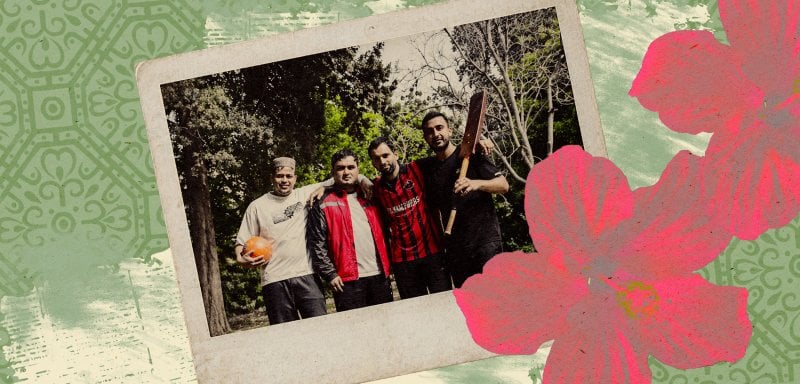
Every Sunday, a parking lot tucked away in Beirut’s Achrafieh neighbourhood transforms into an unlikely playing field — a cricket ground.
Exultation and dismay ride on every swing of the bat, the thump of it against the soft tennis ball audible throughout the neighbourhood. Terrifying explosions sound only a few kilometres away, as Israeli bombs fall on Lebanese homes, shops, hospitals, and schools.
Every week, dozens of migrant workers from India, Pakistan, and Sri Lanka travel from across the country on their only day off to play the sport they love — one unheard of in Lebanon. Their wives and children line the edges of the makeshift pitch, selling chai and homemade snacks.
These are no casual or friendly matches. Teams wear custom jerseys and compete at a high level.
These games have continued through Israel’s war on Lebanon, which has killed more than 2,200 people, according to the country’s National News Agency, and displaced more than 1.2 million people, as reported by Reuters.
A few days after the war began on 2 March, I messaged Ahmed, a fellow cricketer, to check whether he was safe. He responded by inviting me to play with them that weekend.
“The cricket never stops,” he said. “It’s part of our Sunday routine.”

Kelum Ruwan Pathirana, a Sri Lankan known for his elegant style of play, takes his place in front of the wicket. March 8, 2026. Beirut, Lebanon. Photo courtesy of Ali Abbas Ahmadi.
On Easter Sunday, Israeli forces launched several attacks across Beirut, killing at least 39 people. The strikes in Chiyah and Ghobeiry were a few kilometers away from the cricket ground; earlier strikes in Basta and Bachoura were a mere five-minute walk away.
Ahmed, who hails from Pakistan and has been in Lebanon for the past ten years, said he heard explosions while playing.
“What could we do?” he said when I asked him how they reacted. “We continued playing till the evening and went home afterwards.”
This isn’t the first time the cricketers have played during a conflict. Even in 2024, during Israel’s war on Lebanon, the players continued to show up.
Like many others, the players are attempting to continue with their normal lives during the war. Bars and restaurants in neighbourhoods like Mar Mikhail and Gemmyze, less than a kilometre from the ground, are full.
Sugath Priyantha Fernando, a 53-year-old Sri Lankan who organises the matches, is one of the senior-most players at this ground.
“I’ve been here since 1996, and I have faced three or four wars,” he said. He recalled an incident from early 2025, while playing a match on a different ground closer to Dahieh, Beirut’s southern suburbs, where Israel has focused its strikes under the pretext that the residential area is a “Hezbollah stronghold.”
“Once the match finished, both teams were standing, and we wanted to have a picture. As soon as we stood for it, a strike hit right behind us. Maybe a few hundred metres away.”
Fernando explained that the players have grown accustomed to the constant bombs and violence. They came to Lebanon for work opportunities, or were passing through on the way to Europe, but ended up staying. Most have been here for over a decade, living through the Israel-Hezbollah wars of 2006 and 2024, Israel’s near-daily bombing campaign in 2025, and now the war in 2026.
The parking lot they play on is wedged between the Université Saint-Joseph and St. Joseph’s church — an upscale Christian neighbourhood that has thus far been largely untouched by the violence.
Like many others, the players are attempting to continue with their normal lives during the war.
“I feel like [the Israelis] are not going to hit where mostly Christians are living. […] We feel safe, especially in the north side of Beirut and the mountain areas,” Fernando said.
Israel’s war adheres to sectarian lines, with its focus on Lebanon’s Shiite population, whose support for Hezbollah’s arsenal, due to its deterrence capabilities, has rendered them indiscriminate targets. Airstrikes have flattened parts of South Lebanon, Dahieh, and the Bekaa, all regions predominantly inhabited by Shias.
Israel’s defence minister has said they may not be allowed to return.
Christian areas like Ashrafieh have been largely spared, but not unconditionally — Israel has warned Christians to expel Shias from their neighborhoods and not shelter them, or else they face the same fate.
This pressure is exploiting existing fault lines between the sects, with growing fears that it could foment civil unrest.
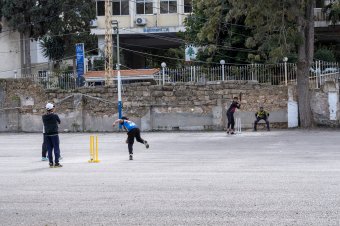
Majid Satti prepares to hit a shot during a match. February 1, 2026. Beirut, Lebanon. Photo courtesy of Ali Abbas Ahmadi.
Like other Beirutis, Fernando and the rest of the players have learned to read the city during a conflict, avoiding areas that are frequently targeted. Having experienced several conflicts where Israeli forces have bombarded Beirut, the Lebanese implicitly understand the pattern of Israeli strikes to protect themselves by delineating where, when, and how aggressively they may attack different parts of the city.
But that calculation has shifted, especially since 8 April’s widespread strikes when Israel hit all parts of the city, including areas they had never targeted before.
Still, the players think cricket is worth the risk.
“They love to come to this place, you know, just to see each other, have a cup of tea together, to chit-chat, that sort of thing,” Fernando said.
For the players on the pitch, cricket isn’t just a pastime. It is their most sacred ritual, the only thing worth spending their weekly day off on. It’s a connection to home, to the streets and villages where they played as children.
In India, Pakistan, Sri Lanka, and Bangladesh, cricket is a religion. They have brought that with them, turning this corner of Beirut into a pocket of South Asia. Indians and Pakistanis share the same ground, wear the same jerseys, and have the same arguments over strategy – two nationalities whose nuclear-armed governments have fought wars and traded insults, finding community in a Lebanese parking lot.
It isn’t just the men who play every week. Women from different migrant communities – including from countries where cricket is not typically popular – play earlier in the morning.
Like other Beirutis, Fernando and the rest of the players have learned to read the city during a conflict, avoiding areas that are frequently targeted.
“We’ve got Sri Lankans, Filipinas, Ethiopians, and Liberians; they play cricket with us. The women have like 12 teams,” Fernando said.
The matches are held with the blessing of St. Joseph’s church, which opens the space to the players and their families every weekend.
They have been held in this parking lot since the 1990s, but the players lost access to it for a few years in the mid-2010s. The ground was eventually returned to them in 2022 with the help of Father Richard Pichai, of the Society of Jesus, a Sri Lankan priest who, until recently, served at St Joseph’s church.
“The migrants work hard all six days of the week. When they get back on the ground, their problems are solved. They mingle with other families from different countries and build beautiful relationships,” Father Pichai remarked.
It’s definitely an odd scene: Lebanese churchgoers coming for mass, walking past South Asian men in bright jerseys emblazoned with ‘Lebanon Super Kings’ or ‘Beirut Blasters,’ teams named after Indian Premier League franchises.
Fernando’s team is called St Joseph’s, in honour of their host.
The church’s relationship with the players runs deeper than just a shared parking lot. It is currently sheltering people displaced by Israel’s war, some of whom are migrants from other communities.
“The church even requested us to teach cricket to some of the people who are stuck in the shelter. […] They’re young boys, 10, 12, 13 years old,” said Fernando.
Stranded for weeks on end with little to do and nowhere to go, Fernando said cricket can give the children an outlet to burn off energy and take their minds off the war.
“We have some African boys who had never played, but they were energetic,” he said.
Majid Satti, 42, plays for 11 Brothers, a team of players from both India and Pakistan that have been champions for the past several years.
He laughed when I told him he had a reputation as one of the best players, recounting a time he was hit all around the ground as an opponent scored freely on every ball he bowled.
“It all depends on your form,” he said. “If you’re in form, then you play well. If not, then you’re nothing!”
Satti was on the ground on Easter Sunday when Israeli forces attacked several locations across the city.
“When we were playing, we saw a lot of [Israeli] planes circling above us,” he said.
“I was telling the others that they must think we are insane – there’s a war going on, and these guys are playing!”
Many migrants in Lebanon have been disproportionately affected by Israel’s war on Lebanon and have been barred from accessing public shelters.
Satti is from Rawalpindi in Pakistan and has been in Lebanon since 2010. He lives and works in Achrafieh as a receptionist, walking distance from the cricket ground — luckier than most. Just like the others, he can’t wait for his day off to play cricket.
“Cricket is a passion, it’s been a passion since I was young. I used to play for my school,” he said.
Unlike most migrants from South Asia who leave home in search of a better life, Satti arrived in Lebanon instead of a Gulf nation like Saudi Arabia or the UAE.
“At that time, a lot of people would easily go to Europe from Lebanon. That’s why I came as well, to see if that could work out,” he said. “Once or twice, I had collected enough money to try and make the trip to Europe, but that never happened. I eventually decided that I’m fine here.”

“Once the match finished, both teams were standing, and we wanted to have a picture. As soon as we stood for it, a strike hit right behind us.
Migrant workers face a difficult life. Many in Lebanon are exploited and discriminated against by the state and their employers, who confiscate their passports and withhold their wages. Many have been disproportionately affected by Israel’s war on Lebanon and have been barred from accessing public shelters.
Fernando acknowledged this and added that migrant women – who are usually domestic workers – face the brunt of the exploitation.
“The women have a hard time; they work until very late and face a lot of abuse,” he said.
Not all the men I spoke to have families in Lebanon. Majid has a family in Pakistan, while Fernando’s wife and daughter are in Sri Lanka. In their absence, the cricket gatherings have become their family.
“If there is no cricket, and if there is no day off on Sunday, I would not have stayed here for 30 years,” said Fernando. “This is the only place where we can have some energy, some freedom.”
Raseef22 is a not for profit entity. Our focus is on quality journalism. Every contribution to the NasRaseef membership goes directly towards journalism production. We stand independent, not accepting corporate sponsorships, sponsored content or political funding.