
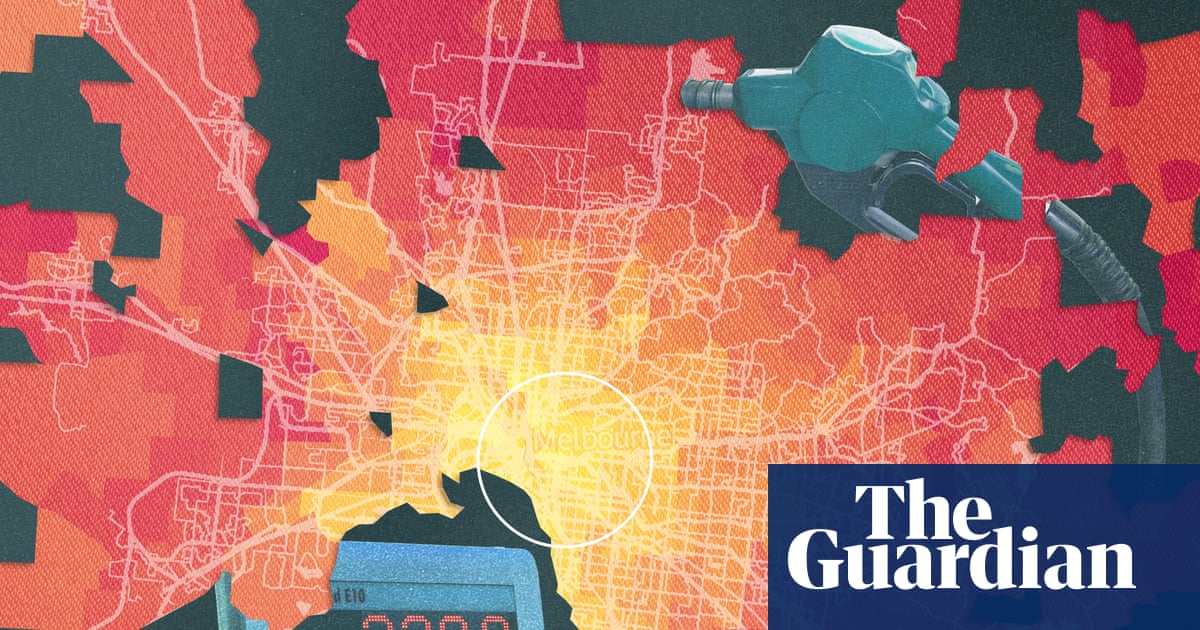
Singh lives in a public transport deadzone, one of the most disadvantaged by the fuel crisis,
ranking 20/30 on the Vampire index. Just 13% of people in her suburb live near regular transport,
with almost 60% driving to work.
“There is a bit of a debate within the urban planning world around whether
it’s the quality of the public transport network that leads to people using
public transport or whether it’s the density of the land use,” Dodson says,
referring to the density of housing and access to other services such as
supermarkets. Someone who lives close to shops or community centres might
choose to walk or hop on a tram. In suburbs without these facilities,
or where they aren’t connected by transport, residents may have no option but to drive.
“Inner parts of our cities tend to be the areas where the tram networks operate,” Dodson says.
“In Melbourne, we’ve still got a tram network. In Sydney, there used to be a pretty extensive tram network, which has mostly been replaced by buses, though rail connections and new light rail are being brought in.”
That many outer suburbs lack access to heavy rail or trams also shapes the specific kind
of commute that Singh and a lot of Australians share – travelling across the city to other
suburbs, rather than into the centre. Only about 20% of jobs in major Australian cities
are based in central business districts, according to Dodson.
“And in [the centre], you do tend to get an urban form that is a bit more amenable
to walking and cycling because it was built in the early 20th century around tram
lines rather than built on the basis of people travelling by car, which is what
happened after the second world war. We shifted to a car-based model.”
You can see this in our final map below, showing transport routes across greater Melbourne:
The closer to the CBD, the better the transport
Showing public transport routes across greater Melbourne
Guardian graphic. Source: Victorian Department of
Transport and Planning
Even though the city has one of the largest tram networks in the world,
it does not reach many of the growth areas, including the west where Singh
lives. And many of the train lines branch out from the centre, pulling
further apart as they go out and making it difficult to cut across the city.
“The radial public transport networks just don’t serve those more dispersed journeys,” Dodson says.
“Particularly what we call orbital or circumferential travel where you’re going,
like, between the spokes rather than along them.
“This has been a problem that’s been well known for many years. We’ve done a really terrible job
actually redesigning our public transport network and expanding our public transport networks
to improve their multidirectional functionality.”
Dodson says Melbourne’s Suburban Rail Loop will improve these cross-city journeys
– “at extraordinary expense” given that it requires digging tunnels. It also won’t
be completed for a decade. But while the connections will be helpful, there will
still be large areas relying mainly on buses – meaning Melbourne still needs to improve its suburban bus networks.
For now the Singhs just want a bus so they can get around more easily and cheaply.
The only other option is to move closer to work, which would be expensive.
“You’ve invested your time, effort and energy in [buying a place], how can you just move?” Singh says. “And why should you move?”