
An Australian research team is exploring a potential way of tackling two of the world’s most pressing environmental issues at once: dealing with plastic waste and reducing our fossil fuel footprint.
The answer? Transforming plastic waste into valuable fuels like hydrogen using solar power.
The new technology would then allow the hydrogen and other gases produced to be utilised as a clean energy source.
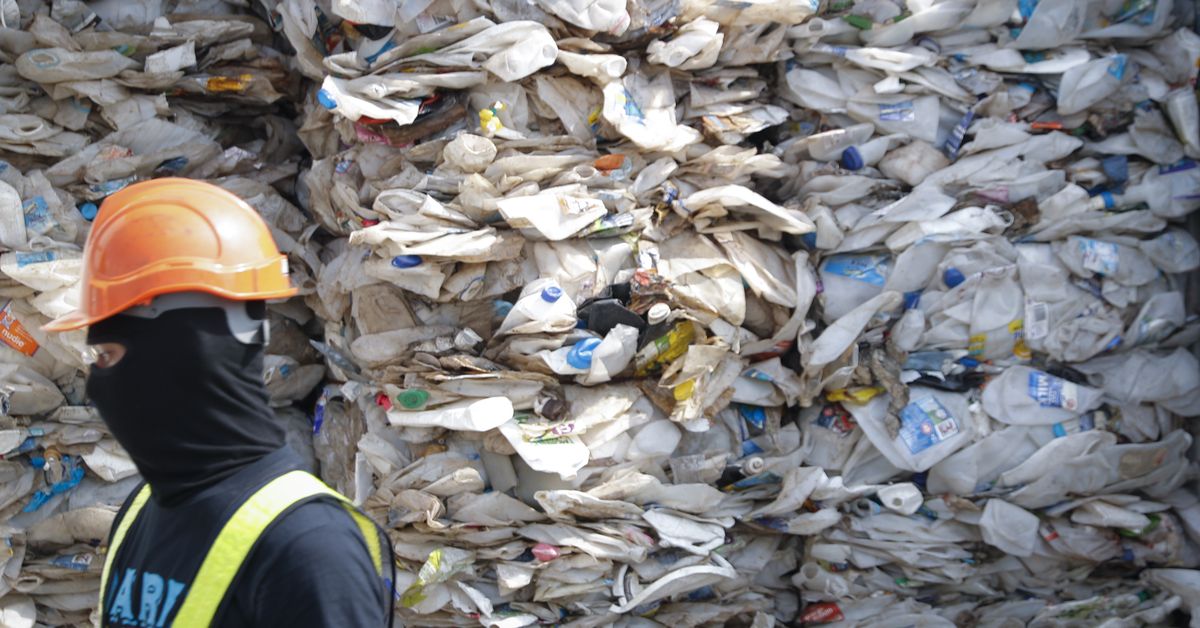
 A container filled with plastic waste from Australia, in Port Klang, Malaysia in 2019. Australia has phased out most exporting of unprocessed plastic waste in recent years. (AP)”Plastic is often seen as a major environmental problem, but it also represents a significant opportunity,” Adelaide University researcher Xiao Lu said.
“If we can efficiently convert waste plastics into clean fuels using sunlight, we can address pollution and energy challenges at the same time.”
Global plastic production has risen exponentially in recent decades, now amounting to around 400 million tonnes a year.
Currently, less than 10 per cent of this gets recycled.
The new technology – known as solar-driven photoreforming – uses light-activated materials called photocatalysts to break down plastics at relatively low temperatures.
These reactions can produce hydrogen – a clean, zero emissions fuel – as well as other valuable chemicals used in industry.
 A green hydrogen electrolyser manufacturing plant in Gladstone, Queensland, was abandoned in 2025. The Adelaide team say using plastics could provide a more energy-efficient large-scale way to produce hydrogen. (Supplied)
Hydrogen is a renewable energy source which can be used to power vehicles, generate electricity and produce heat without carbon emissions.
However, the Adelaide team say the new plastic-based photoreforming has the potential to be more energy-efficient and easier to build into large-scale production.
While the process is not yet able to be achieved at a commercial level, senior author of the research paper, Professor Xiaoguang Duan, said laboratory tests have demonstrated impressive results.
 Australia has struggled to find ways to deal with our plastic waste, with efforts such as the failed REDcycle scheme failing to keep up with the volume of rubbish or remain economically viable. (Supplied/EPA)
In some cases, conversion systems have operated continuously for more than 100 hours, highlighting their growing stability and performance.
“One major hurdle is the complexity of plastic waste itself,” Duan said.
“Different types of plastics behave differently during conversion, and additives such as dyes and stabilisers can interfere with the process.
“Efficient sorting and pre-treatment are therefore essential to maximise performance and product quality.”
If successful, it could provide a viable alternative or addition to Australia’s beleaguered plastic recycling schemes such as the failed REDcycle soft plastics scheme.
Currently, around 87 per cent of plastic waste in Australia goes directly to landfill.
NEVER MISS A STORY: Get your breaking news and exclusive stories first by following us across all platforms.