
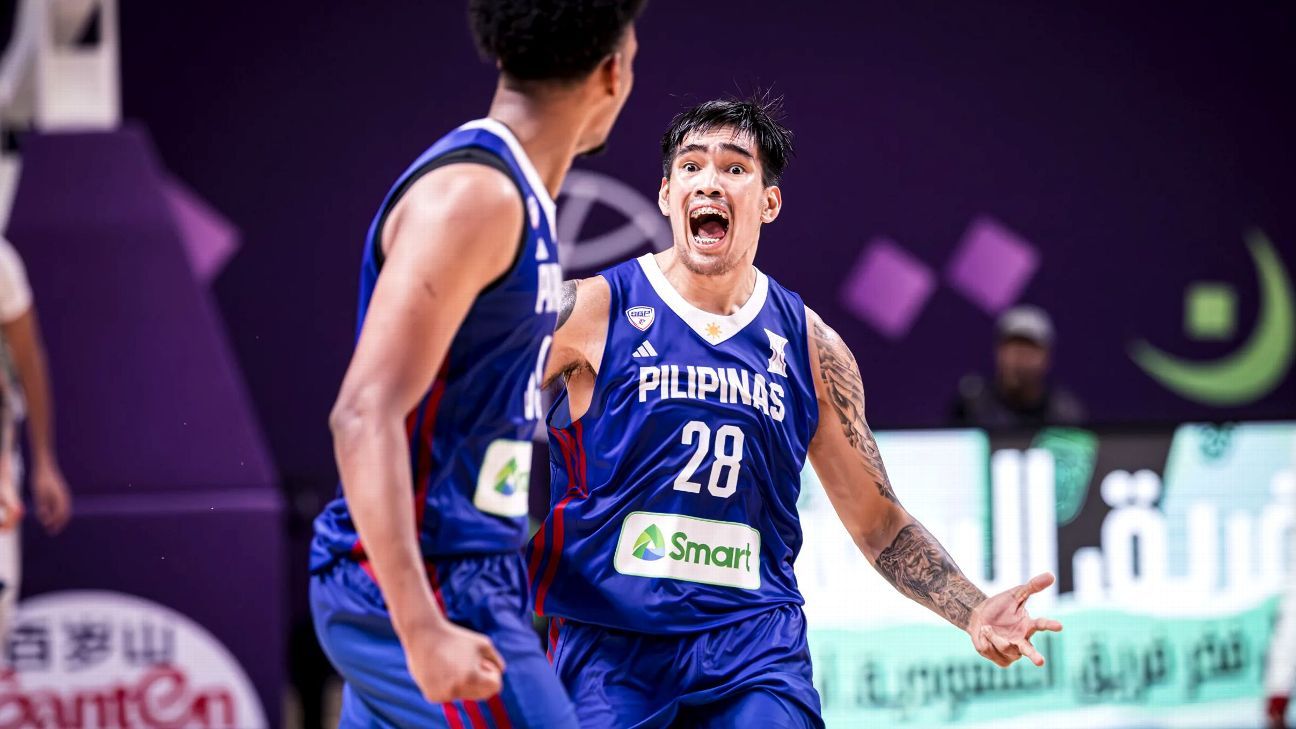
Coming off a heart-stopping overtime victory against host nation Saudi Arabia, Gilas Pilipinas faces a monumental challenge in the quarterfinals of the 2025 FIBA Asia Cup. Fueled by the heroics of Justin Brownlee, the Philippines have clawed their way into the knockout stage, but their reward is a daunting date with the undisputed kings of Asia Cup basketball: Two-time defending champions, Australia.
Editor’s Picks

1 Related
The Boomers enter tonight’s contest as heavy favorites, having swept their group and maintaining an undefeated record in Asia Cup play since joining the competition. This quarterfinal clash is more than just a battle for a spot in the semifinals; it’s a chance for Gilas to rewrite a difficult chapter in their shared history.
The last time these two nations met on the court, it ended in an infamous brawl during the 2018 FIBA World Cup Qualifiers. While only a few players from that contentious game remain on the Gilas side, the memory of that encounter still looms large.
As massive underdogs, Gilas needs to focus on these factors to stand a chance against Australia.
Overall defense has to be better
It should be said loud and clear: The biggest problem for Gilas so far in the Asia Cup has been defense. What’s glaring is that it’s not just one isolated aspect — the issues are scattered across multiple areas, all of which need to be cleaned up before facing a powerhouse like Australia.
One glaring weakness has been their perimeter defense. Even before the tournament, Gilas already had trouble guarding the 3-point line, giving up at least 10 triples in six different games during the Asia Cup qualifiers. That concern has only intensified, with opponents shooting a blistering 42.3% (47-of-111) from deep. Much of this stems from players not staying attached to their man – particularly in transition or when defending off-ball movement. Rotations have been slow and has allowed shooters to find clean looks off flare screens, handoffs, and simple drive-and-kick actions.
At the point of attack, Gilas has struggled to contain ballhandlers, and part of the problem comes from habits formed in the PBA where defenders often go under screens to protect against drives rather than chase over the top. In the international game, this approach has left opposing guards free to step into open jumpers or dictate the tempo coming off picks.
Defense has been an issue for Gilas at the Asia Cup as opponents have exploited weaknesses across the board throughout the tournament. FIBA
These breakdowns on the perimeter then compound another pressure point: June Mar Fajardo in drop coverage. While the eight-time MVP provides valuable rim protection and rebounding, quick guards and wings have exploited the space he gives in pick-and-roll situations, either pulling up comfortably from midrange or using his deeper positioning to set up shooters in the corners.
Against Australia, who excel at creating quality shots through disciplined movement and precise passing, these defensive lapses will be punished relentlessly if not addressed. The team’s top scorer Jaylin Galloway should definitely be the top priority of Gilas’ scouting report.
Kevin Quiambao’s role on Gilas’ offense
With Calvin Oftana officially out for the remainder of the Asia Cup, coach Tim Cone turned to Kevin Quiambao in the critical game against Saudi Arabia. Quiambao repaid that trust with 17 points and three rebounds on an efficient 66 TS% on 31 minutes. This type of production will once again be necessary if they want to compete versus Australia.
What’s intriguing about Quiambao is his versatility within the triangle offense. While there are moments when his decision-making can be erratic, he remains a dynamic threat who thrives in transition – often at odds with the deliberate pace Cone prefers in a structured half-court set. He has emerged as a reliable shooter who can space the floor shooting at 36.8% from 3-point range in 4.8 attempts per game, a sharp cutter who knows how to time his moves into open seams, and an excellent passer who keeps the ball moving. And when the situation calls for it, Quiambao isn’t afraid to go get a bucket himself, whether by attacking the rim or pulling up for a jump shot, resulting to him being the third best scorer of Gilas at 10.8 points in four outings
Against Australia, Quiambao’s ability to make quick, correct reads will be critical. Most importantly, he must match Australia’s physicality — holding his ground when fighting for position and finishing plays through contact. If he can sustain the same level of efficiency and aggressiveness he showed against Saudi Arabia, Quiambao could be the spark Gilas needs to keep pace with the defending champions.
Properly playing off Justin Brownlee
There’s no secret that the Philippines’ best option on offense is Justin Brownlee. He is currently the third-best scorer in the Asia Cup at 23.3 points per game on an excellent 67.9 TS%. Expect Australia to throw every possible defender at him by switching between long, physical wings and active help defenders — and even send double teams to force the ball out of his hands. How Gilas responds to that pressure will dictate much of their offensive success.
Brownlee’s ability to score in isolation remains his most dangerous weapon. Whether he’s attacking slower bigs off the dribble or using crafty footwork to create separation against smaller defenders, he has consistently found ways to manufacture points. Under Cone, he is heavily featured at the pinch post within the triangle offense, where his versatility shines. From that spot, Brownlee has the freedom to jab, face up, and go into a quick jumper, attack the lane, or feed a cutter when the defense overplays. This area becomes a hub for Gilas’ scoring options, allowing Brownlee to both create his own looks and act as a decision-maker that keeps the defense on edge.
The other layer to maximizing Brownlee’s impact lies in leveraging the defensive gravity he generates. When opponents commit two on the ball — either through aggressive traps or hard doubles — Gilas must be ready to punish those rotations. That means surrounding him with reliable shooters spaced correctly, ensuring cutters time their dives when help turns its head, and having secondary playmakers ready to keep the ball moving.
Brownlee’s scoring will always be the primary threat, but how the team exploits the openings created by his presence could be the difference between trading baskets and actually stealing momentum against Australia.