
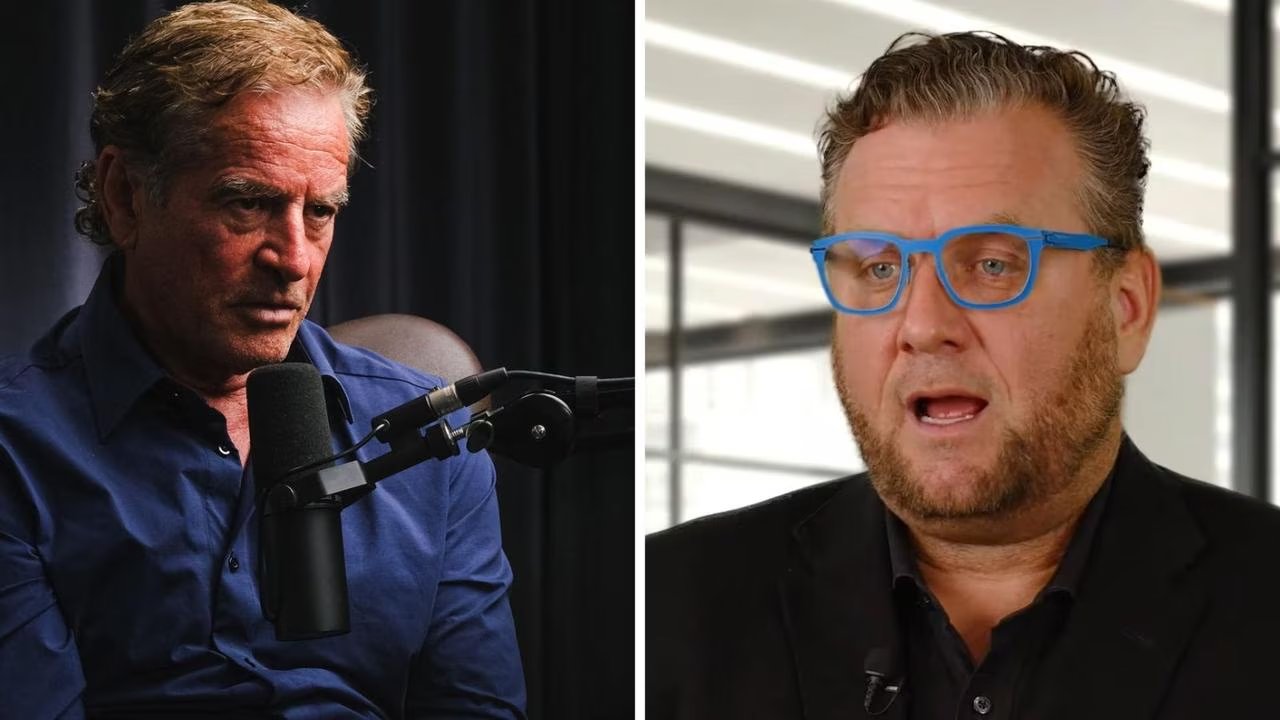
One of the nation’s leading finance minds lamented how Australia has gone from the lucky country to “lazy land”, saying it lost its mojo as workers increasingly relied on the government for jobs.
Christopher Joye gave a frank assessment of the economy during an appearance on business guru Mark Bouris’ Straight Talk podcast, asserting it was being “artificially inflated by immigration and by government spending”.
“The lucky country has become the lazy land and … we’re basically on a track to becoming Asia’s Ibiza where we just sell our physical amenities – our beaches, our budgies, our bikinis and our natural resource endowments,” Mr Joye said.

MORE:Unexpected high-paying roles that don’t need a degree
“When you get lucky, you tend to get complacent and tend to suffer from hubris … Australia has lost its mojo, there’s absolutely no doubt about it.
“And it’s sad because we were the world’s most competitive country at one point, one of the world’s richest countries. We were world beaters.
“My recollection growing up was Aussies in every domain … we were just winners. We’re not, we’re losers right now.”
Mr Joye spoke at length about how inflation pressures and slow productivity were weighing on the economy, in contrast to the tech-led business boom unfolding in the US.
The Coolabah Capital Investments executive said, despite inflation rising above the target range in America, “the zeitgeist there is super positive amongst businesses” under Donald Trump’s dramatic economic and immigration policies.
MORE:6-figure job you’ve probably never heard of
In Australia the Reserve Bank (RBA) had faced the “absolute capitulation and humiliation” of having to hike rates higher than Covid as inflation spiked even before the Iran war, he said.
“In the RBA’s defence, when inflation smacked them in the face, they said ‘we’re going to lift rates’. So all power to them,” he said.
But he said Australia had a bigger problem with inflation compared to the US because it was “not being driven by all this private sector growth, it’s being driven by government spending”.
“The other dynamic is immigration … if you dump half a million people a year on Sydney and Melbourne, we just can’t cope,” he said.
“Because we don’t have that much rental accommodation, we don’t have that much capacity to transport this population shock efficiently.
“So the Aussie economy has been artificially inflated by immigration and by government spending, not by businesses … in fact the private sector is in a per capita income recession and has been since 2023.”
Mr Joye said while the private sector was shrinking, the government part of the economy was the biggest since World War II, labelling it “stealth socialism”.
Data from the Australian Bureau of Statistics showed there were almost 2.6 million public servants in June 2025, up 3.3 per cent on the year before.
Mr Joye believed Australians had become “addicted to the idea that the Dan Andrews of the world will bail them out”.
“According to the Centre for Independent Studies, one-in-two Australians now drive more than half their income from government and related sectors,” he said.
“So this means we have an economy built on fake growth, an economy with a lot of cost pressure, built on debt and immigration.
“If you talk to mums and dads, they’re like, ‘I’m working my arse off, and why are rates rising and why is my cost of living rising? How am I contributing to these problems?’.
“You’re not, it’s got nothing to do with you, mate. It’s got everything to do with politicians and population.”
Treasurer Jim Chalmers has rebuked commentary that government spending was fuelling inflation, saying economic data had shown “a resurgence in the private sector”.
He has, however, flagged cuts in next month’s budget with the government announcing major reforms to funding for the National Disability Insurance Scheme as one example.
Australia’s debt is predicted to hit $1 trillion in 2026, with interest payments rising to $36.7 billion in four years’ time.
Dr Chalmers said this month that war in the Middle East and the major shocks running through the global economy had unwound recent local progress.
“The Australian economy is, in lots of ways, hostage to those developments and those decisions (in Tehran and Washington),” he said.
The government has also said migration was falling after post-Covid highs, with the Treasury forecasting net overseas migration figures of 300,000 people per year – down from 429,000 a in 2024 and 661,000 in 2023.
Mr Joye said Australians were dealing with declining income per capita, falling living standards and shrinking prosperity, which he argued would have political consequences.
“I think that galvanises or catalyses the change in the political Zeitgeist. Whoever wins government, I think you’re going to see big policy changes,” he said.
“This is my prediction; we’re going to see Australia for pretty much the first time in history without any population growth.”
He said the country was stuck in a “bit of a time warp” and was “very disconnected on leading analysis on what’s happening in the world”.
“Australia today just looks very different to what it did to what it did 30 to 40 years ago, and it is very different,” he said.
“And that’s a good thing because we’re the most multicultural country in the OECD (Organisation for Economic Co-operation and Development) … so that brings with it lots of positives but is also brings with it challenges.
“And one of those challenges is a massive, basically amongst the world’s highest inflation rates and highest cost of living.”
Mr Bouris, reflecting on his interview with Mr Joye, said one of the things that stood out to him was “the concept of ‘why don’t Australians want to work as hard as we used to work?’.
Both men said taxes were too high for workers, with Mr Joye saying the best and brightest were attracted overseas, where they kept more of what they earned.
“When I go back to when I was a kid watching my parents, and even me growing up working, hard work generally speaking was pretty much rewarded,” Mr Bouris said.
“We weren’t sort of sitting here thinking ‘I’ll work hard and someone takes all my taxes and I have to donate half my money that I earned … to the government.
“And then a whole lot of that money gets wasted on a whole lot of government policies, government initiatives which, by the way, I never voted for and a lot of you never voted for.
“And there really is a sense of frustration in our community today.
“And I know lots of different parties are talking about it, and I hear the current government is trying to address this the next budget coming up. And they’re trying to stop wastage.
“But what happened to our country? How did we get into this state … I’m not looking for anyone to blame, I just want to know how it happened.
Mr Bouris said Australians needed to ask if it that was what they wanted their country to be.
“Or would we rather be a country where taxes were lower, governments could raise enough money because taxes are low we actually felt encouraged to work harder, therefore we earn more money … overall we paid more tax but not as much per dollar,” he said.
“And therefore made Australia a richer country.
“Like, look at our resources … we have in our country, yet at the same time, here we’re are worried about importing petrol and gas into Australia.
“I don’t know, something’s happening in this joint and … we need a solution. Because it is the greatest country in the world and we’re just not operating that way.”