

Since Sydney hospitality group Etymon appointed him head chef of its latest project, Osteria Luna, Peter Fiander has been hard at work optimising the kitchen. “The kitchen we have is quite small for the size of the restaurant,” he says. “You do have to get a bit creative with what space and what technology you have.”
Upon opening in December 2025, the chef quickly identified early bottlenecks in the operation.
“We had a manual pasta roller, and keeping up with the numbers that we were doing was a bit of a struggle,” says Fiander. “So we invested in an electric pasta machine for rolling out, specifically at the moment, our mushroom ravioli. That cut down our workload significantly. The job that would take three chefs an hour, one chef can now smash out in about 45 minutes. That’s been a real game changer.”
The ravioli he is talking about is one of Osteria Luna’s most aesthetically noteworthy dishes (a crucial hook in a culture where food has become enmeshed with social media imagery): an entire unseparated sheet of ravioli al funghi doused in brown butter.

Fiander doesn’t believe that using machinery like the pasta roller has any negative impact on the craftmanship of the dish. “It’s just motorised rolling pins. It’s doing the exact same thing – but it saves your arm muscles and does it quicker than you could.”
There are a number of pressure points facing commercial kitchens at the moment – from tight margins and rising energy costs to labour shortages and increasing expectations for consistency. For chefs like Fiander, finding the right equipment acts as both a productivity tool and a strategic business decision.
Brisbane’s Norman Hotel Executive Chef Frank Correnti says that for high volume operations, having good equipment is crucial for maintaining consistency and quality in what they produce.
The hotel hosts more than 3000 covers per week, with most guests ordering steak. Chips make up about 50 percent of the sides that the team serves, which means “having a good deep fryer system is imperative,” according to Correnti. The hotel installed Frymaster Filtration Fryers from Comcater, which have frequent, rapid filtration that can extend oil life by up to 40 per cent, reducing oil consumption, disposal costs, and overall operating expenses.

Correnti says there are a number of benefits with this system. “In the first year, I saved in excess of $9000 in oil alone, and that’s adding another 25-litre deep fryer to the system. It also helps with the health and safety in the kitchen.”
Not only does the oil lifespan save money – it allows the kitchen to save time (and stay safe) by keeping the oil within the filtration system, which means staff don’t have to carry dangerous hot oil across the floor. “We used to manually filter the fryers daily, now it’s quite easy for our staff to do, which has reduced the number of hours per week.”
Not every kitchen has such a high output, especially more compact operations. Fiander is no stranger to getting creative in small spaces, having spent a few years at Love Tilly Group’s Sydney CBD pasta joint Ragazzi, where he worked his way up to sous chef.
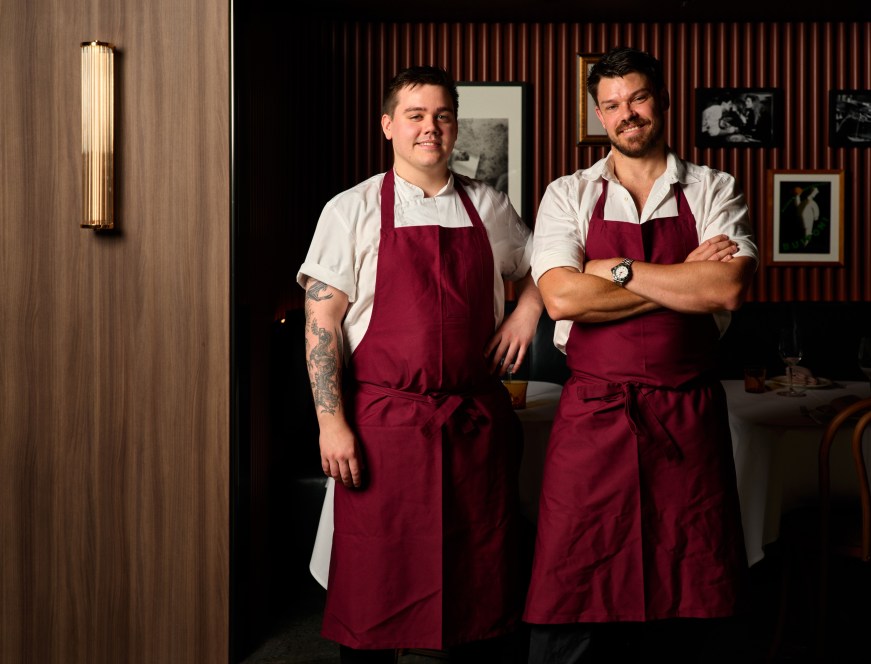 Osteria Luna Head Chef Peter Fiander and Executive Chef Billy Hannigan
Having a well-oiled team is the first step in ensuring efficiency, and particularly for the Osteria Luna team, where synergy is make or break in the confined space. Fiander quickly developed a “solid” team made up of staff who trained at upstairs restaurant The Charles, which – like Osteria Luna – is owned by Etymon, and others who he’s worked with in the past.
“The stars aligned. They were all looking for jobs at the right time, and we ended up working together and creating this team that gels together really well,” says Fiander.
The kitchen itself didn’t have a huge amount of equipment. At opening, there was only a four-burner gas stove, a target top, a deep fryer, and – despite the kitchen’s compact size – a very welcome Rational combi oven.
The kitchen team uses the combi oven for steaming, baking, roasting, and braising the likes of lamb shoulder overnight for ragu.
“It really cuts down on how much time you need to utilise the oven for when you need it for service,” says Fiander. “We wouldn’t be able to do the kind of braises and ragu that we do without it, to be honest.”

The combi oven also helps save space in the tight kitchen, allowing the team to “throw things in there on steam rather than having however many pots on the stove for blanching and all the rest of it,” says Fiander.
“It’s a real space saver, especially in something like an Italian restaurant where the food is so heavily based on all the sauces that you’re making. If you come in the morning and you’ve already got six pots for your base sugo sauce, your ragu, and then you’re trying to fit a cotoletta and whatever else on there, it gets a bit tight when you’ve got a four burner gas stove and a target top.”
Stoddart Food Equipment Corporate Executive Chef Nick Marsden adds that being able to use combi ovens while the kitchen is closed makes them an asset to commercial kitchens. “To be able to take advantage of lower energy costs in that off-peak period, but also have those ovens working when they’re not there is a huge benefit to chefs,” says Marsden.
Marsden says that due to the computer programmability, and multi phase cooking abilities, combi ovens are “very versatile pieces of equipment”.
Marsden points to Giorik combi ovens, which have revolutionised traditional systems. Rather than the traditional boiler driven or injector driven oven, they have a hybrid steam generating system. These ovens also have smaller boiler sizes: Rather than a six to ten litre boiler, they use a 400ml boiler in a 10 tray combi. “This means we’re providing less power for more efficiency to heat the water in the steam generator,” says Marsden. “And we’re providing steam to the unit a lot quicker.”
Marsden says that combi ovens are suitable for all sectors of hospitality, a benefit of the different sizes available.
In terms of robotics optimising kitchen processes, Fiander is optimistic. “I’ve been cooking for about 11 years, and I’ve seen the evolution of things like a Thermomix or a Robot-Coupe. That’s such a game changer. I can’t tell you how many Hollandaise and Beurre Blancs I split as an apprentice. Being able to chuck them into those machines and set them to the perfect temperature is pretty amazing.”
Fiander says machines like this can make the training staff much easier and much more consistent. “You don’t have to worry about splitting another hollandaise and throwing it away again. So there’s definitely the money saving aspect of that.”
Even though machines are improving and allowing consistency in the kitchen, Fiander still prides himself on his hands-on, minimal machinery knowledge. “It’s a responsibility of the chef to be able to do it without all the luxury,” says Fiander. “Technology has come a long way and it’s quite reliable, but it’s never 100 per cent accurate.”
 Osteria Luna
“You see videos all over the place of wok robots making a stir fry, or something like that. But in terms of cutting out more of a chef’s job, I think we’ve still got a way to go. You can’t really, as far as I’m aware, teach a robot how to taste a sauce.”
Because of this, Fiander values taking an “analogue” approach in the way he trains. At the end of the day, says Fiander, making what you’ve got on hand work is just part of being a chef.
“Working in the restaurant industry, you have to be pretty savvy,” says Fiander. “I had this big grand wish list of things, as every chef does. But when you really tear it back, you don’t need all the other fluff.”
Photography by Steven Woodburn and Comcater.
This story was originally published in the March/April 2026 edition of Hospitality. Read more or subscribe here.