
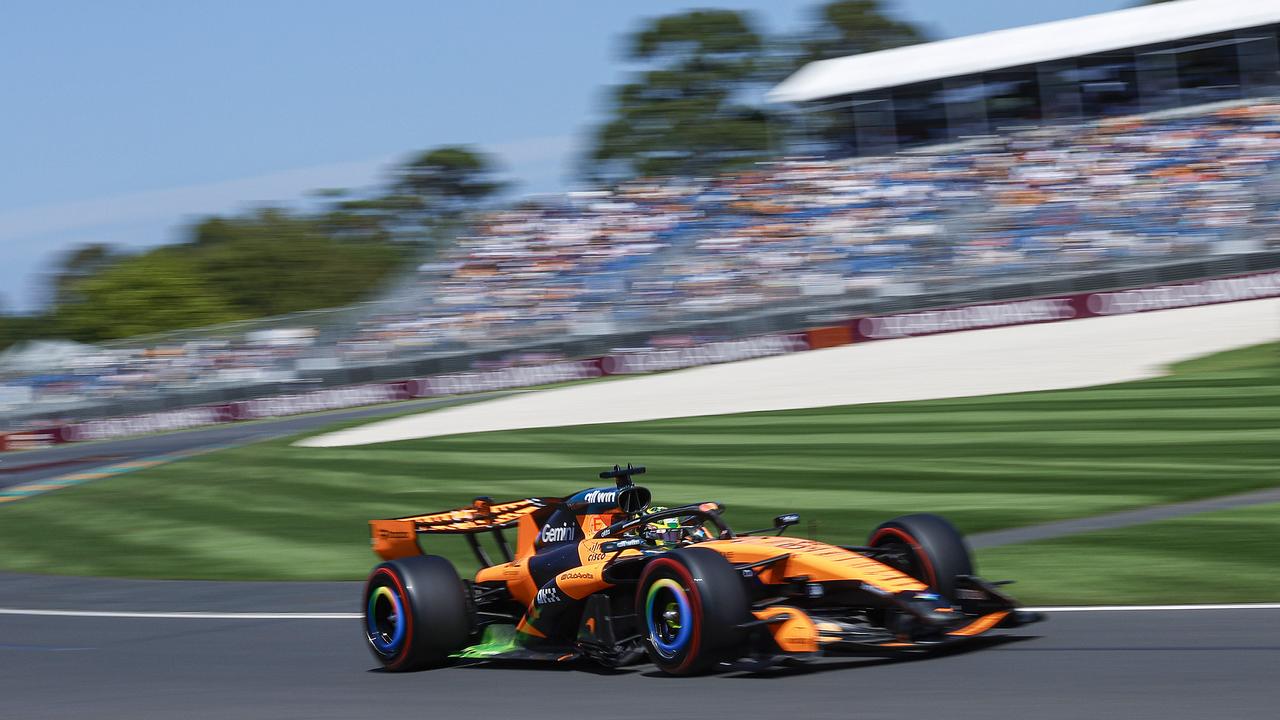
The Australian Grand Prix is expected to lose its coveted spot as the opening round of the Formula 1 season next year as construction work on new pit and paddock facilities continue at Albert Park.
Melbourne traditionally hosted the season-opening race upon joining the calendar in 1996 but lost the right to the high-profile slot during the pandemic, when Bahrain solidified its hold on round 1.
Australia returned to the position in 2025 and 2026 due to the timing of the Muslim holy month of Ramadan, preventing competition from taking place in Bahrain and Saudi Arabia for most of March.

Fox Sports, available on Kayo Sports, is the only place to watch every practice, qualifying session and race in the 2026 FIA Formula One World Championship™ LIVE in 4K. New to Kayo? Join now and get your first month for just $1.
However, with the lunar-based Ramadan shifting mostly into February next year, Bahrain will be available to resume season-opening duties, with the 2027 campaign expected to get underway on 14 March. The Saudi Arabian Grand Prix will follow on the subsequent weekend, as it has since 2022.
Bahrain pays for the privilege of hosting the first race, as it reportedly does for hosting pre-season testing, which is expected to return to its usual three-day format at the Sakhir circuit in the fortnight before the first round next year.
It will be the first running of the Bahrain and Saudi Arabian races since 2025, with both events called off this year owing to the ongoing conflict in the Middle East.
The Australian Grand Prix is therefore likely to fall on the weekend of 2–4 April, the week after Easter and around a month later than it was this year.
The Australian Grand Prix Corporation was contacted for comment.
The date change brings one potential benefit of having the race on the first day the clocks move backwards after daylight saving time ends, meaning Sunday’s main event would take place at a more palatable early-morning timeslot for European audiences.
The date change won’t be permanent, however, with Melbourne contractually assured of three more opening-round slots under its current hosting contract, which ends in 2037.
Melbourne was always unlikely to open the 2027 season regardless of Ramadan given the circuit will be in the middle of a $395 million upgrade to renew its ageing pits and paddock complex.
The permanent pit building has been in place since Melbourne’s first championship grand prix 30 years ago, and its replacement — along with new hospitality spaces — was a key part of contract negotiations concluded at the end of 2022.
Demolition began shortly after this year’s race concluded, with everything pulled down except the race control building, which will remain standing for another season.
New permanent garages will be constructed in time for next year’s race, but hospitality and paddock club guests will be hosted in temporary facilities.
The race control building will be torn down after the 2027 grand prix. A new structure, along with the additional hospitality floors above the garages, will be completed in time for 2028.
The ongoing demolitions and construction mean Albert Park was never a likely candidate to open the 2027 campaign. Assuming works remain on schedule for completion, Melbourne could be back in contention to host the first race in 2028, or at the latest in 2029.
Alex Marquez wins as Marc crashes out | 01:40
WHAT ABOUT THE REST OF THE CALENDAR?
Formula 1 is believed to be contemplating rearranging the Asian leg of the season next year, with a triple header comprising Australia, Japan and then China a possibility to get the sport to the end of April. This year Australia and China were run on consecutive weekends, with Japan standing alone at the end of March.
The Miami and Canadian grands prix will follow, as is the case this season. A repeat of this year’s two-weekend break between North American races is unlikely, but it’s unclear whether the sport will be able to run the races back to back to maximise logistical efficiency. Montreal has been reluctant to move too early in the year due to weather, while Miami organisers are similarly unwilling to move later in the month.
The European part of the campaign is to be decided, with two new rounds set to be inserted into the schedule.
The Portuguese Grand Prix will return on a two-year contract beginning at the Autódromo Internacional do Algarve in Portimão. The Turkish Grand Prix is also making a comeback on a five-year deal for Istanbul Park.
Though no dates have been announced for either, inserting Portugal into the June slot to be vacated by the Barcelona-Catalunya Grand Prix next year would be an obvious pick.
Barcelona is on an alternating deal with the Belgian Grand Prix that will see the Spanish round return to the schedule in 2028, potentially triggering a shuffling of the European races preceding the August mid-season break.
The Turkish Grand Prix was originally run in August when it joined the calendar in 2005, and it’s likely to find space there again next season, after the Dutch Grand Prix runs its last race this year.
With the new Spanish Grand Prix in Madrid likely to run back to back with Monza’s Italian Grand Prix as the first races back from the mid-year break, Türkiye and Azerbaijan would make an obvious geographical pair, with Baku currently standing alone on the calendar.
Originally Istanbul was considered a European race for logistics reasons, with teams travelling across the Bosphorus by truck, as they would do for any other continental race, though it became a hybrid fly-drive event during its two-year stint during the pandemic.
Azerbaijan, however, is a fly-only race without road freight. Pairing the two would likely see Istanbul treated the same way.
From there the sport will head to Singapore in mid-October, with races in Austin, Mexico City and Sao Paulo following, likely on consecutive weekends, as they will be this season.
Formula 1 is committed to ending the year with the bizarre triple-header spanning Las Vegas, Qatar and Abu Dhabi.
This strange set of races has come about because of the obligation to hold the Las Vegas Grand Prix on the penultimate weekend of November, the weekend before Thanksgiving. Historically this has been the quietest weekend in the tourism-centric city, and F1 has been able to pitch itself to local authorities as a solution to that problem.
Qatar and Abu Dhabi then follow on consecutive weekends owing to a reluctance to complete the season too late in December. A post-season test often follows the final race, meaning crews and equipment often aren’t back at base until the following weekend, around a fortnight before Christmas.
The regulations require that all factories close from 24 December until 2 January.
Marc Marquez goes off in a HUGE crash | 00:39
ARE THERE ANY NEW RACES ON THE HORIZON?
The reintroduction of the Portuguese and Turkish grands prix will bring the 2027 calendar back up 24 races, which is both the sport’s minimum target and, by agreement with the teams, also the maximum number of rounds.
Portugal’s two-year contract is a clear outlier at a time Formula 1 is attempting to stitch up much longer deals to ensure stability of cash flow and logistical certainty.
The short-term contract gives F1 flexibility at a time it says the phone is ringing off the hook with countries interested in joining the tour.
The Thai Grand Prix has been foreshadowed since 2025, when the government approved a multimillion-dollar program to set up a Bangkok street race following meetings with F1 CEO Stefano Domenicali.
Little has been heard about the plan since, however — not helped by a tumultuous change of government — and now the earliest the race could appear on the calendar is 2029 thanks to Portugal’s two-year inclusion.
The same goes for the various mooted races in Africa. There are multiple bids in South Africa as well as a government-backed project in Rwanda for a permanent circuit outside capital Kigali.
All have gone off the boil after a flurry of interest in 2024. The earliest any might be able to join Formula 1 is now 2029, though this would still represent a tight time frame given the relative immaturity of most of those projects.
Korea’s plan to join the F1 calendar will also have to wait until 2029 at the earliest despite the mayor of Incheon — the city outside Seoul that hosts the country’s biggest airport — saying his $1.1 billion street track could be ready in time for the 2028 campaign.
It also puts the lie to claims by India’s Minister of Youth Affairs and Sports, Mansukh Mandaviya, that his country had secured Formula 1’s return to the Buddh International Circuit for 2027, remarks subsequently dismissed by F1.
The 2029 season looms as the earliest Formula 1 can add new venues into the mix, with Mexico City and Singapore also up for renewal along with Portugal.
Singapore is likely to be extended, though Mexico City is on somewhat shakier ground, having signed only a three-year contract in 2025.
F1 contracts expiring
2026: Netherlands*
2027: Las Vegas
2028: Mexico City, Portugal, Singapore
2029: Japan
2030: Abu Dhabi, Azerbaijan, China, Sao Paulo, Saudi Arabia
2031: Belgium, Italy, Türkiye
2032: Hungary, Qatar, Spain (Barcelona)
2034: Great Britain, United States (Austin)
2035: Canada, Monaco, Spain (Madrid)
2036: Bahrain
2037: Australia
2041: Austria, Miami
*not renewed