
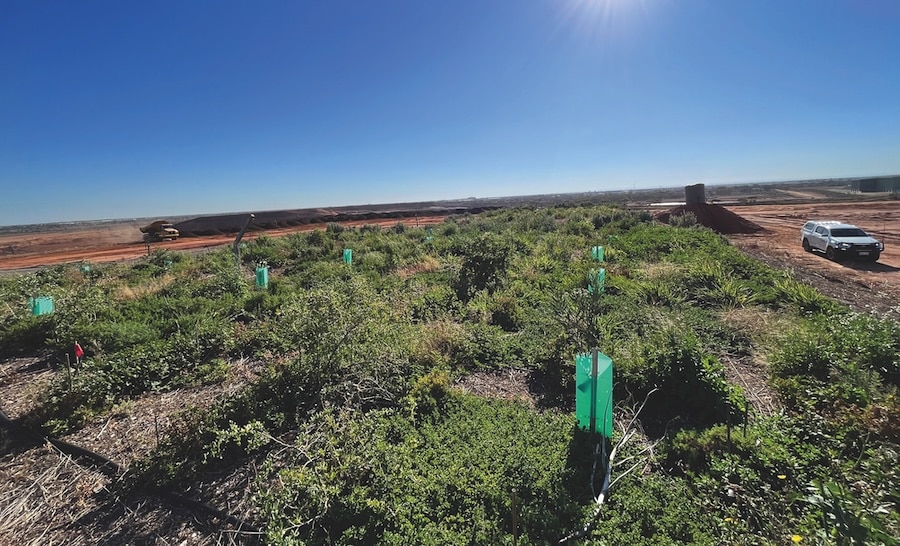
Modern landfill capping offers an opportunity to restore habitats and boost biodiversity using recycled organics.
Historically, mulches applied to a landfill cap surface have been used for their ability to minimise the impact of water and wind erosion and maintain soil moisture levels.
However, the use of recycled organics has far more wide-ranging benefits, according to Ellie Leopold, an environmental scientist with Ennovo.
Ellie says the integration of recycled organics into evapotranspiration-based (ET) landfill caps, or phytocaps, is enabling these types of landfill caps to increase their effectiveness and ultimately achieve the goal of rehabilitating a once highly impacted part of the landscape.
Phytocaps are plant-based landfill covers that act as a living, self-repairing barrier to prevent water from entering waste. Ellie says the use of recycled organics as a critical amendment through the soil profile is resulting in multiple benefits.
“Not only does it lead to the establishment of a very effective plant-growing medium, but it also has additional benefits related to water-holding capacity, nutrient availability, soil biology and storage of carbon,” she says.
“The benefits of recycled organics in landfill capping are only just being realised to their full extent, and the results are genuinely exciting.
“Beyond the clear environmental gains, this approach is also proving very cost-effective for landfill operators.”
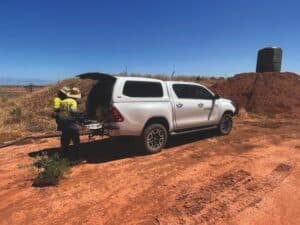 The recycled organics division works closely with the compost processing team to ensure the products required for the landfill cap are fit for purpose. Image: Ennovo
The rapid establishment of native vegetation on landfill caps is critical, as this vegetation has numerous functional benefits. The plants themselves work with the surface mulch layer to reduce water and wind erosion as well as create a habitat for animal species – all part of the broader landfill rehabilitation goals.
However, many landfills are situated in harsh environments, often making it difficult to establish native plants. Ennovo has been involved in the development of recycled organics-based growing mediums to rehabilitate landfills for many years.
Ellie has overseen the establishment of native plant species on landfill phytocaps under the harshest of weather conditions.
“It was satisfying to see our seedlings get through some very tough times when they were trying to establish, and the use of recycled organics definitely helped to get them through those early dry periods,” she says.
As part of Ennovo’s recycled organics division, Ellie works closely with the compost processing team to ensure the products required for the landfill cap are fit for purpose.
Together with Dr Mitchell Hodgkinson, Technical Manager of the division, they ensure the required quality assurance specification is met – a critical consideration due to the volume of product required and the impact it has on the success of the rehabilitation strategy.
The benefits of recycled organics in agricultural applications are well known. Ellie says that, in a similar fashion, these organics transform soil physics and biology to enhance landfill cap performance.
Compost blended with soil increases porosity, aggregate stability, and available water-holding capacity, supporting deeper roots and more vigorous growth.
In turn, this improves water balance functionality in the landfill cap, enabling it to pump water back to the atmosphere and complete the cycle.
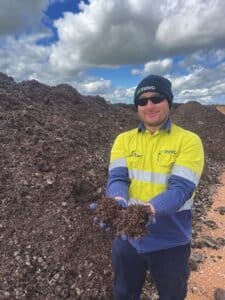 Ennovo technician Dylan Simunsen on site. Image: Ennovo
Ellie says it’s a much more efficient process in comparison to a soil or growing medium that is devoid of organic content. Additionally, landfill caps employing recycled organics, such as a compost amendment within the soil profile, together with surface mulch layers, also function as biocovers – oxidising methane via methanotrophic bacteria that thrive in moist, aerated organic substrates.
“Using recycled organics in landfill caps is a textbook circular solution,” Ellie says.
“Home gardeners, landscapers and agricultural users of recycled organic mulch and soil amendments have received benefits for many years, but the use of these materials in landfill caps, when designed correctly, can achieve all these benefits and much, much more.
“Ultimately, they divert organic waste streams from being landfilled and return carbon to soils as stable organic matter to support the establishment and ongoing growth of vegetation.”
She says expanding the use of quality-assured recycled organics into landfill rehabilitation provides a reliable, high-volume end market for the sector.
As Australia increases its organics recovery, the development of certified products will be critical for specialised applications like landfill caps and the establishment of healthy native ecosystems.
“For Australian landfill owners and designers, the opportunity is clear: we must pair robust design – focusing on water balance and native vegetation – with quality-assured recycled organics that meet local regulatory frameworks,” Ellie says.
“The end result is a functional landfill cap that performs better hydrologically, resists erosion, and contributes to national organics recovery targets. By doing so, we rehabilitate a once highly impacted landscape and achieve a truly circular outcome.”
For more information, visit: www.ennovo.com.au