

An increasing number of home owners are experiencing mortgage stress after the Reserve Bank of Australia has hiked interest rates twice already this year to 4.1%, leaving 26.8% of mortgage holders ‘At Risk’ of mortgage stress.
That’s more than 1.4 million Australians, up 130,000 from a month ago.
The record high of 35.6% of mortgage holders at risk of mortgage stress was reached back in mid-2008.
While the figures are basically the same as a year ago, the number of Australians considered ‘Extremely At Risk’, is now numbered at more than 1 million, or 18.9% of mortgage holders.
For comparison, the long-term average over the last two decades is 16.3%.
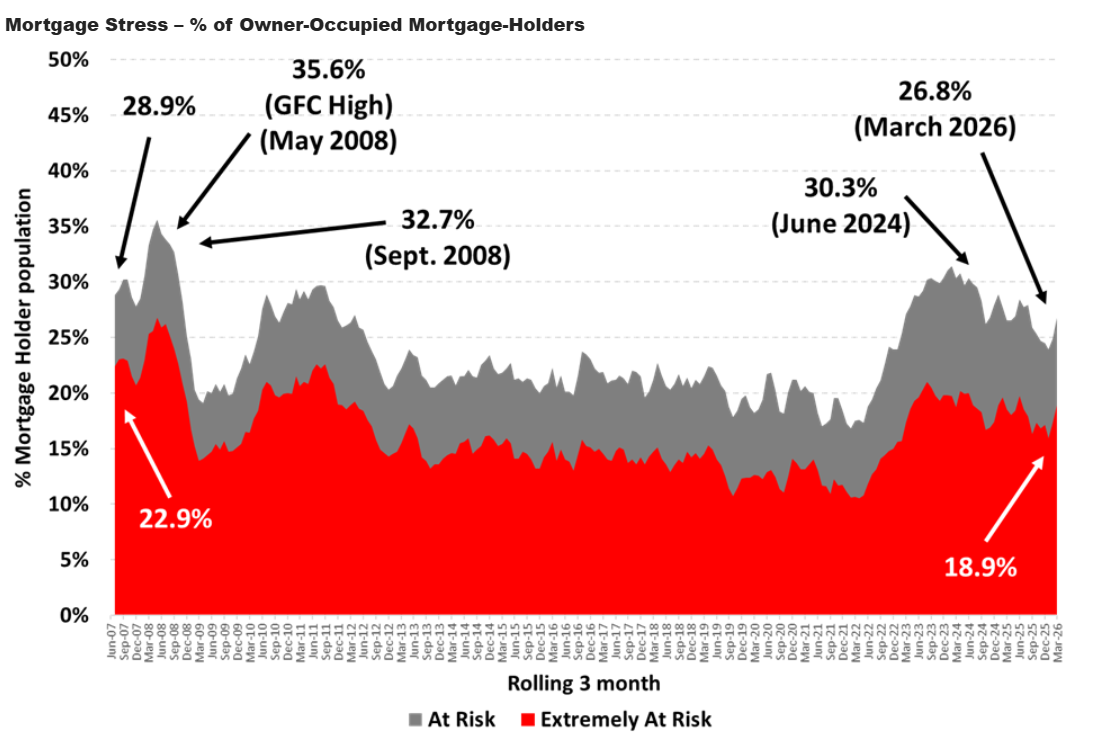 Australians 14+ with owner occupied home loan. ( Roy Morgan Single Source (Australia), average interviews per 3 month period April 2007 – Mar 2026, n=2,889.)
Roy Morgan considers mortgage holders ‘At Risk’ if their mortgage repayments are greater than a certain percentage of household income – depending on income and spending.
Mortgage holders are considered ‘Extremely at Risk’ if even the ‘interest only’ is over a certain proportion of household income.
Roy Morgan has modelled the impact of further RBA interest rate increases:
If the RBA raises rates in May by +0.25% to 4.35%, the share of mortgage holders ‘At Risk’ is forecast to rise to 30.4% (up 3.6% points from now) and equivalent to 1,641,000 mortgage holders, up 194,000 from now.If the RBA raises rates in June by 0.25% to 4.6% the share of mortgage holders ‘At Risk’ would increase to 30.9% – up 4.1% points from now and equivalent to 1,666,000 mortgage holders, up 219,000 from now.
Michele Levine, CEO at Roy Morgan, says the interest rate increases this year by the Reserve Bank has already wiped out most of the relief given to mortgage holders last year, particularly given geopolitical tensions and inflation.
“The high degree of uncertainty about how the Middle Eastern conflict will play out over the next few months has introduced an additional, and volatile, variable into the decision making of the Reserve Bank over the next few months as inflationary pressures are set to build,” she says.
“The good news – at least for the short-term – is that the Albanese Government has been quick to assure Australians the country is well supplied with energy over the next four-six weeks at least.
“It is important to appreciate that interest rates are only one of the variables that determines whether a mortgage holder is considered ‘At Risk’ – the largest impact on whether a borrower falls into the ‘At Risk’ category is related to household income – which is directly related to employment.”
She says, however, the employment market has been strong over the last four years.
“This has provided support to household incomes which have helped to moderate levels of mortgage stress despite interest rates being significantly higher than in May 2022.”