
Formula 1’s relationship with the United States has changed almost indescribably in the last 15 years.
It was only 15 years ago that F1 had no presence in the USA. It had left Indianapolis in 2007 in disgrace, having put on a farcical six-car grand prix in 2005 that risked permanently obliterating its relationship with the country.
The Circuit of the Americas was attempting to bring the race back, but the purpose-built project faced financial and political headwinds — some triggered by F1 itself — that had work stopped in 2011 and left the United States Grand Prix dangling by a thread.

Fox Sports, available on Kayo Sports, is the only place to watch every practice, qualifying session and race in the 2026 FIA Formula One World Championship™ LIVE in 4K. New to Kayo? Join now and get your first month for just $1.
But the circuit clawing its way into rotation in 2012 was the first step in the relationship’s rehabilitation. It was also the crucial first building block for Liberty Media’s plans to grow the sport in the United States when it took the wheel in 2017.
With a foothold in the world’s biggest consumer market, F1 invested its own money in setting up blockbuster races in Miami and Las Vegas, tripling its footprint as a bet that new management could succeed where old management had failed.
The US audience was carefully cultivated until it developed its own momentum. Spectator numbers sharply increased. Television viewership is booming. American sponsors have flooded in.
Cadillac, after some coaxing and some messy politics, joined the grid this year and will become a fully fledged works team by the end of the decade.
Fifteen years after F1’s American nadir, the trans-Atlantic relationship has never been stronger.
But still there’s a piece missing. Even with a second home team to cheer on at three different home grands prix, there’s a pervasive feeling that it will take a competitive American driver to make Formula 1 a permanent fixture in the US sporting landscape.
PIT TALK PODCAST: McLaren will bring an all-new car to the Miami Grand Prix this weekend. Can it take Oscar Piastri to back-to-back wins in Florida? Listen to Pit Talk now >
Despite America’s powerful motorsport tradition, the last US race winner remains Mario Andretti, the 1978 world champion. He’s also the country’s most recent podium- and pole-getter and, with the exception of Eddie Cheever, the last American driver to start more than 100 grands prix.
The worlds of American and European motorsport have grown apart over the years. There’s more than enough opportunity for talented drivers to make a successful career for themselves domestically to dissuade them from spending big on a longshot gamble on the Formula 1 ladder.
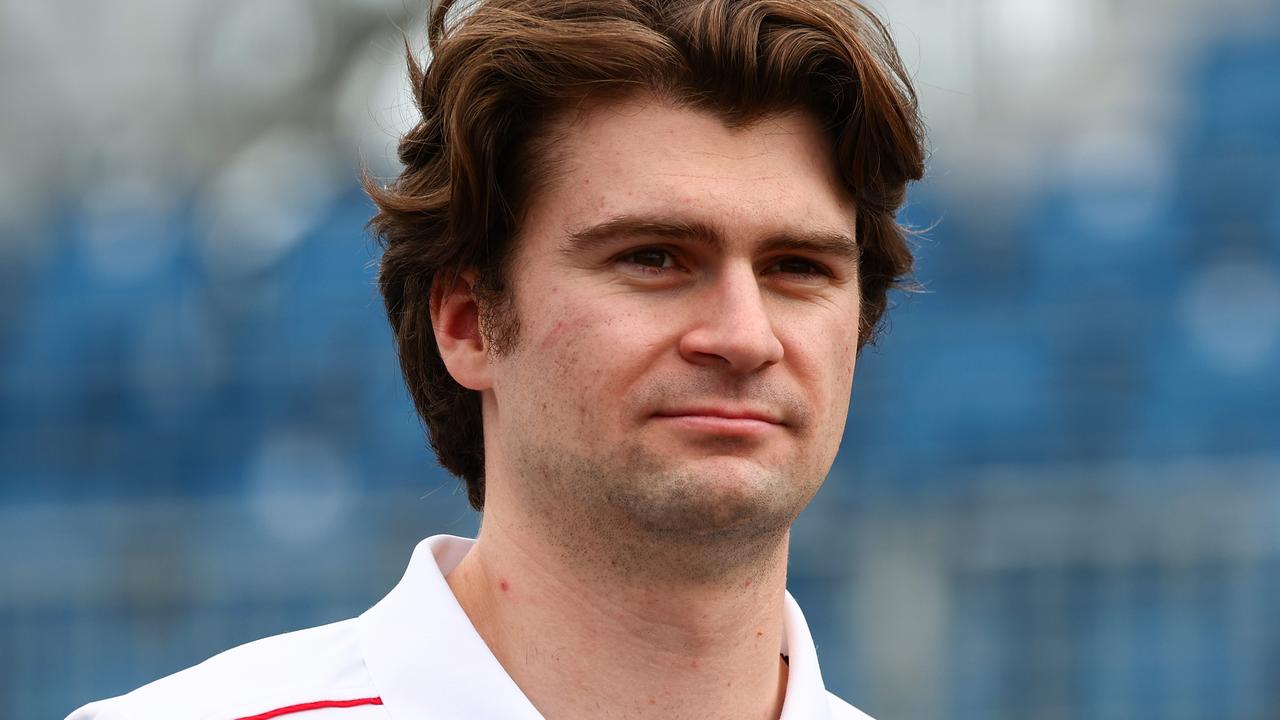
It’s what makes Colton Herta such a fascinating prospect. He’s giving up those comfortable domestic opportunities on exactly that gamble.
Alex Marquez wins as Marc crashes out | 01:40
Herta is an established IndyCar star. Clearly quick during his two years in the junior Indy Lights category, he had little trouble racking up nine wins once promoted to the main game, including a third-place championship finish in just his second full season and a runner-up result in 2024. He’s also a two-time class winner at the 24 Hours of Daytona.
But his motorsport career started in Europe. He was a multiple winner in his single seasons in British Formula 4 and Euroformula Open, finishing third in both championships. It was only when the money dried up that he returned to the United States.
But the Formula 1 dream has continued burning inside him, and Cadillac is now providing the fuel for that fire.
In pursuit of that dream, Herta quit IndyCar at the end of last season to race in Formula 2 with Hitech with the goal of reaching Formula 1.
At 26 years old, he’s effectively hit the reset button on his career.
“I think it’s great, what he’s doing,” Cadillac principal Graeme Lowdon tells Fox Sports. “Maybe it’s because I’m so old that I kind of hark back to the good old days, whether they existed or not, but I just love the fact that he’s taken a decision that a proper racing driver would take.
“When he announced the decision there were a few commentators who said it might risk his image or this, that and the other.
“If you’re bothered about just the image, just spend your whole time on social media and pictures of the gym or something like that and memes or whatever they are. But if you’re a proper racing driver — and I mean a proper racing driver — then this is the move that you would take.”
There are regulatory and practical reasons Herta hasn’t just turned up in Formula 1.
The first is that IndyCar isn’t sufficiently recognised by the FIA for him to have the requisite number of superlicence points to race in Formula 1, having not won the series championship. Formula 2 is rewarded far more generously as F1’s designated feeder category.
But it’s also recognition of how far apart the worlds of Formula 1 and IndyCar are that Herta sees F2 as a better apprenticeship than his successful domestic US racing career.
“He wants he wants to go into Formula 1, and if you want to be in Formula 1 it makes sense to look at that well-trodden path, and it’s well-trodden for a reason,” Lowdon continues. “The tyres are quite unique. The circuits are not ones that you get a chance to drive on — like Miami, Monaco, Melbourne. Also just getting used to the environment and the way things work — it is very, very different from IndyCar and everything around it as well.
“I take my hat off to him. If you want to do F1, I think he’s doing exactly what a proper racing driver would do, and I class him as a proper racing driver.
“He’s quick, and again, his attitude — the first thing he said to me when we discussed the F2 thing is it was very clear that he knew that that championship attracts very, very fast drivers. You don’t just go in and blow everyone away. That’s not the objective.
“The objective is understand the circuits, learn the tyres, understand the environment — how does the media work? — all that kind of stuff.
“And he’s a great guy as well. It’s really good to have him on the team.”
Marc Marquez goes off in a HUGE crash | 00:39
IS THIS AMERICA’S NEXT F1 DRIVER?
Herta was part of the Cadillac F1 team before it existed.
A protégé of Michael Andretti, he was the designated driver of the American motorsport mogul’s F1 ambitions, at the centre of which was a desire to promote young US talent onto the grand prix grid.
Andretti came close to buying the Sauber team ahead of the 2022 before the deal collapsed at the final moment, but the name recognition proved useful for Herta. He got a spin in F1 machinery after becoming a McLaren development driver — McLaren CEO Zak Brown and Andretti are business partners, including formerly in Supercars — and he was for a time on Red Bull’s radar until the FIA refused Herta a superlicence exemption.
But the Andretti connection did eventually bear fruit. When long-time Andretti sponsor TWG Global bought both Andretti’s IndyCar team and its F1 bid, which it owns jointly with General Motors, Herta had his in, and he was announced as Cadillac’s development driver late last year.
“Having the opportunity to try and get there and try to achieve that dream, that goal, of being a Formula 1 driver — I saw it as a great opportunity,” Herta told the Beyond the Grid podcast. “It was very easy for me to say yes to.
“It was disappointing to have those two instances where I thought maybe [I could make it]. Not so much on the Sauber one — I thought there was a chance with that one — but the AlphaTauri deal seemed very real to me, and then when that didn’t happen, I was like, ‘Look, okay, I’m kind of getting up there in age, probably won’t have another opportunity’.
“Then this came around and I was like, ‘Jeez, count my lucky stars’. This is an amazing opportunity.
“I’m fully focused on making this one the one that counts and works. I’m fully focused on trying to get here and dealing with my F2 career at the moment, trying to go through that side of things and learning as much as I can.”
As part of his development driver duties, Herta will get all four of Cadillac’s mandatory FP1 rookie slots, with his first scheduled for June’s Barcelona-Catalunya Grand Prix.
It’ll be a busy weekend for the Californian, who’ll also be in the thick of his fifth Formula 2 weekend this season, having opened his account in Melbourne with a seventh-place finish in the Sunday feature race after having started 14th on the grid.
It was a decent first weekend, but given the enormity of Herta’s objective, he’s keeping his feet on the ground and setting himself no concrete targets so early in his first campaign.
“Progression — that’s the biggest thing,” he said. “It’s great to finish seventh on Sunday, but progression and finishing inside the points as much as possible [is the aim].
“Eventually you want to get to the point where you win and you’re qualifying on pole. That’s every driver’s goal. What are you doing this for if it’s not to win. That’s obviously the main goal, but progression and learning would be a simpler goal.”
Though don’t take that for a lack of self-belief.
“I don’t think I’d be here if I didn’t think I could win or compete. That’s a huge part of any driver’s DNA. They are an arrogant breed, I would say. We also think we’re the best.”
Agius sets sights on MotoGP debut | 04:19
WHAT ARE THE ODDS?
There are only 22 people on the planet at any one time who can call themselves a Formula 1 driver. Herta might be talented — he might be more than talented enough to qualify for a chance — but breaking into that elite 22 requires as much circumstance as it does ability.
His arrival in F1’s orbit is at a potentially awkward time.
This year as many as 17 drivers could be out of contract or have access to favourable exit clauses.
But that means almost all the grid is almost certain to be locked in over the 2027–28 driver market period, when Herta is most likely to be looking for a way in.
Drivers out of contract in 2026
Mercedes: George Russell, Andrea Kimi Antonelli
Ferrari: Lewis Hamilton
McLaren: none
Haas: Esteban Ocon, Oliver Bearman
Alpine: Franco Colapinto
Red Bull Racing: Isack Hadjar
Racing Bulls: Liam Lawson, Arvid Lindblad
Audi: Nico Hülkenberg, Gabriel Bortoleto
Williams: Alex Albon, Carlos Sainz
Cadillac: none
Aston Martin: Fernando Alonso, Lance Stroll
The above list assumes the increasingly favoured ‘multi-year’ contract lasts two seasons unless the length of the deal has been subsequently confirmed.
Drivers with reported exit clauses
Ferrari: Charles Leclerc (contracted until 2029)
Red Bull Racing: Max Verstappen (contracted until 2028)
The general rule of Formula 2 is a driver is allowed only two seasons to stake a claim for F1 promotion. Without extenuating circumstances, a driver who needs three seasons to win the championship is considered not good enough for a shot at the elite level.
Unpacking new F1 rule changes | 04:46
Of course Herta’s situation is unique both as a driver with a very different background to his F2 rivals but also with years-long backing from the company that owns and operates the Cadillac team — though that could either reframe his results more favourably or leave him with even less slack than expected given his IndyCar pedigree.
But that two-year window would appear to put him into the market when there are unlikely to be many seats available.
Cadillac, though, is one clear exception to that rule.
Both Valtteri Bottas and Sergio Pérez have been hired specifically because their combined 26 seasons of experience are seen as critical to accelerating the team’s development.
“Right from shakedown onwards we had super accurate feedback, focus on all of the right things,” Lowdon says. “They’re saying all the right things to the engineers.
“In certain areas of our engineering team we’ve got a mix of experience but we’ve also got a lot of quite young people as well, and the drivers have really played their part in gelling that engineering team together. I couldn’t ask for anymore from both of them.”
It’s also clear that both drivers are committed to their comebacks after a season on the sidelines; this isn’t just one last pay slip for either.
“They had the two attributes that are needed: one is experience, but secondly, both demonstrated desire,” Lowdon continues.
“The reaction of both drivers when we told them that we wanted to sign them for me was really quite important, and in both cases the reaction was kind of the same reaction — as if when you tell a guy in F2 that they’re going to get a drive: it was excitement, enthusiasm, commitment.
“Once I saw that, I knew we were going to be in a good place with both drivers.”
Both drivers will be difficult to unseat, particularly if their labour begins paying dividends in the form of improved results next season.
But Cadillac wants to complete its project with an American driver, and if Herta does the business in Formula 2, it will be difficult to argue against giving him a crack given his career standing, given his sacrifice in returning to Europe and given his own commitment to the project.
Both Bottas and Pérez will know that uncomfortable truth in the back of their heads as 2026 turns to 2027.
It’s too early to say whether Herta will put the team in that position, but more than 15 years after Formula 1 looked all but dead in the United States, he could be the final piece in its resuscitation.