
Everything is amped up in the Stanley Cup playoffs — excitement, tension, concern and, most of all, drama.
That is even more true with five teams pushed to the brink of elimination. Those teams no longer have the luxury of brushing off a loss and reloading for the next game. One mistake could mark the end of the season.
So how worried should these teams be? It’s time to dust off the Concern-o-Meter™.
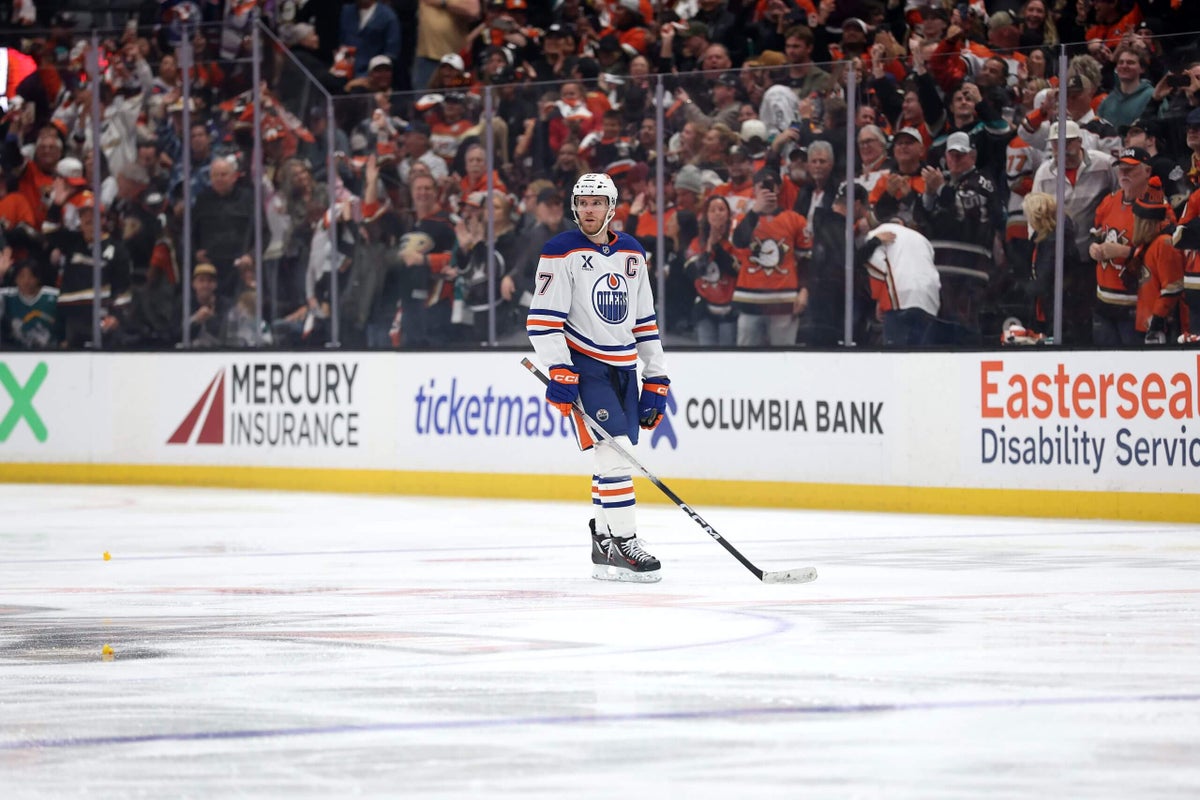
Edmonton Oilers
Concern-o-meter: 9/10
The Oilers of the last few seasons have proven one thing: The regular season doesn’t matter that much once the playoffs begin. This team knows how to flip a switch and dig in when the pressure rises. Any concerns should be tempered until this team finds itself up against it in the postseason.
Unlike the past two years, it took only four games to reach that point.
It didn’t seem like that would be the case after Game 1 — not after the Oilers won their first game all season without Connor McDavid getting on the scoresheet. The return of Leon Draisaitl helped Edmonton play spoiler in the final two minutes of regulation to steal the first win of this series.
And then the Ducks bounced back and started beating the Oilers at their own game.
This series was always going to be a race to see who could outscore their problems. As much promise as the Ducks’ up-and-coming core showed this year, the team defense has been an outright disaster. Edmonton, at least, cleaned up its defensive zone coverage with the return of Paul Coffey behind the bench, which seemed like enough to give its shaky goaltending some help.
But in Games 2, 3 and 4, the Oilers couldn’t even string together semi-competent defense in front of Connor Ingram or Tristan Jarry.
Connor McDavid looked ordinary at best, clearly hampered by his injury. The Jackson LaCombe matchup shut him down even more. Draisaitl’s line couldn’t carry this team enough to counter a Ducks offense coming in waves, all the way down to its pesky fourth line. Anaheim’s dangerous power play poured on the scoring, too. So, heading into Game 5, the Oilers looked totally outmatched.
Edmonton thrives under pressure and responded with a strong start led by the ‘in case of emergency’ top-loaded line of Draisaitl and McDavid, who looked much more active despite his injury. This is a battle-tested team that has fought back from even more daunting deficits, like being down 3-0 in the Stanley Cup Final just two years ago. So after Game 5, there is reason to think this group could battle back against an inexperienced Ducks team.
Still, the big picture is sounding alarms on the concern-o-meter. What would be worse than a Round 1 elimination? Management chalking up the early exit to fatigue from two deep runs and injuries to McDavid, Draisaitl, Zach Hyman, Jason Dickinson, and Adam Henrique, among others.
That would actually be the worst-case scenario if it led to another misguided offseason that leaves the team in the same position (or worse). The reality is the clock is ticking on the McDavid era. He opted against a long-term deal, instead signing a two-year contract that keeps his options open in case the team takes a less-than-inspiring direction. Since signing that deal, management has mismanaged the cap and limited trade assets, while leaving gaping holes that landed this team in a 3-2 hole.
There’s a lot more riding on this series than just the Oilers’ season ending early at this point.
Boston Bruins
Concern-o-meter: 8/10
Jeremy Swayman can steal a few games, but he can’t win a playoff series single-handedly.
Swayman has given his team a chance to win with four quality starts in six outings. And his last outing, where he saved 2.62 goals above expected, literally saved Boston’s season. The Bruins don’t just have the best goaltender in this series; they have one of the best in the entire league.
And yet that hasn’t been enough so far. Swayman needs some help on the other end of the ice.
He can be a difference-maker even without much defensive help. Defense and footspeed were always potential weaknesses for Boston in this matchup. The Sabres are one of the faster teams in the league and have used that to their advantage in this series. Just take Game 4, when Buffalo pushed the Bruins to the brink. The Sabres played to their strengths early, using their speed and pressure to force turnovers — three of which led to first-period goals, which absolutely crushed Boston early.
The problem is, the Bruins haven’t converted on chances enough to counter that. Add in some mistake-riddled performances from some of their key players across this series — from Hampus Lindholm, Elias Lindholm and even Charlie McAvoy at times — and it added up to a 3-1 deficit heading into Game 5.
Boston’s best stood tall to force a Game 6. Swayman was outstanding, and David Pastrnak came through with the overtime game-winner to keep the season alive.
There is a real opportunity to build some momentum from that. After some lineup tweaks for Game 5, the Bruins did a much better job getting to the net-front areas and making life hard on Alex Lyon. Add in Noah Östlund’s Game 4 injury, and how that could unravel the progress the Sabres’ power play was making, and there is an opening here for Boston to take advantage of.
There is just so little margin for error, even with Swayman in net. Winning one game while facing elimination is a challenge. Pushing that momentum to three straight is even more daunting against a team that has won games in different ways so far. But the Bruins have been nothing if not a streaky team this year, so there is a slim opening to make things interesting.
Tampa Bay Lightning
Concern-o-meter: 7/10
This series has been as back-and-forth as it gets, with Montreal and Tampa Bay trading one-goal wins through five games. Each time the Lightning have trailed in this series, they have responded to even things back up.
There is reason to think the Lightning can pull that off once more to stave off elimination and extend the series. Naturally, it revolves around Tampa Bay’s elite talent and experience in these situations. At times in this series, the Lightning have taken over games and looked like the more seasoned team built for this — overtime in Game 2 was the prime example of that.
But Tampa Bay has looked a step behind even more often, controlling just 46 percent of the xG share. Surprisingly, it’s not the Lightning’s defense holding them back. The Canadiens, even without Noah Dobson, have suppressed the Lightning’s dynamic offense to just 1.72 xG per 60. A lot of that falls on the top of the lineup.
Nikita Kucherov has had his moments, but hasn’t hit his top gear. He wasn’t as crisp on the power play in Game 5, where Tampa Bay has done a lot of damage so far. Kucherov didn’t convert on his chances at even strength, either, like an early third-period chance that would have pulled the Lightning ahead.
Brayden Point hasn’t been at top speed. Neither has Andrei Vasilevskiy, whose playoff lore is starting to fade.
The Canadiens’ top liners may not be at their usual offensive heights in this series, but at least they’re getting production elsewhere. Jake Guentzel and Brandon Hagel are pulling their weight for Tampa Bay, and Dominic James stepped up in Game 5. But the fourth line hasn’t been on the ice for a single goal for this series, while Montreal’s has come up clutch to give the team a more balanced approach than expected.
A return from Victor Hedman still seems unlikely, so the Lightning will have to find a spark from within. Otherwise, this team will be looking at a fourth straight Round 1 exit. At this point, it doesn’t matter how successful this team is in the regular season if it doesn’t translate to a deep run; the pressure is on to change that because this core isn’t getting any younger.
Dallas Stars
Concern-o-meter: 6.5/10
Jake Oettinger tends to shoulder a lot of the blame for the Stars’ shortcomings. His playoff history and tendency to let up weak goals do raise some red flags. Just take Michael McCarron’s third-period goal that ended up as the game-winner for Minnesota in Game 5.
Oettinger hasn’t been sparkling this spring, but he isn’t the reason the team is in this position. It’s the fact he doesn’t have goal support at five-on-five.
It’s a familiar position for Dallas, which only mustered 1.69 goals per 60 at five-on-five last year and let the power play do a lot of the heavy lifting. This year, the Stars’ pace is even lower at 0.67 per 60.
Dallas has only mustered three five-on-five goals (while giving up 11). For context, that’s as many goals as the Senators scored on their way to a Round 1 sweep, and only one more than the Kings tallied.
The Stars, at least, have had a ton of power-play success, with nine goals so far. And those scoring woes aren’t for a lack of trying, with shot quality that adds up to 10.3 xG. That shakes out to 2.31 per 60 when accounting for minutes played, which isn’t a dominant mark this postseason, or equal to what the team generated in the regular season. It is a shade above the Wild, though, without results to show for it.
Jesper Wallstedt has a lot to do with that. But so do some disappointing performances, which start at the top of the lineup. Wyatt Johnston, one of the Stars’ best scoring chance generators, only has one goal this spring. Mikko Rantanen has yet to tally a single point at five-on-five, has a team-low 37 percent xG rate, and has been outscored 4-0 in his minutes.
And the depth isn’t scoring enough to make up for it. Some of that’s due to injury; with Roope Hintz out for Game 6 (and likely 7), it forces Matt Duchene into the top six, leaving the bottom six extremely short-handed offensively.
A few things save Dallas from a higher reading on the meter. This was always going to be a long series, and this team is built for that. Jason Robertson has been a total standout for Dallas, plus Rantanen has that Big Game Ability (and showed it just last spring). Pair that with the Jonas Brodin injury leaving Minnesota’s blue line short-handed, and there is a path to extending this series.
Utah Mammoth
Concern-o-meter: 6/10
Just when it seems like Utah has some momentum, Vegas finds a way to turn the tide. Game 5 was the prime example of that.
The Mammoth’s speed was once again a problem for the Golden Knights in the third period. First, when Dylan Guenther and Kailer Yamamoto turned on the jets in the neutral zone and sped down the ice to score in transition. Then, about seven minutes later, when Alex Kerfoot sent Michael Carcone a cross-slot pass to set up another rush goal.
It wasn’t just those two-on-one sequences that gave Utah the edge in the third period. It was how the Mammoth disrupted the Golden Knights’ ability to get set up in the zone or get many looks from their forwards.
But Pavel Dorofeyev’s third goal of the game played spoiler to force overtime. Those extra frames were where things started to get dicey for the Mammoth, who started to look gassed as time rolled on into double overtime. The Golden Knights, despite all their footspeed issues, have experience in these types of games. So despite showing a lot of resilience in regulation, the Mammoth fell short for the second straight game. Now they’re facing elimination.
Utah’s power-play struggles add another level of concern to the situation. While there are generally fewer penalties called late in series (and rounds), the Mammoth still need to find a way to take advantage of their opportunities — especially if they are going to keep giving their opponent chances to get their power play back on track. Not only did Utah fail to convert on five opportunities in Game 5, the team has now been outscored 2-1 on the man advantage this postseason after Brett Howden’s short-handed game-winner.
Concern is officially brewing in Utah now that the Golden Knights have the momentum. But there are ways to make this a series: sticking to that speed game clearly exposes Vegas, and the goaltending has been below average. If the Mammoth can stop getting caught puck-watching and tighten up a little more defensively, this could go seven games.
The difference here between Utah and some of the other teams facing elimination is that this is the start of the Mammoth’s playoff window, and this being such an even series shows how much this team has grown. Any sort of elimination would obviously be a disappointment, but this dynamic core has an exciting future ahead.
Data via Evolving-Hockey, HockeyViz, HockeyStatCards, All Three Zones, HockeyStats and Natural Stat Trick. This story relies on shot-based metrics; here is a primer on these numbers.