
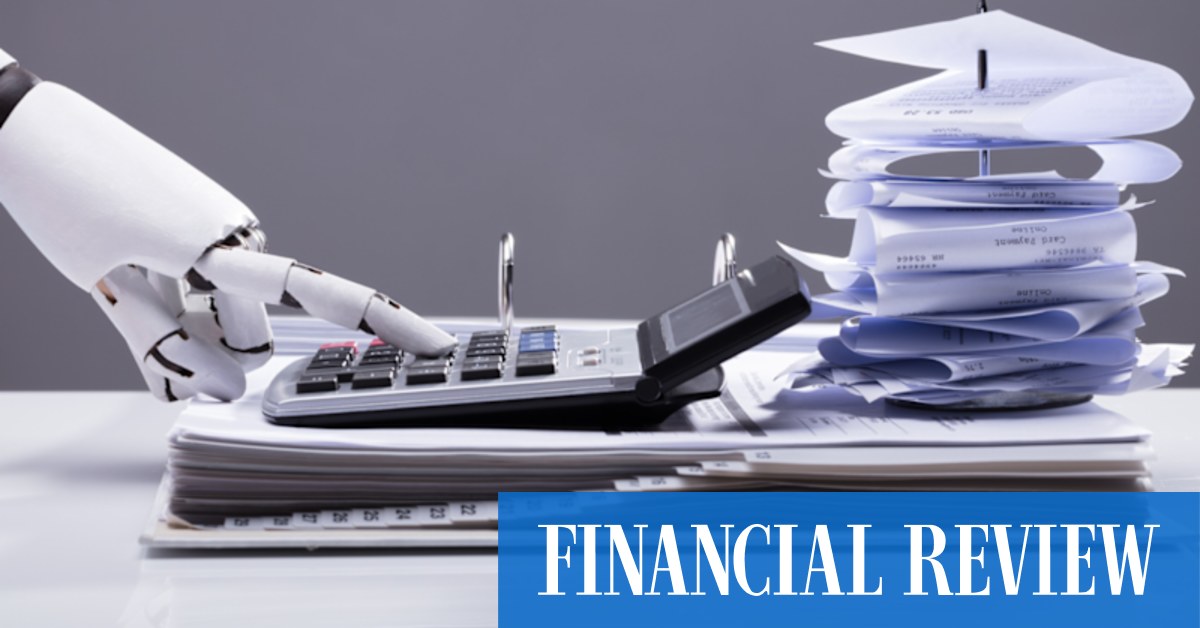
“AI is the biggest shift in the history of modern business,” says Paul Robson, CEO of MYOB. “It’s not just changing the way we engage with our customers; it’s changing the way we build and operate our own company as well as the way that SMEs run their businesses.”
Earlier transitions, such as the move to cloud computing, altered how software was delivered and consumed. Artificial intelligence goes further, extending what software can do.

MYOB CEO Paul Robson.
“Software has traditionally automated parts of a task, but stopped where human judgement was still required,” Robson says. “AI is changing that boundary, reshaping how decisions are made within the workflow itself.”
This raises the stakes for technology incumbents. Adapting is not simply a matter of adding new features, it requires a rethink of how products are designed, how organisations operate and how value is created. Companies that have built their position on stable, repeatable models are now being challenged at their core.
“You have to have a mindset that is willing to embrace change,” Robson says. “You have to have a business that is resilient enough culturally and willing to disrupt itself.
“There will be winners and losers in the world of AI.”
For customers, the most visible difference is interacting with systems that record activity to systems that participate in it. Accounting software has traditionally generated financial statements or tracked transactions, with interpretation left to business owners, accountants and advisers.
“An accounting system can provide data, but you still need someone to analyse that data and provide direction,” Robson says. “Artificial intelligence extends that workflow, allowing software to move beyond recording and into execution. This enables businesses and their advisors to make better-informed, more timely decisions.”
That shift is reshaping where value sits. Competitive advantage is increasingly tied to where a company operates within the workflow and the data it controls.
“If you’re a software business that works on a data asset that is proprietary and you’re at the start of the workflow, you have a tremendous opportunity,” Robson says.
For accounting and business management platforms, that starting point is often the creation of invoices, the recording of expenses and the reconciliation of transactions. These activities generate a continuous stream of financial data that can be extended into reporting, compliance and decision support, reducing the need for manual intervention as work moves through the system.
“This isn’t SaaS being disrupted by AI; it’s SaaS rebuilt with AI at the core.”
Rita Hanna, a MYOB customer who has operated across service and hospitality sectors, says that evolution is already changing expectations.
“My expectations have shifted from software being a passive record-keeper to an active co-pilot,” she says. “In my previous businesses, software was something you fed data into. Now, I expect the software to feed me insights.”
That change is also reshaping how time is allocated within a business.
“Instead of starting my day buried in what happened yesterday, I can start by looking at what is happening today,” Hanna says. “Automation handles the foundational busy work, which allows me to remain lean and fast.”

Courier Rita Hanna.
For smaller operators, the impact can be disproportionate. Removing manual processes does not just improve efficiency, it changes what a business can do with the same resources.
“Automation is the great equaliser,” Hanna says. “Business owners who implement AI to automate their admin will have the headspace to innovate and pivot. Those who don’t will be left behind.”
Delivering that outcome depends on extending workflows from start to finish rather than addressing isolated tasks.
A single workflow can take an invoice or expense, match it to the bank account, post it to the general ledger, and then automatically generate and prepare the required reports,” Robson says. “Point solutions that target part of that workflow don’t necessarily add holistic value.”
That requirement is also reshaping how software companies operate internally.
“At MYOB we talk about toolset, mindset and skillset. Do we have the right toolset in the business? Do we have the right mindset at the leadership level? And do we have the right skillset to use those tools?” says Robson.
“If technology businesses want customers to feel the real impact of AI, they have to change from the inside out – you only get standout AI experiences when you transform the business behind them.”
Partnerships are playing a role in accelerating that shift. MYOB’s five-year strategic partnership with Microsoft is designed to support the development and scaling of AI capabilities, combining access to global models and engineering expertise with local data and workflows.
As Hanna points out, as artificial intelligence becomes embedded in core systems, the transition from a system of record to an orchestrator of action is no longer theoretical. It is beginning to reshape how businesses operate and fundamentally alter how they compete.
To find out more, please visit MYOB.