
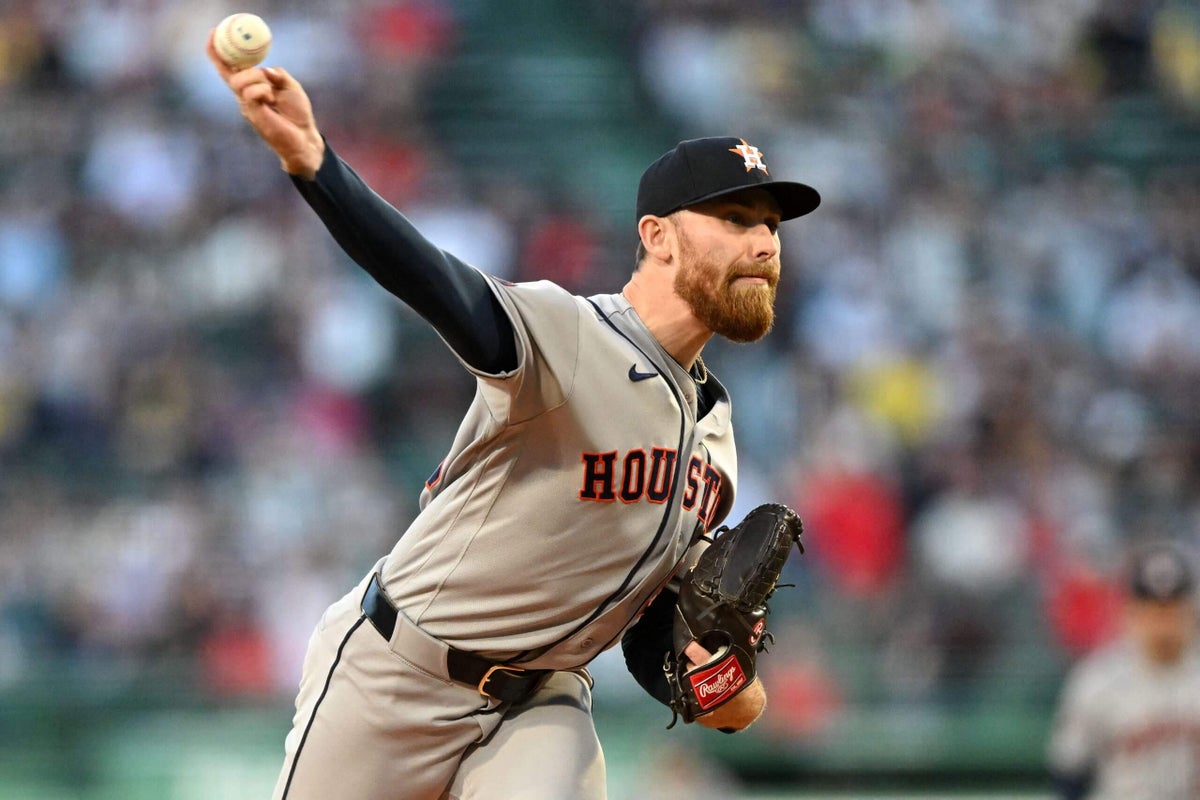
BOSTON — This is no time for nuance, not when the Houston Astros are staring down a spiral and sporting the American League’s worst record. A pivotal piece of their star-crossed starring rotation may be the unluckiest man in the major leagues, but baseball is a bottom-line business that recognizes results, regardless of how they’re reached.
So, 5.97 is the only number that matters for Mike Burrows. Of the sport’s 73 other qualified starters, only Michael Lorenzen awoke on Friday with a higher ERA — and he pitches his home games at Coors Field for a team that is not constructed to win.
Burrows, however, pitches for a team with championship expectations but which is now careening toward disaster. Blaming him for the brutality is unfair. So is absolving Burrows of any altogether. Underlying metrics may paint a more favorable picture of Burrows’ poor performances, but the Astros aren’t going to author a turnaround from speculative statistics.
“At the end of the day, the (numbers are) the ones that are on Baseball-Reference or whatever,” Burrows said after his April 25 start against the New York Yankees, during which he allowed two earned runs over five innings while striking out eight. “It’s nice to know, but it doesn’t really make up any ground for me.”
Burrows is one of six additions from general manager Dana Brown’s pitching-focused winter. The five who’ve appeared in a game have combined for a 5.99 ERA. Burrows is the only one who hasn’t switched roles, been placed on waivers or gone on the injured list, making him a model of consistency in this otherwise catastrophic circumstance.
Burrows has thrown more innings than any Astros pitcher. That he sports an ERA nearing six underscores the state of a pitching staff being sabotaged by both itself and some brutal baseball luck. No American League staff entered Friday with a higher batting average on balls in play than the Astros’ .319 mark.
Burrows himself has a .373 BABIP. Only Philadelphia Phillies left-hander Cristopher Sánchez has a higher one, among qualified starters. Philadelphia, ironically, is the only pitching staff with a higher BABIP than Houston’s. In six of Burrows’ seven starts, opponents have averaged lower than a 92 mph exit velocity. Anything over 95 mph is considered “hard-hit.”
Opponents are still slashing .318/.379/.519 against Burrows. The .898 OPS he is allowing trails only Lorenzen for the highest in the sport. Those are the marks that matter for a team nine games below .500 and searching for any sort of stability within its starting rotation.
Burrows still may be the person to provide it. By removing ballpark and defense factors, Baseball Savant calculates expected statistics based on just the quality of contact a pitcher surrenders.
Among pitchers that entered Friday with at least 100 plate appearances taken against them, Burrows had the biggest gap between his expected slugging percentage and actual slugging percentage. Ditto for the disparity between Burrows’ weighted on-base average and his xwOBA.
Mike Burrows’ Bad Luck
Actual Stats
Expected Stats
Difference
.315 BA
.241 xBA
.074
.523 SLG
.393 xSLG
.130
.357 wOBA
.311 xwOBA
.046
6.25 ERA
3.85 xERA
2.40
Stats above are through his sixth start, against the Yankees on April 25.
Only two pitchers had a wider chasm between their ERA and expected ERA, and only one had a larger contrast between batting average and expected batting average.
“It’s a humbling game,” Burrows said. “You can do everything right and still, stuff happens.”
The team has lost six of Burrows’ first seven starts, but has scored only 20 runs in support of him during those seven games. For an offense averaging an American League-best 5.12 runs per game, it is an obvious outlier.
Pitching with a minuscule margin for error has magnified Burrows’ misfortune. He carried a perfect game into the fifth inning on April 19 against the St. Louis Cardinals, but did so with just a 1-0 advantage. Two singles that traveled a total of 19 feet — sandwiched around a walk — ended the bid for history.
Issuing a bases-loaded walk afterward tied a game that Houston went on to lose. That is a self-inflicted struggle, which Burrows is still prone to despite his dreadful luck. He boasts one of the sport’s most hittable four-seam fastballs — a problem that plagued him last season in Pittsburgh and has not improved in Houston.
According to Baseball Savant, Burrows’ four-seamer entered Friday with a minus-6 run value. Only four qualified pitchers have a worse mark. One of them is teammate Ryan Weiss, another of Brown’s pitching imports this winter.
Five of the eight home runs hit against Burrows have come against his four-seamer. Before he even arrived in Houston, Burrows planned to throw his sinking two-seam fastball more often in hopes of getting hitters away from the four-seamer. He has followed through, but is seeing similar results.
Perhaps that is to be expected for a pitcher still young in his career, adjusting to a new team. Part of the allure in acquiring Burrows was his six years of team control, making him a possible pillar for future Astros rotations. Injuries have increased Burrows’ importance to this one.
Brown did not acquire Burrows to be an ace. Even envisioning him as a top-of-the-rotation starter felt far-fetched, especially for someone with 99 1/3 innings of major-league experience before his arrival. A superb spring training skyrocketed some expectations, but the beginning of this season accentuates the silliness of taking Grapefruit League play seriously.
Flashes of potential still appear. Burrows’ past three starts showcase that. Team officials have helped him improve his direction to home plate and given some tips on better pitch sequencing. Burrows even spun his first quality start of the season on Friday night at Fenway Park, but even then fell victim to what has plagued him all season.
Burrows began the third inning by issuing an 11-pitch walk to Boston catcher Carlos Narváez. Nine-hole hitter Chad Durbin followed by bouncing a neck-high slider up the middle. The bleeder exited Durbin’s bat at 80.6 mph, dribbled past the pitcher’s mound and between two converging middle infielders.
“You try to make a pitch to get that double play and then it just squeaks in a spot where nobody is,” Burrows said.
Three pitches later, leadoff man Jarren Duran destroyed Burrows’ biggest mistake. The hanging curveball landed somewhere in the right-field seats. Houston’s lineup mustered nothing in the next seven innings, making Duran’s three-run home run enough to sink a pitcher searching for something to go right.