
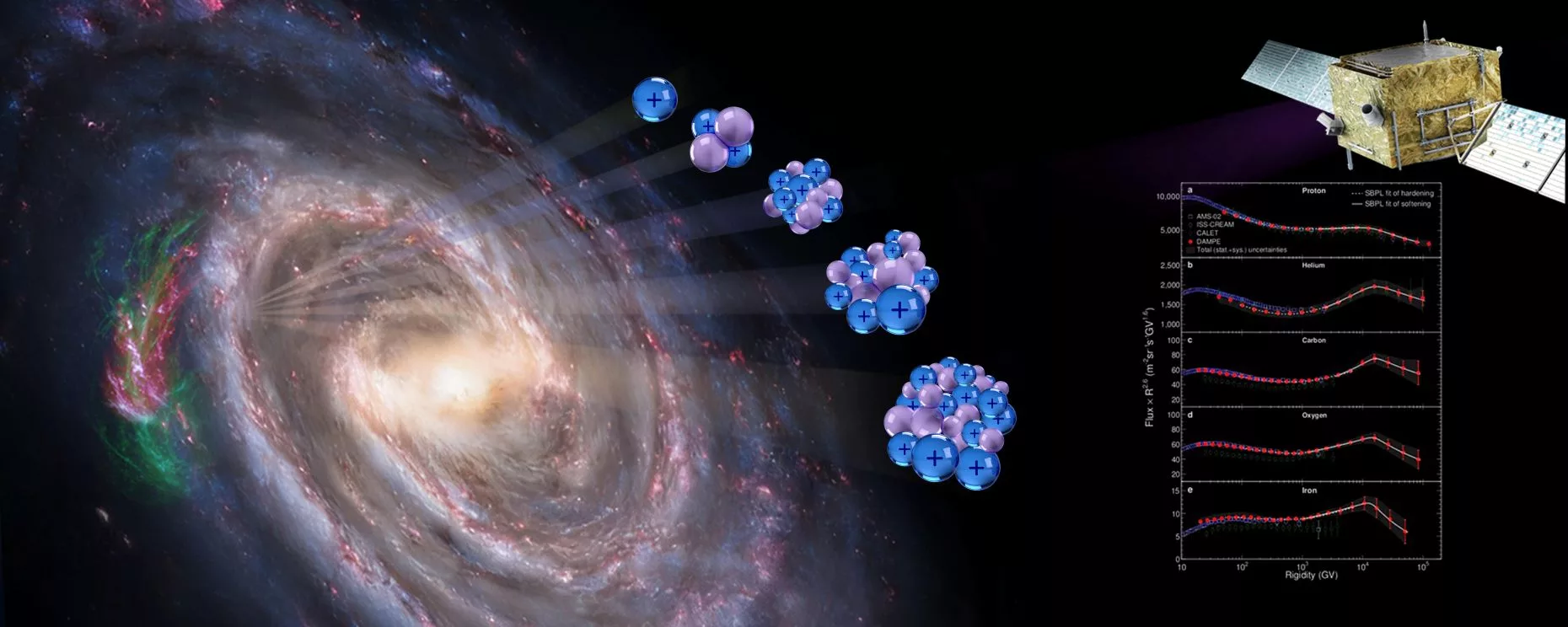
In most theories regarding particle acceleration and propagation, prominent features in cosmic ray spectra (e.g., acceleration limits or changes in spectral slope during travel) are assumed to be sensitive only to a particle’s electric charge. Another possible explanation is that these features instead depend on the particle’s mass.
Until now, it has been difficult to gauge which pattern nature follows, mostly because measuring the spectra of single particles at extremely high energies is very hard. It was like a cosmic telescope, the DAMPE (Dark Matter Particle Explorer), which examines the heavens to see whether those bizarre bends and breaks in cosmic ray spectra might be due to dark matter itself.
In short, the task of DAMPE is to perform a box-office test: whether known forces control cosmic rays or whether dark matter has an elusive effect on them.
Direct measurements of the energy spectra for carbon, oxygen, and iron cosmic rays from 20 gigavolts to 100 teravolts (and up to 60 teravolts for iron) are published in a new study. It is the result of nine years of continuous observations from the DAMPE space telescope.
Precise measurement of the energy spectrum of cosmic-ray helium nuclei
Across all the nuclei studied, the researchers observed a steep decline in particle counts above a threshold energy. This accelerated drop, also called “spectral softening,” means that, in general, particle numbers decline more rapidly. Still, the sort of fall inside a rigidity of about 15 teravolts (TV) has been considerably larger than just before.
Rigidity measures the extent to which a particle resists deflection in magnetic fields. That this spectral feature consistently appears at the same rigidity, independent of nucleus type, strongly favors rigidity-dependent cosmic-ray acceleration and propagation models. In contrast, models that focus on the energy per nucleon are safely excluded with a confidence level of ≈99.999%.
Andrii Tykhonov, associate professor at the DPNC in the Faculty of Science at UNIGE, and co-author of the study, said, “Cosmic rays are primarily composed of protons, but also of helium, carbon, oxygen, and iron nuclei. These particles are also categorized according to their energy: low, up to a few billion electron-volts; intermediate, from a few billion to several hundred billion electron-volts; and high, from 1,000 billion electron-volts and beyond.”
The team based in Geneva played a key part. Data is analyzed using the above techniques, and researchers are continually detecting events with DAMPE, helping to obtain key measurements of proton and helium fluxes, as well as carbon spectra. What is more, they were at the helm of designing one of the most important instruments on DAMPE, the Silicon‑Tungsten Tracker (STK), a sub-detector essential for accurately tracing particle paths and charge.
Something is keeping cosmic rays out of the Milky Way’s center
These results mark crucial progress in uncovering the origins of cosmic rays and the processes that govern their evolution throughout our galaxy. They provide up-to-date experimental constraints that refine models of particle acceleration in astrophysical sources and their propagation through the interstellar medium. Together, these results lead to a clearer, more refined description of high-energy particle populations in the universe.
Journal Reference:
The DAMPE Collaboration. Charge-dependent spectral softenings of primary cosmic rays below the knee. Nature (2026). DOI: 10.1038/s41586-026-10472-0