
Welcome to the Antonelli History Column, where a 19-year-old sets new Formula 1 records every weekend.
Andrea Kimi Antonelli, Formula 1’s youngest ever championship leader, just can’t help but break new ground in grand prix racing.
On Saturday he became only the third driver in history — after Ayrton Senna and Michael Schumacher — to claim his first three pole positions in succession.

Fox Sports, available on Kayo Sports, is the only place to watch every practice, qualifying session and race in the 2026 FIA Formula One World Championship™ LIVE in 4K. New to Kayo? Join now and get your first month for just $1.
“I feel stronger and stronger every time, more in control of the situation,” he told Sky Sports.
“Overall it was a strong race, and I’m happy that we brought it home.”
It wasn’t a straightforward afternoon, but Antonelli has been making a habit of winning under duress.
He lost places off the line again and was running second behind Lando Norris for most of the opening stint until a perfectly executed undercut — by both team and driver — got him crucial track position.
His job was then to absorb Norris’s pressure while dealing with a “wheel connectivity issue” that disrupted his gear shifts to grind out a narrow victory.
“Leading with someone really putting pressure on you from behind, particularly at the beginning of the stints with Norris, and then sustaining this pressure and being able to drive away is really a great, great character trait that he has — among many,” Toto Wolff told Sky Sports.
READ MORE
‘Oh my god!’: Last-ditch Piastri stunner as title statement sent in Miami chaos
‘Definitely’: Piastri reacts to big McLaren shift… and verdict over ‘crazy’ F1 controversy
‘F***’s sake’: Norris left fuming over costly Miami call as ‘gutted’ star throws team under bus
Andrea Kimi Antonelli, Formula 1’s youngest ever championship leader, just can’t help but break new ground in grand prix racing.Source: AFP
“[He has] the speed, and now add to that more experience, I think we’re talking about lots of success in the future.
“I hope he can continue on this positive slope, but most important is not to be carried away. We have a good car … but he is a fierce competitor.
“It’s just important to keep both feet on the ground.”
You get the sense that Wolff will be preaching caution after many more races this season — until eventually the caution become unnecessary.
The plaudits are nice, but the points are more important.
Antonelli’s victory has put him 20 points clear of the field — and of anonymous teammate George Russell, who toiled to fourth.
It’s a handy buffer as rival teams begin closing the gap, with Russell’s lacklustre result demonstrating how having more drivers in the mix — regardless of whether they’re victory contenders — can punish whichever Mercedes driver is second on any given weekend.
It’s far from the Mercedes dynamic we expected this season. It’s now up to Russell to respond.
STRATEGY CALL DECIDES THE RACE
There was a moment deep in the first stint of the race that Norris seemed to have victory in his grasp.
He’d passed Antonelli for second place in the opening laps and then pounced on Leclerc after the safety car restart. The McLaren car looked much more convincing in race trim than it had during qualifying, and the clean air ensured he could set his own pace without stressing the car or tyres.
On lap 21 his margin over Antonelli reached 3.1 seconds. With the pit stop window looming — Russell had just taken his service to start the sequence — it was up to McLaren to cash in.
But McLaren allowed Mercedes to take the initiative by stopping Antonelli first, on lap 26, to get the undercut advantage, and Norris rejoined the race in net second place when he responded on the following lap.
“It was a brilliant move from the strategy team back in Brackley and also here,” Wolff said. “Quite risky [given the gap], but then the stop was perfect, the out-lap was great.”
While the undercut proved powerful, the lap data shows how Antonelli executed.
On the lap before his stop, he was 2.14 seconds adrift.
His in-lap was 0.62 seconds quicker.
His pit stop was 0.437 seconds faster.
But his out-lap did the damage. From turn 1 after leaving the pits until the moment Norris hit the brakes to enter pit lane in response, Antonelli gained 1.9 seconds.
It means just in this pit stop sequence he gained around 2.9 seconds on Norris, who rejoined the race fractionally behind, deciding the outcome.
Lando Norris was furious he was udnercut by Antonelli.Source: AFP
“We should have boxed first, it’s as simple as that,” Norris lamented to Sky Sports. “I don’t know if my stopping 0.2 seconds quicker would have helped.
“I think we just have to be honest and say we should have boxed before. We shouldn’t have been waiting.
“He was quite a bit quicker at that point of the race. I told the team I didn’t quite have the pace compared to him at that point, and we didn’t really seem to do a lot about it.”
Though Norris walked back slightly from calling it a lost victory, it was clear from his demeanour that he thought more was on the table.
“We could have fought for it more,” he continued.
“His pace was better than us today. I don’t know if he still would have come out behind me and maybe still would have overtaken me, but we could have done more to defend for the win today.
“We need to review some things and what we could have done better.”
WHY DID McLAREN NOT PIT?
The Miami Grand Prix took place in unusual circumstances — three hours ahead of schedule owing to a dire thunderstorm forecast that could have seen the race not run at all.
The circuit had got a taste of the deluge early in the morning, when warning messages blared around Hard Rock Stadium urging people to take shelter as a wave of storms rolled in.
The window selected by the FIA was perfectly timed, with the rain holding off long enough for the race to get underway in the dry, but the worst of the weather was still coming, and the threat of rain clearly influenced strategic decision-making for some.
McLaren signalled early that it wanted to extend the first stint of both drivers in the hope that, if wet-weather tyres were required, Norris and Piastri could make them their first stop. Instead it left Norris vulnerable to the undercut.
“When it’s so close, it’s a matter of execution sometimes. It’s a matter of details,” McLaren principal Andrea Stella told Sky Sports.
“We had an opportunity to win, 100 per cent. We were chased by a car that was a little bit faster than us. We were monitoring the weather at the same time, and when Kimi pitted, his out-lap was just mega. We couldn’t match it with our performance on the in-lap.
“We could have done better.”
These sorts of crunch strategy calls are a persistent McLaren weakness, at least in relative terms. We saw several fumbles last year, often under internally generated pressure but later under pressure applied by Verstappen and Red Bull Racing.
In Miami it allowed Mercedes to put it under pressure, and it erred.
It’s perhaps the only blind spot in an otherwise dependably high-performing set-up, but if the frontrunning group is to be as close as it looked in Miami, it could be decisive.
As tends to be the way with these things, not only was the race completed in the dry, but the forecast deluge during the original race window didn’t manifest either.
Despite the disappointment, this was a meaningful weekend for McLaren.
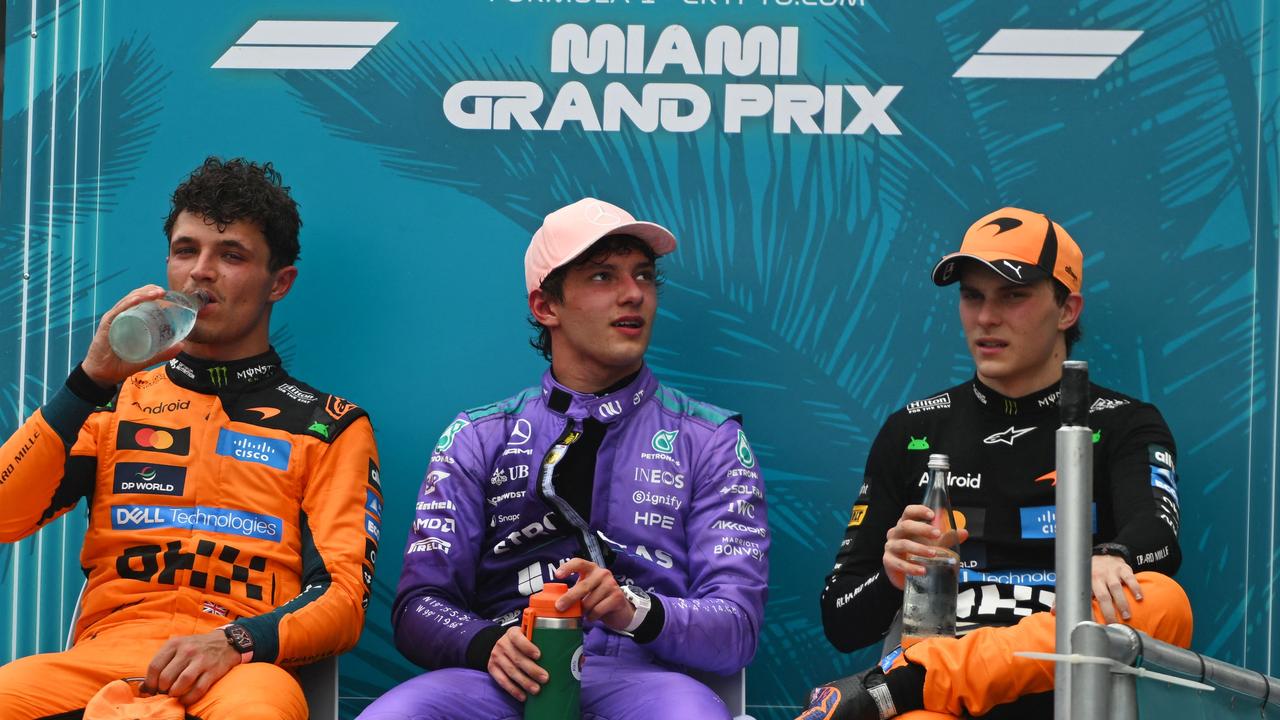
It was the team’s first double podium of the year, with Oscar Piastri charging home to third.
McLaren was also the weekend’s highest scoring team, handing Mercedes its first defeat of the season 48-45.
Victory was elusive, but McLaren is still a winner.
“We always said internally, irrespective of where we are at the start, that we know what we’re capable of,” Stella said.
“We take all the positive out of this weekend. We are there. There’s some new stuff coming for the coming races, so exciting times ahead of us.”
FERRARI FRUSTRATION, PENALTY COSTS LECLERC
While McLaren can walk away from Miami feeling buoyed, far less can be said of Ferrari.
After tentatively hopeful beginnings, the Italian team’s weekend collapsed spectacularly on Sunday.
Leclerc’s lunge for the lead on the first corner was as good as it got.
Lewis Hamilton could have made big gains on the first lap too but found himself bearing down on the spun-around Verstappen, and evasive action cost him places.
He was then hip-and-shouldered by Franco Colapinto, causing him car damage that cost him around half a second of performance per lap for the entire race.
Leclerc fought valiantly to defend his lead, but it was clear the Ferrari car wasn’t of the same quality as the leading Mercedes or McLaren machines, and he was dethroned shortly after the safety car.
An ugly end to the race for Charles Leclerc just kept getting worse.Source: Getty Images
Nonetheless, he executed a typically strong Leclerc race to hold third place ahead of Piastri until the end of the penultimate lap, when he made a series of catastrophic decisions.
“I pushed very hard on the second to last lap,” he explained to Sky Sports. “I thought it was a good idea to let Oscar go for me to get the overtake [mode]. I knew it was going to be very difficult to stay in front otherwise. But it was a very poor decision.”
A big slide out of the final corner meant he immediately lost touch with Piastri, and then he got too happy on the throttle out of turn 3 and spun into the barriers.
Though he was able to limp to the chequered flag, he was passed by both Russell and Verstappen just before the line.
“In the space of four corners I put a very strong race in the bin. I’m very frustrated about that.
“It’s all on me, and I don’t have much to add other than that. Very disappointed with my mistake. It shouldn’t happen.”
Worse, though, was to come after the flag, with the stewards slapping him with a 20-second penalty for leaving the track “on several occasions without a justifiable reason” despite the Monegasque arguing that his car could not turn right properly.
“I did my best to try and make the corners. It was probably a lot more difficult than what it looked for outside,” he said.
The penalty cost him two places, dropping him to eighth behind Franco Colapinto.
The mistakes are extremely uncharacteristic of Leclerc, who — sadly for him — has become something of an expert of dragging his Ferrari to the maximum possible result, sometimes beyond the expectations of even the team.
You have to wonder whether these errors were even just a small amount of frustration creeping in as Ferrari struggles to keep up with the leaders in the development game. While the Italian team’s big upgrade package was a step forward, everyone else — McLaren and Red Bull Racing especially — made much bigger steps, demoting Ferrari to the status of fourth-fastest team in Miami.
Given the expectations for this season, and given the early optimism, you’d certainly call that a frustrating place to be.
HADJAR’S GHOST OF RED BULL PAST
Verstappen’s recovery to fifth after his first-lap spin — he thinks a podium otherwise would’ve been on the cards — looked a lot like old-fashioned Max in terms of pace and execution.
Unfortunately for Red Bull Racing, the same is true of the other car as well.
Isack Hadjar has had the weekend that the team must have been fearing was coming.
The Frenchman was 0.825 seconds slower than Verstappen in qualifying, and his race lasted only a few laps before he smashed his cars at the clumsy turn 14-15 chicane.
He was visibly furious with himself in the cockpit of his stopped RB22. It’s a Hadjar trait to get his emotions out in this way, but it was also an illustration of how much frustration he was carrying by the time he ended up in the barriers.
Isack Hadjar was furious in a worrying moment for Red Bull.Source: Getty Images
“There was no point trying to flirt with the limit in this corner, so I’m really pissed off.
“It’s the first time I’ve really struggled with my overall pace. This is new and I really need to dig deep, because I don’t want another weekend like this.”
It’s true that Hadjar until this weekend has been in Verstappen’s ballpark — exactly what the team had hoped it would get after dumping Yuki Tsunoda and, before him, Liam Lawson and Sergio Pérez, all of whom were miles from the Dutchman.
But this weekend felt a lot like it could have been from the playbook of any of his predecessors.
A quote after qualifying stood out.
“The car was very hard to drive,” he said. “It was very fast; in Q3 I just couldn’t put it all together.”
A car that’s fast but so difficult that only Verstappen can drive it — it could have been a line from any of the last few years.
Red Bull Racing will be hoping this was a blip in Hadjar’s otherwise solid start to life at Milton Keynes. The alternative is too alarming to consider.