
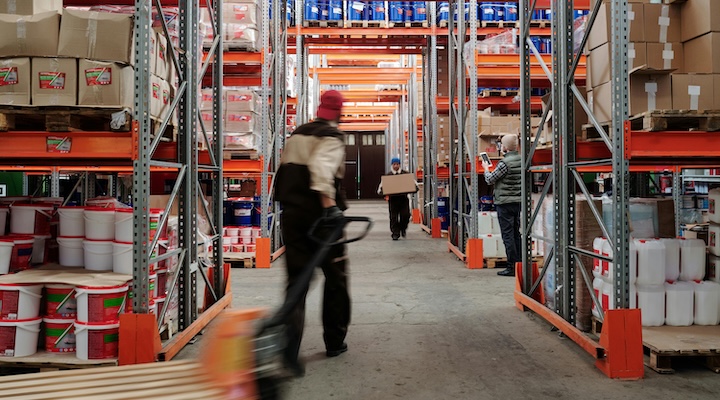
FMCG supply chains operate under some of the most demanding conditions in logistics. High SKU counts, tight margins, rapid stock turnover and customers who expect speed and accuracy regardless of what is happening upstream. The pressure is constant with little room for error.
When businesses look for ways to improve, the instinct is to look sideways. What are competitors doing? What are the biggest players in the sector investing in? It is a logical starting point, but it has a ceiling. When everyone in the same industry draws from the same pool of knowledge, improvements tend to be incremental. The step change – the kind that reshapes cost structure or throughput – tends to come from somewhere else entirely.
“FMCG business operating inside its own bubble,” says Peter Jones, MD of Prological Consulting. “The people running those supply chains are experts in their sector. But that also means they’re largely drawing on the same knowledge as everyone around them.”
“It takes a deliberate decision to go looking outside your industry. Most businesses don’t do it because there’s no obvious trigger.”
What Ferrari found when it went sailing
When Ferrari launched its Hypersail project – a full-foiling, 30-metre monohull designed to break ocean records – the Italian marque was entering a field well outside its expertise.
The connection, as Ferrari’s team quickly identified, was aerodynamics. Modern foiling yachts operate on the same fundamental principles as high-performance cars: Both are concerned with how surfaces interact with their surrounds, whether that’s through air or water. Ferrari brought decades of expertise in aerodynamic design, control systems and computational fluid dynamics to a field that had largely focused on sail efficiency and hull movement through water. The aerodynamics of the vessel had not been a major consideration.
Ferrari Hypersail CTO Matteo Lanzavecchia explained at the project’s launch, “We’re trying to transfer the experience and know-how that Ferrari has in the automotive world – the control systems, aerodynamics and energy management – into the sailing world.”
Peter sees the same logic at work in supply chain. “Ferrari already knew more about aerodynamics than anyone in sailing,” he says. “But by working in a completely different environment, they discovered things they couldn’t have found by staying in their traditional lane of high-performance cars and Formula One. That’s the point.”
He points to FMCG. “The same thing is happening in supply chain. The answers to some of the sector’s most persistent problems are sitting in other industries, but nobody has gone looking for them yet.”
The FMCG application
For FMCG businesses, there are equivalent opportunities for innovation. Peter uses truck payload as a concrete example. “FMCG trucks very rarely run at full weight or full cube,” he says. “That’s an inefficiency the sector has largely accepted because it’s how things have always been done.”
The solution, he argues, already exists – not within FMCG, but in automotive engineering. Purpose-built loading systems and trailer designs developed in the automotive sector can add 35 to 50 per cent payload capacity per truck movement. “That knowledge is out there,” Peter says. “It’s just not sitting inside the FMCG world. It exists somewhere else.”
This is the same move Ferrari made: Take a problem that exists in one domain, locate the engineering answer in another, and apply it. The difficulty for FMCG operators is access. Businesses embedded in a sector develop deep knowledge of that sector, but along with this comes limited visibility into the worlds outside it.
Advisers with cross-industry experience are in a different position. “We won’t know any individual FMCG business (or any other) as well as the people running it,” Peter says. “But we know more about the full range of what’s available, what is possible across industries, technologies and engineering disciplines than any FMCG operator is likely to have. That perspective is where the value lies.”
Pace and the cost of a narrow view
The competitive pressure facing FMCG supply chains is heightened by leaner operators, shifting consumer expectations and the pace of technological change. Businesses benchmarking themselves only against others in the same sector are working from a narrowing frame of reference. The insight that changes a cost structure or improves throughput doesn’t necessarily come from an obvious place.
Ferrari’s Hypersail yacht is expected to launch and sea trial in 2026, with ocean records in its sights. Whether it breaks them or not, the engineering exchange the project has generated is already indicative of the value of operating in unfamiliar territory.
“The best supply chain solutions I’ve seen in FMCG didn’t start inside FMCG,” Peter says. “They started somewhere else, and someone had the curiosity to go looking. That curiosity is how the businesses that keep finding advantage get ahead.”
For more information about Prological, visit here.