

Summary
The Middle East conflict has driven large increases in global energy
prices. This chapter sets out the channels through which increases
in energy prices can affect output and inflation, and provides some estimates of
the size of these effects for Australia. The chapter focuses on higher energy
prices as this is likely to be the main channel by which the conflict will affect
the Australian economy. But there are also likely to be important spillovers via
the prices of other commodities, including fertiliser, rural commodities and
aluminium, as well as an increase in global uncertainty.
In general, energy price increases add to inflation for a period, but
their effect on output in Australia is less certain. Higher energy
prices can reduce demand through some channels and boost demand through others.
For example, energy price increases reduce aggregate household real incomes,
weighing on spending (though the strong financial position of Australian
households in aggregate could act as a buffer). On the other hand, Australia is a
net energy exporter, so higher energy prices may raise national income; and
energy price increases tend to raise the price of imports relative to domestic
production, which could weigh on imports and support GDP growth.
In practice, the extent to which the conflict affects the Australian
economy will depend on its duration and intensity, its effect on global
energy supply, relative price movements of the energy commodities Australia
exports and imports, and domestic supply and demand conditions. The
pass-through of higher energy prices to inflation may be larger and occur more
quickly when inflation and short-term inflation expectations are elevated and the
economy is operating with capacity pressures, as is currently the case.
Chapter 3: Outlook presents scenarios that illustrate how the economy might
evolve under some specific alternative assumptions about energy and commodity
prices; in the baseline forecast energy price increases are expected to boost
inflation in the near term but have only a modest negative effect on GDP growth.
4.1 Energy commodities play an important role in the Australian economy
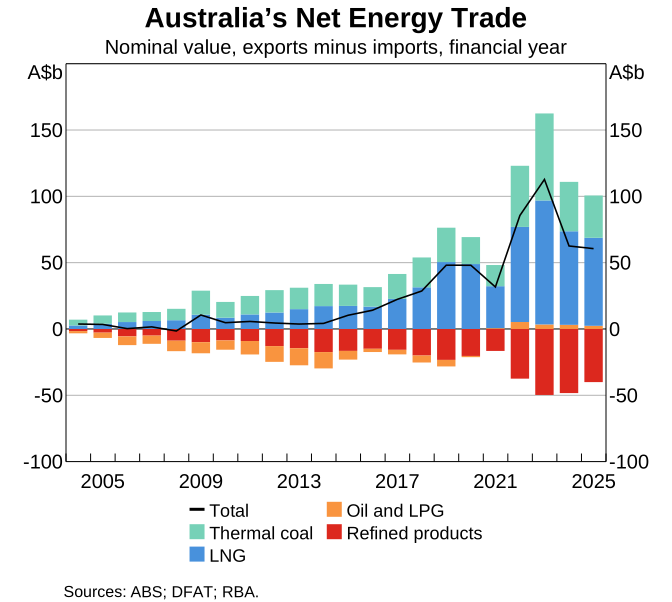
Australia imports oil and refined products but is a net exporter of energy overall.
Australia is a substantial net exporter of energy, in particular of thermal coal and liquefied natural gas
(LNG), but a net importer of oil, especially refined products like diesel, petrol and jet fuel
(Graph 4.1). Almost 80 per cent of Australias total demand for these refined
products (on an energy-equivalent basis) is met via imports, with the bulk of these imports coming from
Asian countries such as Singapore, South Korea and Malaysia. Most Asian refiners, in turn, typically
source crude oil from the Middle East, and face technical constraints to using alternative sources in the
short run as their refineries are optimised for specific types of crude oil. This has led to lower fuel
production across Asia recently – as refiners adjust to these constraints and conserve limited
crude oil inventories – and higher fuel prices (see Chapter 2: Economic
Conditions).
Australian importers have been able to source refined products from alternative sources on global markets
when necessary, though these have come at substantially higher cost.
Australia has stocks of around 30 days of diesel and jet fuel, and around 45 days of petrol.
While these stock levels are lower than some other countries, the risk of shortages affecting Australia
(and other higher income economies) may be mitigated if they are willing to pay higher prices than lower
income countries to secure supplies in global markets.
Graph 4.1
Oil products are important inputs to production, but GDP is less oil-intensive than in the past.
Almost all industries use fuel, notably diesel, as an input to production, with the transport, mining and
agriculture sectors in particular accounting for a large share of fuel use by Australian businesses.
Around 90 per cent of Australias diesel consumption is by businesses. By contrast, most
petrol consumption in Australia is directly by households.
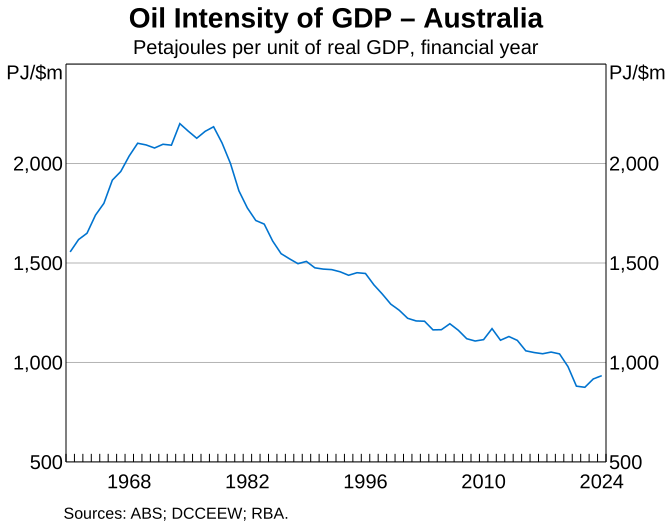
That said, as in other advanced economies, the amount of oil needed to produce a unit of output (the
oil intensity of GDP) in Australia has declined over time, alongside declining energy
intensity of the economy more broadly (Graph 4.2). The declining oil intensity of GDP has reflected
a structural shift in the composition of domestic output away from oil-intensive sectors towards services
industries, improved energy and fuel efficiency, and a decline in the use of oil for electricity
generation. An important exception to this trend has been diesel. Australias use of diesel per unit
of GDP has increased since the 2000s (though not by so much as to offset the decline in the use of crude
oil and other refined fuels). This has reflected strong demand from diesel-intensive sectors such as
mining and agriculture, greater reliance on diesel-powered road freight – where substitution
options are limited in the short run – and the increased popularity of diesel passenger vehicles.
Consistent with this, Australias per capita diesel consumption is among the highest globally.
Graph 4.2
In addition to oil products, gas is an important energy source for the Australian economy.
Gas is used both directly by households and businesses, and as an input to electricity production. Gas
accounted for 5 per cent of electricity generation over the past year. While gas-fired
generators are not the dominant source of electricity in Australia, they are sometimes used as a source
of marginal supply and, under marginal cost pricing, gas-fired generators sometimes set
wholesale prices. However, domestic wholesale and retail gas prices have recently tended to be quite
insulated from the global gas market, partly due to regulation. They have not responded to recent
international gas price increases so far, and energy market contacts do not currently expect them to,
absent an increase in domestic demand for gas (for example, in response to disruptions in the
availability of other energy sources).
4.2 Higher energy prices will have direct and indirect effects on inflation
Higher fuel prices will push up consumer price inflation through several channels. The higher cost of
retail fuel in the CPI will have a direct effect on consumer prices. Over time, higher fuel prices will
tend to cause other consumer prices to rise as higher input costs are passed through. An increase in
general price inflation could also potentially increase inflation expectations, which could further flow
back into price and wage setting behaviour.
The speed with which the indirect effects of higher fuel prices flow through to consumer prices is
uncertain. Empirical exercises suggest that full pass-through typically takes around one to two years,
though the speed and extent of pass-through are likely to depend on the economic backdrop. In circumstances
– such as currently – in which the increase is large, inflation and short-run inflation
expectations are high, and the economy is operating with capacity pressures, firms may respond more
quickly than otherwise, and second-round effects via inflation expectations may be larger (see
Chapter 3: Outlook). For example, firms are likely to be reviewing and changing prices more
frequently when inflation is high, and consumers may be less sensitive to price changes when economic
conditions are strong.
The price of fuel used by households directly affects CPI inflation.
The large recent increase in energy prices is already adding directly to headline inflation through higher
prices for retail fuel (see Chapter 2: Economic Conditions). A rule of thumb is that the
direct effect of a 10 per cent increase in domestic fuel prices will lead to an
increase in headline inflation (via higher retail fuel prices) of a bit over 0.3 percentage points
over one to two quarters. This reflects the fact that fuel directly makes up 3.3 per cent of
the CPI basket. For households, petrol makes up around 90 per cent of fuel consumption, while
diesel is much less important. In Australia, global crude oil prices account for around
40 per cent of the final price of retail fuel, and oil price changes tend to flow through
quickly to fuel with a lag of up to one to two weeks. However, the change in the local price of retail
fuel is not always consistent with the change in crude oil prices (adjusted for the 40 per cent
share of oil in fuel), particularly during periods of disruption to refining or shipping capacity. As
such, the effect of changes in global oil prices on Australian inflation can differ over time.
Fuel price increases also affect inflation indirectly over time via higher input costs.
Higher fuel and other oil-sensitive prices also influence inflation indirectly and over a longer period
through higher input costs, which in turn may be passed on to consumers. These costs can be related to
the cost of imports (including oil-derived products such as fertiliser and plastics), domestic production
costs and transportation costs. For domestic production and transport, diesel is the most important type
of fuel, accounting for three-quarters of usage in production (excluding the travel industry, which uses
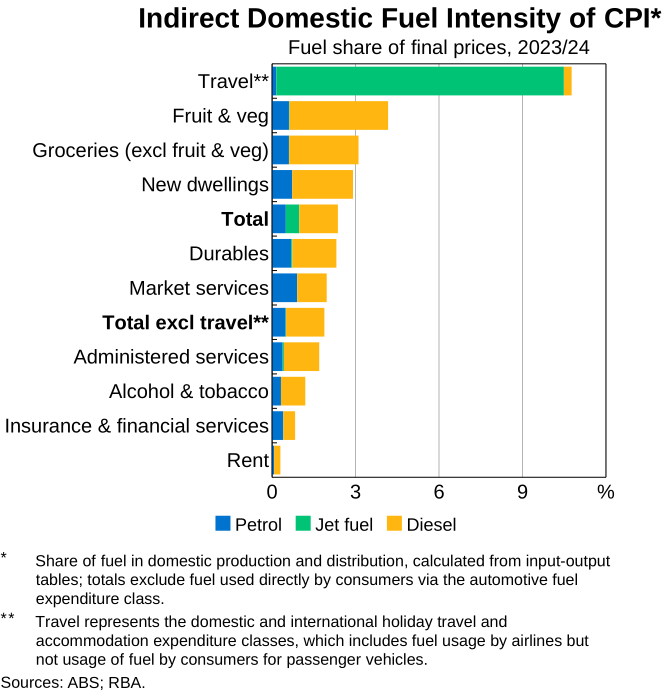
jet fuel). Indirectly, fuel accounts for around 2 to 2½ per cent of the domestic costs of
producing and distributing other goods and services in the CPI (Graph 4.3). The contribution of oil
within global supply chains to import prices is more difficult to quantify.
Graph 4.3
Overall, we estimate that the indirect domestic cost effects of a 10 per cent
domestic fuel price increase, via higher input costs, would cause the price level to be around 0.2–0.25 per cent higher over one to two years, other things equal. This
assumes the increase in domestic fuel prices is expected to persist long enough that all costs are
eventually fully passed through to prices, and excludes the effect of any changes in non-fuel import
costs. This indirect cost channel would generally be expected to have equal-sized effects on headline and
underlying inflation. The speed of pass-through to prices would vary across different products, depending
on where costs are incurred in the supply chain. An empirical exercise suggests the pass-through to
prices is faster for goods than it is for market services, for example.
If fuel price increases were only temporary, or expected to be temporary, the indirect cost
effects on consumer prices are less clear. On the one hand, some firms – for example, in sectors
where consumer demand is more sensitive to price changes – may look through an increase in fuel
prices that is widely expected to be temporary, absorbing the higher costs in their margins for a time.
On the other hand, in the event of a large but temporary shock, firms may raise prices initially and then
reduce them. This may be more likely to occur when the economy is operating with limited spare capacity.
An increase in fuel costs will affect specific consumer prices differently, reflecting – among other
factors – the share of fuel-related costs in total costs of production and distribution. Higher
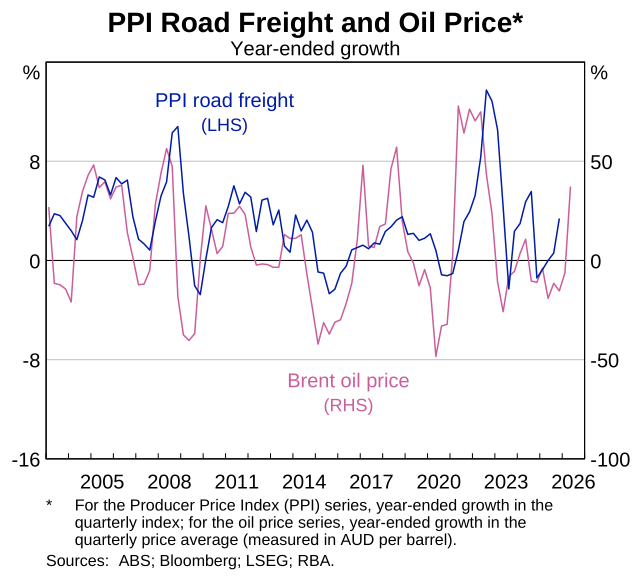
fuel costs will tend to push up the cost of most goods via higher transportation costs, such as road
freight costs (Graph 4.4). Food and dwelling construction are more reliant than most items on fuel
and fuel-related costs (for example, domestically produced materials) (Graph 4.3). Unsurprisingly,
holiday travel is heavily reliant on jet fuel, and so travel prices may be most sensitive to higher fuel
costs.
Graph 4.4
Fuel price increases may also have second round effects via higher inflation expectations and
wages growth, particularly when the increase in fuel prices is large and/or sustained.
Higher fuel prices, along with the resulting increase in inflation, can influence short-term inflation
expectations. Research in Australia and elsewhere finds that changes in fuel prices can affect
households inflation expectations by more than might be expected given its share in overall
consumption.
This is likely to be because fuel is frequently purchased, and its price is highly visible and widely
covered in the press.
An increase in inflation expectations can flow through to higher inflation now and in the future. If firms
expect costs and their competitors prices to increase, they could be more likely to increase their
own prices by more than otherwise.
An increase in inflation, and inflation expectations, may also be expected to contribute to higher wages
growth. Workers who expect higher inflation may build this into their bargaining for wages, and an
unexpected pick-up in inflation could influence subsequent negotiations as workers seek to catch up with
the higher level of prices. Since enterprise bargaining agreements are re-set every three years, on
average, some of the effect of higher inflation would flow through to wages growth with a lag.
While wages growth may pick up in response to higher inflation, we would generally still expect real wages
to decline. Indeed, empirical evidence suggests oil supply shocks have tended to push up nominal wages
growth in Australia, but by less than the increase in inflation. Nonetheless, the extent of this decline
in real wages would be likely to depend on the extent of tightness or otherwise in the labour market at
the time.
4.3 Recent energy price increases are likely to weigh on output growth
Increases in energy prices can affect economic activity through several channels, some of which tend to
boost aggregate demand and some of which tend to reduce aggregate demand. Overall, the net effect of
higher energy prices on Australian GDP is uncertain but, if a range of energy commodity prices increase
at the same time, is likely to be only modestly adverse (though the scale of the effect on
economic activity will depend on the size and duration of the price increases, and how the
relative prices of key energy commodities change). That
reflects the buffers available to many households to smooth their consumption, Australias position as a
net energy exporter, and the potential for substitution towards domestically produced goods and services.
While higher energy prices are likely to weigh on households and firms spending, the adverse
effect on output may be mitigated by the relatively strong financial position of the Australian household
sector and other channels that could provide an offsetting boost to growth.
Energy price increases can affect economic activity – and hence aggregate labour demand and
employment – through a number of channels:
Higher energy prices will (all else equal) tend to reduce total real household
income. That will tend to reduce aggregate household spending in real terms, as demand
for energy products is relatively insensitive to price changes in the short run and many households
will need to allocate a larger share of their budgets to energy. The size of the spending impact will
depend in part on the degree to which households are willing and able to reduce saving to maintain
their consumption of non-fuel goods and services and housing investment; the strong financial
position of most Australian households should enable them to smooth their spending if
desired. Households with minimal savings buffers and those who need to spend a relatively
high share of their income on fuel will, however, be more likely to need to reduce their
consumption of other goods and services.
A deterioration in sentiment or heightened uncertainty about future economic prospects could
reduce asset prices, household spending and business investment. Alongside the effect of
higher energy prices on real incomes, the impact on household spending will depend on factors such
as: whether fuel prices are expected to stay high; the extent of households uncertainty about
their future economic position; and the effect of changes in sentiment on equity and housing prices,
which affect household wealth. Business investment could also be lower, for example if higher energy
input costs compress firms expected margins, or lead to heightened uncertainty around future
demand or input availability. Lower overall household and business spending in the economy would also
be expected to weigh on investment.
Higher prices for oil- and fuel-intensive imports could encourage households and firms to
substitute towards different goods and services that are produced domestically.
Australias domestic production is generally less oil-intensive than our imports, so higher oil
prices may raise the cost of imports relative to goods and services produced in Australia (depending
on the exchange rate). To the extent households and businesses substitute towards domestically
produced items, that would boost GDP growth in Australia (all else equal) by reducing imports. For
example, consumers could substitute some of their spending away from imports such as international
travel. On the other hand, demand for Australias non-energy exports may be somewhat lower if
energy price increases reduce economic growth in our trading partners.
Energy price increases boost earnings from Australian energy exports such as LNG and thermal
coal (which is a partial substitute for oil and gas). While Australian production and
export volumes are unlikely to respond materially to these price movements in the near term, this
will nevertheless raise Australian exporters revenues (provided movements in the Australian
dollar exchange rate do not fully offset this). If prices were persistently high, exporting firms,
for example in the LNG sector, would have a greater incentive to invest to increase production
(though this is unlikely to happen in the near term, given the very long lead times for such
investment).
Higher export prices and profits in energy-producing sectors raise government tax revenues
and household incomes. Higher dividends would boost households non-labour income
(though a large share of dividends accrues to foreign investors), and wages in energy-producing
sectors could increase. If export prices were to rise by more than import prices – which is a
favourable shift in the terms of trade – that would increase national income and purchasing
power overall, though the size and persistence of the effect would depend on relative commodity price
movements as well as the exchange rate. Following the Russian invasion of Ukraine in 2022,
Australias terms of trade increased sharply, as the effects on thermal coal and LNG export
prices outweighed higher crude oil and imported fuel prices.
The extent to which changes in energy prices affect output growth overall will depend on the relative
strength of these different channels. Estimates of the impact of energy price changes on GDP tend in
practice to be relatively small. For example, a modelling exercise suggests that a 10 per cent
increase in oil and LNG prices, even if it persisted for two years, would reduce the level of Australian
GDP by less than 0.1 percentage point. However, such estimates are uncertain and the impact of higher energy prices in any given
episode will depend on the specific nature of the shock and prevailing economic conditions; in the
current episode, we expect higher energy prices to weigh modestly on GDP growth (see Chapter 3:
Outlook), though uncertainty and confidence effects could increase the size of the adverse impact on GDP.
Increases in energy price are likely to affect households unevenly. For example, cost pressures from
higher fuel prices would likely fall disproportionately on lower income households, which tend to spend a
larger share of their income on petrol, and on those based in rural or regional areas needing to drive
longer distances and with limited public transport options, while the benefits of higher export incomes
accrue elsewhere. That said, Australias domestic gas production helps to reduce the extent to which
global energy price increases would otherwise impact real household incomes.
A prolonged increase in energy prices may reduce the economys medium-term potential supply
capacity, though this effect is likely to be small.
Temporary increases in energy input costs, of the kind assumed in the baseline forecast set out in
Chapter 3: Outlook, are unlikely to affect the economys medium-term potential supply capacity
because the capital and labour available to produce output will not change.
If higher energy prices were sustained for an extended period, some firms may reassess their production
methods, write off equipment, postpone maintenance or delay investment plans, which could affect capital
accumulation and reduce potential output over time. On the other hand, there may be some countervailing
effects if other firms and sectors, for example natural gas, expand over the medium term.
Higher energy prices may also encourage measures that strengthen resilience to future energy price
increases but weigh on productivity, such as investment in storage capacity that is infrequently used or
investment in relatively high cost domestic refining capacity. Changes in production methods or a
reallocation of activity across firms and sectors may also reduce productivity, and could lead to some
mismatch in skills between workers and available jobs, further reducing potential output at least for a
time.
Higher energy prices could also affect labour supply directly, though the overall effect is uncertain. In
the short run, higher living costs may encourage some workers to enter or remain in the labour force, in
an attempt to offset any fall in their real incomes. Over time, however, weaker domestic activity associated
with higher energy costs and softer demand could make it harder for job seekers to find employment,
discouraging people from joining or remaining in the labour force.
Overall, the reduction in potential output following energy price increases is typically estimated to be
small even if higher prices are sustained for several years.