
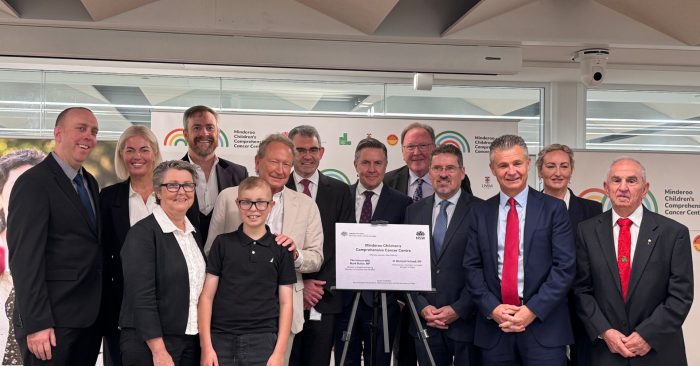
Integrated care and research under the one roof
The Centre spans Sydney Children’s Hospital, Randwick and the adjacent UNSW Health Translation Hub, where researchers, clinicians and educators work collaboratively to accelerate treatment discoveries from labs to nearby hospital beds of cancer patients.
The MCCCC includes:
state-of-the-art research laboratoriesmodern, family-centred oncology inpatient unitsa new day oncology treatment spacededicated education, training and research facilitiesshared spaces designed to foster staff connection and collaboration.
Families will benefit from light-filled, private inpatient bedrooms equipped with an ensuite and carer bed, more play and recreational spaces, a kitchen to prepare meals, an outdoor terrace and a laundry.
This initiative builds on a 40-plus year partnership between Children’s Cancer Institute and SCHN’s Kids Cancer Centre.
The partnership has delivered several successful ventures, including the national precision medicine program Zero Childhood Cancer (ZERO), which supports more than 1000 young Australians each year in children’s hospitals across the country.
Dr Michael Holland, Parliamentary Secretary for Health, said: “The opening of Australia’s first children’s comprehensive cancer centre is a landmark moment for children and young people with cancer, and for the families who support them.
“It shows what’s possible when governments, researchers, clinicians and philanthropists work together to deliver better healthcare outcomes.”
Professor Louis Chesler, Executive Director of Children’s Cancer Institute and Co-Director of MCCCC, said: “In the MCCCC, we’re taking what we’ve learnt through successful teamwork programs like ZERO and multiplying it by ten.
“Here, close collaboration between scientists and doctors will accelerate research discovery and translate into clinical impact quickly and efficiently, ultimately leading to better outcomes for children with cancer.
“We intend for the Centre to become a world leader in its field. As it shares expertise, data and research with other leading cancer institutions, children and young people worldwide will benefit from its discoveries and innovations.”