
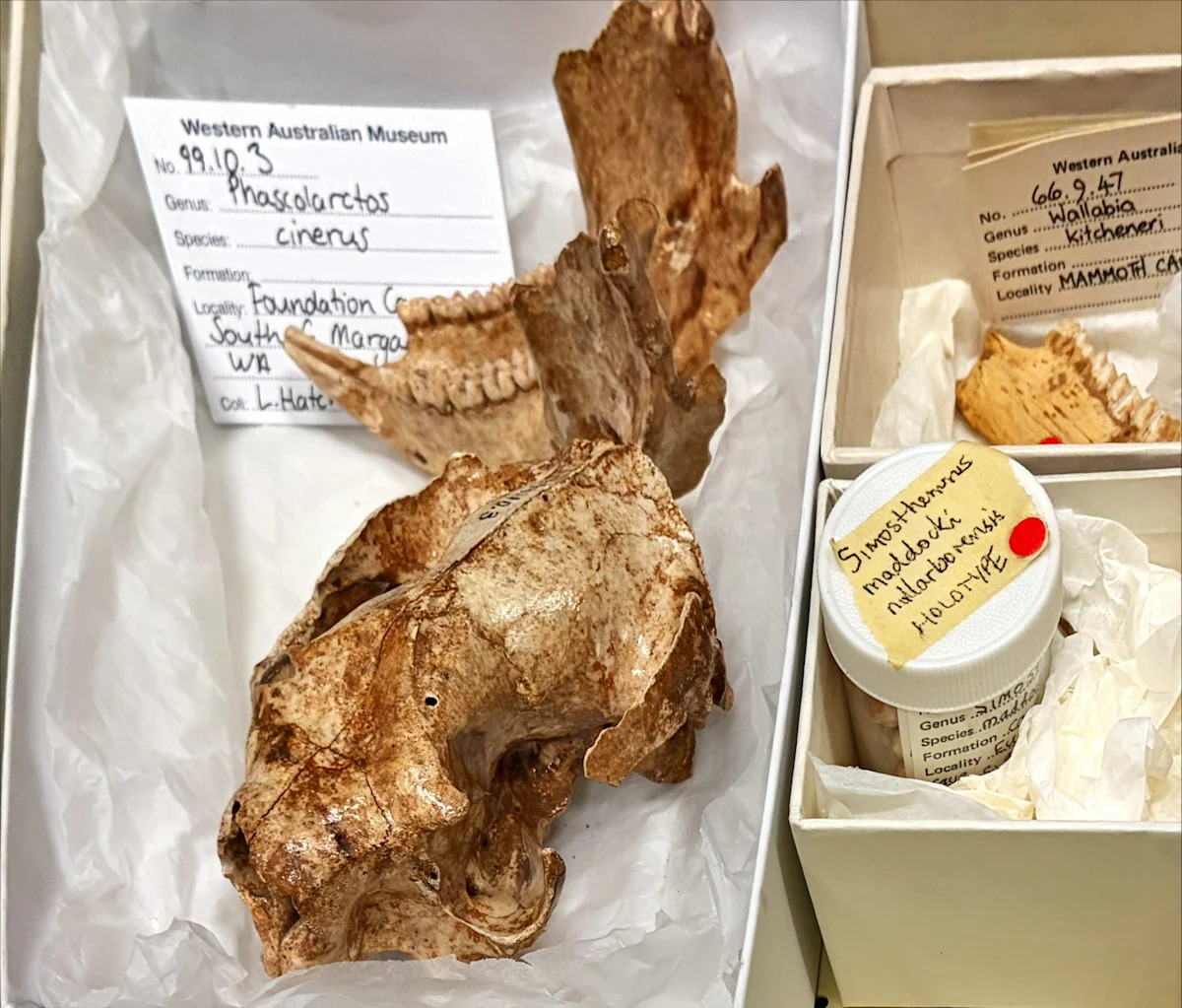
Ninety-eight old bones, including complete skulls, housed in the drawers of an Australian museum, were found to belong to a previously unknown animal.
The newly described species has been found only in Western Australia, and while it resembles koalas living in the eastern states, scientists have reported that it has an “unusual” face.
Museums often house vast collections of specimens, and modern science is helping analyse their age and appearance more accurately.
In 2024, the shell of a previously unknown species of turtle was revealed to be on display at a Top End museum, and last month, the fossilised remains of the world’s oldest octopus were found to belong to a completely different animal.
What was so ‘unusual’ about its face?
The newly described koala was housed at the Western Australian Museum and named Phascolarctos sulcomaxilliaris, meaning “grooved maxilla” or more plainly “dimpled cheekbone”.
Its mammal curator, Dr Kenny Travouillon, explained these cavities would have housed big facial muscles, giving it a radically different appearance to the koalas we see today.
“The animal may have had unusually large, mobile lips, possibly for manipulating eucalyptus leaves, or maybe to flare its nostrils to enhance its sense of smell and detect food from greater distances,” he said.
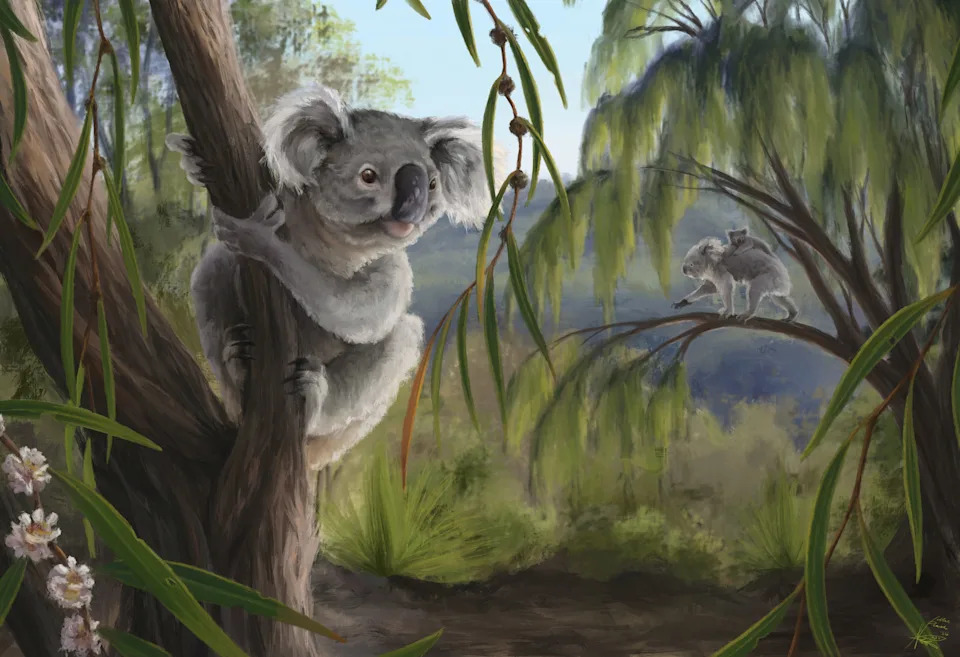
An illustration of the newly described Phascolarctos sulcomaxilliaris.
(Nellie Pease/WA Museum)Can I still see a Phascolarctos sulcomaxilliaris?
It likely disappeared around 28,000 years ago during the late Pleistocene, when the climate became cooler and drier, destroying around five per cent of eucalyptus forests.
“With food and shelter dramatically reduced, koalas in the region likely faced severe habitat loss, leading to the extinction of this unique species,” Dr Travouillon said.
Remains of Phascolarctos sulcomaxilliaris were first collected in 1910, but they were mainly just isolated jaws and teeth.
Have you unearthed any strange fossils? Contact newsroomau@yahoonews.com
Over the last 25 years, complete adult skulls have been found, allowing the assumption that they were the same species as modern koalas to be disproved.
It’s the fourth koala species from the last few million years to be documented.
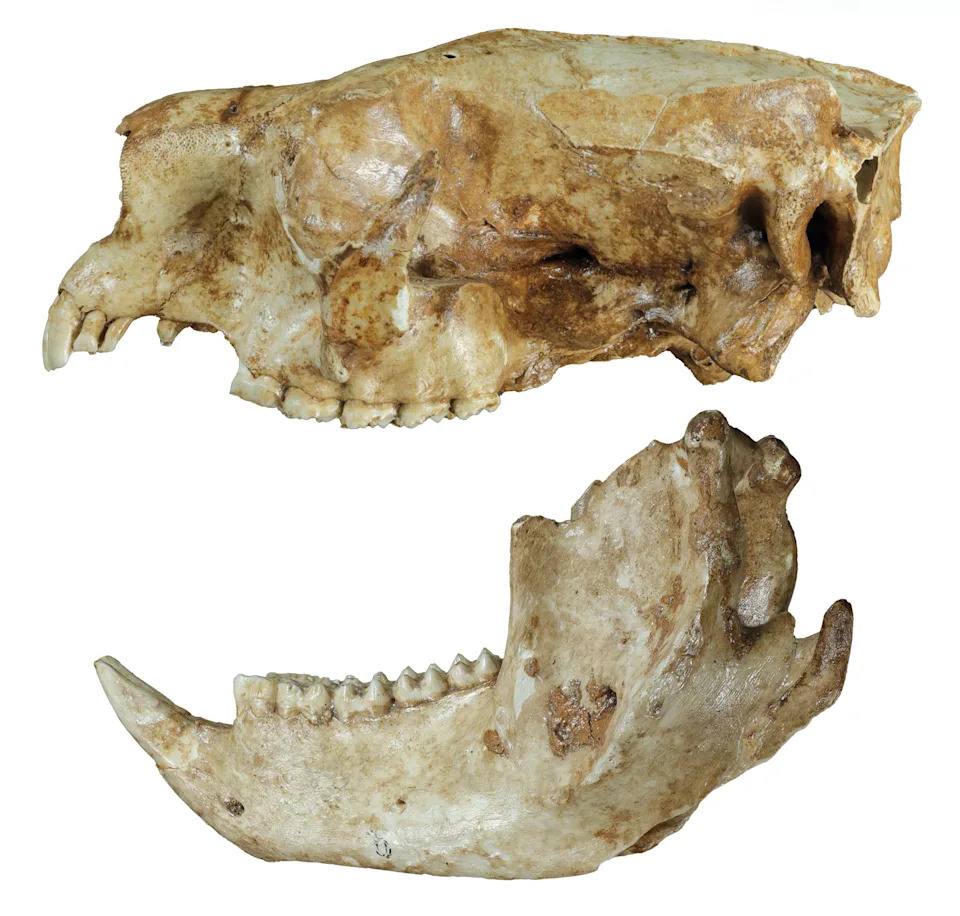
Phascolarctos sulcomaxilliaris had deep grooves in its skull.
(WA Musuem)Did it behave the same as modern koalas?
Modern koalas are known for being largely sedentary, but this species is thought to have taken this lifestyle to a whole new level.
“Its skeleton was likely less agile than modern koalas and may have spent less time moving between trees,” Dr Travouillon said.
RELATED
Research into the animal was a collaboration between the Western Australian Museum and Murdoch University, with dating analysis completed by the University of Queensland.
The study was published in the journal Royal Society Open Science, London.
You can also follow us on Facebook, Instagram, TikTok, X and YouTube.