
MEASURING progression from the starting grid position is great, but how do you compare drivers who start from the front with those who start from the back?
That’s the question that led to the development of V8 Sleuth’s new Race Performance Ranking (RPR).
A common benchmark for measuring a driver’s race progression is the net number of places gained and lost over races.
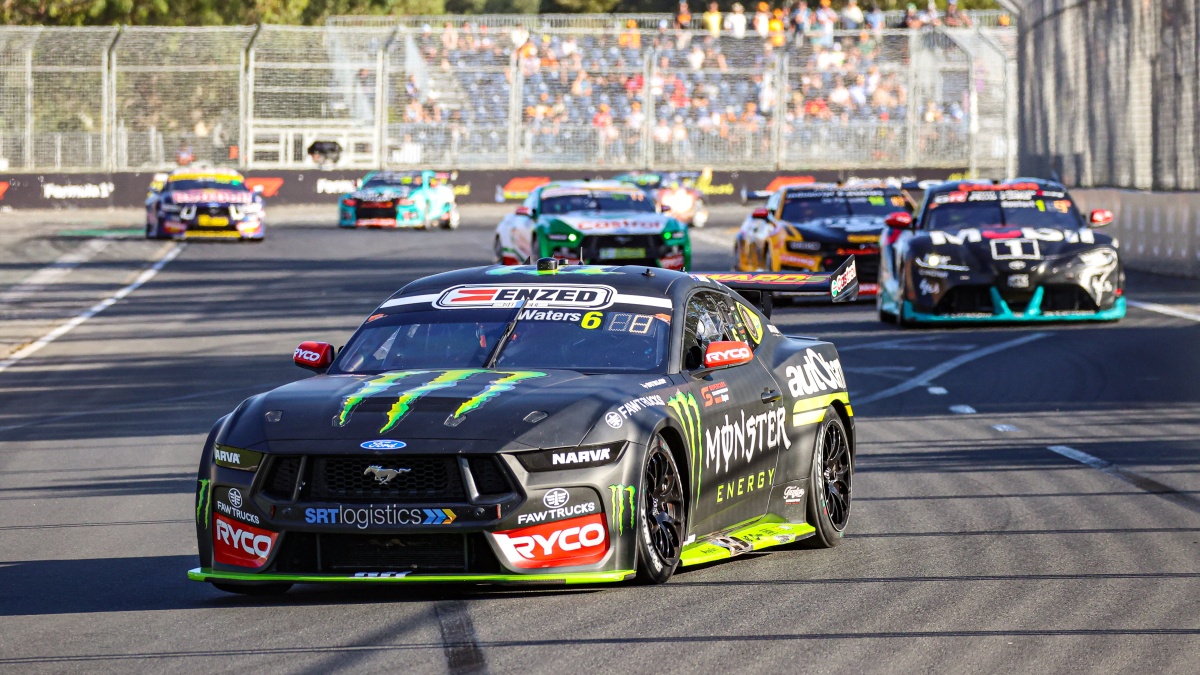
For example, Cam Waters has improved by a net 50 positions during the races this year, while Brodie Kostecki has lost a net 10 positions compared with his starting position.
Kai Allen has gained two positions and appears to have roughly finished where he started.
The Undercut – Fuelling the feuds in Supercars!
The Undercut returns in a massive week of sport, with Aaron Noonan once again joined by Jack Perkins, breaking down the inaugural New Zealand double header!
But none of this considers how the driver could have gone – if you start on pole position, you can’t gain any places, you can only lose them – that’s where the RPR evens the playing field.
The RPR takes into account the driver’s starting position, giving each race performance a score between 0 and 100, with 100 representing the best effort the driver could achieve from their starting position and 0 the worst.
This is achieved using a formula based on previous race performances of all cars in the Gen3 era.
What this means is that starting ninth and finishing sixth, starting 16th and finishing 10th, or starting 23rd and finishing 15th are all scored roughly the same value. This is because, based on historical data, all these performances are roughly equally difficult to achieve.
Some additional refinement, developed after the most recent edition of The Undercut went to air using data exclusively captured during the races by V8 Sleuth, further excludes results where the driver influence was clearly not a factor in a particular race result.
The Race Performance Rankings for 2025 and 2026 to date tell a story that may become important later in the year.
The 2025 rankings were one of the few metrics on which Feeney didn’t top the list.
2025 V8 Sleuth Race Performance Ranking
Of note, six of those seven drivers made the final seven, which includes all four finalists (Mostert, Brown, Feeney, and Allen).
As a comparison, ranking the field by qualifying average, champion Mostert was seventh, while Allen was 11th.
This indicates that while qualifying is important, performing well in the races matters more, especially in a finals format.

2026 V8 Sleuth Race Performance Ranking
Looking at 2026, Waters is having a run akin to Will Brown’s 2025 season, unable to nail qualifying but going superbly in the races, including a pit lane start to a fifth-place finish most recently at Rupauna.
Here, the traditional measurement of “gained three from his qualifying position” doesn’t do the performance justice.
But the main thing to watch out for is second on the list.
The numbers say Brodie Kostecki has lost 10 spots this year compared to where he started, but the raw numbers, clouded by the Sunday Ruapuna dust, hide excellent race craft – from eight top three starts this year, he’s maintained or gained his position seven times in the races.
Kostecki has improved his qualifying average from 8.8 to 4.0 between last year and this year, and coupled that with a RPR improvement from 53.5 to 68.6 in 2026.
Improving both metrics is the challenge, just ask Cam Waters, whose qualifying average in 2025 was 7.9; in 2026, it is 10.6.