
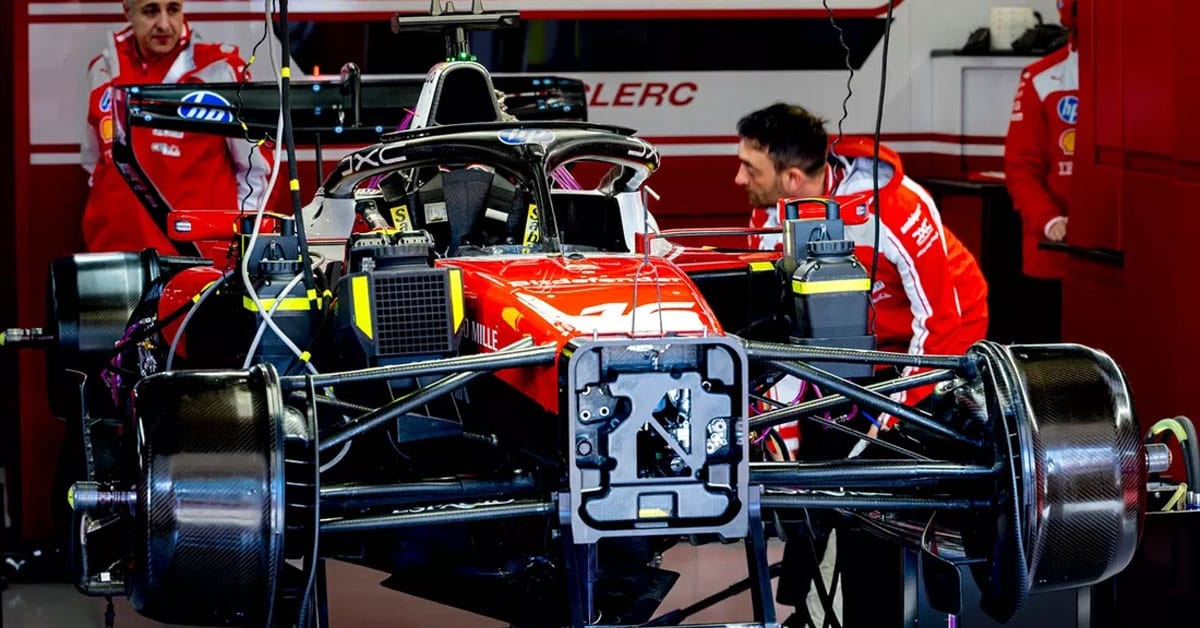
The mystery of Ferrari’s missing 30 horsepower – between lost power and the shadow of the ADUO
Luigi Mazzola has revealed what many inside the Formula 1 paddock now consider Ferrari’s biggest paradox: a reported deficit of 30 horsepower and the enormous gamble surrounding the ADUO system. His analysis offers a brutally honest look at recovery timelines, reliability risks, technical compromises, and the true meaning of engine performance in modern Formula 1.
The sound of the engines had barely faded away after the Miami weekend, but Ferrari was left with far more than disappointment following another difficult race. One topic in particular has quickly become the center of discussion among engineers, analysts, and Ferrari supporters alike: the claim that the Maranello power unit is lacking as much as 30 horsepower compared to its main rivals.
Such a gap would represent a major disadvantage in contemporary Formula 1, especially during a regulatory era where the smallest performance differences can completely change the competitive order. Some believe that the controversial ADUO system — Adjustment of Development Usage — could offer Ferrari a route back into contention. But is the situation really that simple? And what would it actually take to recover such a deficit?
These questions were addressed to one of the most respected technical voices connected to Ferrari and Formula 1 engineering: Luigi Mazzola. The former Ferrari engineer, well known for his deep understanding of both the technical and political side of the sport, delivered an analysis that was as sharp and uncompromising as ever.

The power paradox in modern Formula 1
For years, aerodynamics and chassis development were widely considered the dominant factors behind Formula 1 performance. The revolutionary designs created by Adrian Newey helped define entire generations of success. Yet today, the narrative appears to have shifted once again.
Even Lewis Hamilton, discussing the current limitations of his Mercedes, recently admitted: “The car has improved, but we are lacking power.”
Mazzola believes this apparent contradiction is actually perfectly logical within the modern world of Formula 1 engineering.

“When you are designing a car, especially during such a major regulation change, the different departments — engine, aerodynamics, electronics, vehicle dynamics — do not work separately,” explained Mazzola. “They all come together and try to find the best compromise possible. You can build a very powerful engine, but maybe that creates disadvantages elsewhere. You may require more cooling, which then impacts the aerodynamics because you are prioritizing engine needs rather than pure aerodynamic performance. Everything becomes a compromise.”
He continued: “If, within that compromise, you slightly reduced power in order to favor other aspects of the car, then once you arrive at the track you may realize you are missing horsepower. What does that mean? It means the others simply found a better compromise.”
30 horsepower: not just a number, but a complex puzzle
The figure of 30 horsepower sounds enormous in an era where Formula 1 power units are already pushed close to their absolute technological limits. According to Mazzola, however, the issue is far more complicated than simply increasing engine output.
“It is not as simple as saying: ‘Guys, now we need an engine with 30 more horsepower.’ It does not work like that,” Luigi Mazzola stressed. “You do not find 30 horsepower in the blink of an eye. Thirty horsepower is an enormous amount of performance gain. Normally, you improve by five or ten horsepower over a long period of development, maybe over one or even two years, unless you completely got the original project wrong.”
He also highlighted how modern Formula 1 engine development involves multiple areas working simultaneously.
“There are many areas involved. Maybe there are opportunities through fuel development, combustion efficiency, or various internal engine components. But you do not solve those things in two minutes.”
At the same time, Mazzola pointed out that Ferrari’s performance deficit may not purely come from the engine itself.
“Ferrari is not losing performance in every part of the circuit,” he explained. “Maybe the problems appear in specific situations — on the straights, during deployment phases, or under acceleration. But it could also be aerodynamic. It could be drag.”
He then expanded on the delicate balance between downforce and straight-line speed.
“If Ferrari is faster through certain corners, that probably means the car has more downforce. But more downforce can also create more drag. So if you already compromised on engine power and then add more drag on top of that, naturally the car struggles more on the straights.”
The picture, therefore, is much more complicated than a simple “lack of horsepower” headline might suggest.
ADUO: a tool to increase power or reduce it?
The ADUO system, which could potentially allow Ferrari additional testing time and development resources in order to close the gap, has become one of the hottest topics inside the paddock.
Yet Luigi Mazzola believes the current philosophy behind the mechanism may be fundamentally flawed.
“In my very humble opinion, it is much harder to increase power than it is to reduce it,” he stated bluntly. “If you have established that Mercedes has 30 more horsepower, then maybe you should tell Mercedes to reduce some of that advantage, because taking horsepower away is easier than adding it.”
However, Luigi Mazzola also acknowledged the political reality of Formula 1.
“But Mercedes would never accept that. Their answer would simply be: ‘We managed to do it, so that is your problem.’”
The former Ferrari engineer remains skeptical about the possibility of the ADUO system allowing Ferrari to suddenly unlock an additional 30 horsepower in a short period of time.
“For me, it is much easier and often more effective to work on aerodynamics rather than trying to completely transform an engine package,” he concluded.
Reliability and timing: the biggest obstacles
Another crucial factor involves timing and reliability. Rumors suggest Ferrari could attempt to introduce a new power unit as early as June, but Mazzola warned that such aggressive timelines come with enormous risks.
“There is no guarantee that introducing a new engine automatically means reliability problems will disappear,” he warned.
Mazzola then referenced Ferrari’s difficult experience during the 2017 Formula 1 season, when Sebastian Vettel’s title challenge was heavily compromised by reliability failures following rapid development updates.
“The ADUO system essentially gives you more testing time, more dyno sessions, and more resources to invest,” he explained. “But it does not guarantee that you will immediately produce an engine that is both more competitive and more reliable. Eventually you may get there, yes, but certainly not within one or two months.”
The former Ferrari engineer also emphasized how dramatically Formula 1 regulations have changed compared to previous eras.
“Back in our Ferrari days, we had seven engines per driver for every Grand Prix weekend. Today, drivers only have four engines available for an entire season. At that time you could bring different internal geometries and multiple specifications because the regulations, the budgets, and the testing opportunities allowed it.”
Recovering a 30-horsepower deficit therefore appears to be an enormous challenge for Ferrari — not only from a technical perspective, but also from a logistical, financial, and strategic point of view.
Luigi Mazzola’s analysis ultimately highlights one of Formula 1’s greatest truths: every technical decision is built around compromises, and behind a single performance number often hides an entire universe of complexity.
May 8, 2026Sofia Bianchi
Let other Scuderia Fans know about us


