
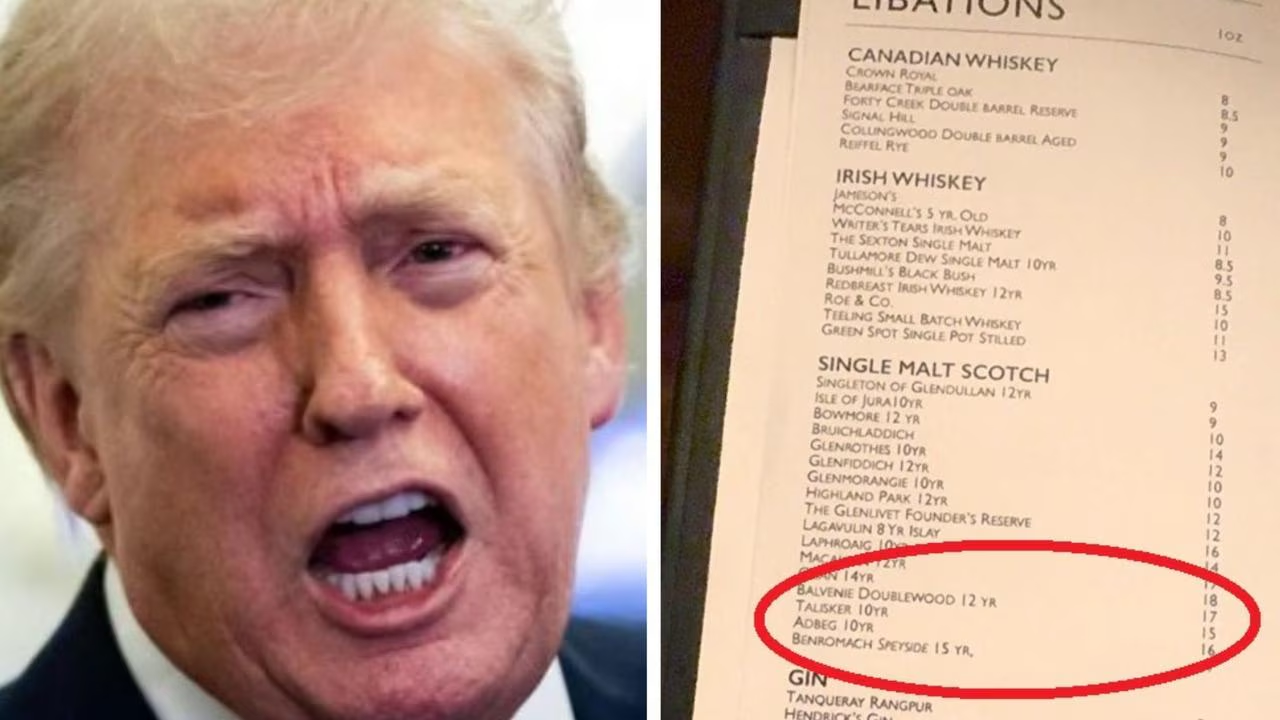
In a cosy gastropub in Toronto’s leafy neighbourhood of Cabbagetown, on the edge of the city’s bustling CBD, is a sight Donald Trump despises.
So bad is it, it’s now hanging over imminent trade talks between the Trump administration and Ottawa.
Yet, the cause of the consternation might be hard to spot at House on Parliament, which offers British-inspired fare with a Canadian twist, like Nova Scotia fish and chips.
What’s rankled the White House is something that is missing from the menu. And not just this menu: it’s vanished from almost every menu across this vast nation.

Go to the drinks section, and you’ll see scotch, Irish whiskey and, unsurprisingly, Canadian whiskey listed.
Nowhere will you now find US whiskey.
Huge American bourbon brands, like Jack Daniels, have disappeared from Canadian restaurants, bars and bottle shops. Wine and beer produced by Canada’s neighbour, just 65km away over the frigid Lake Ontario waters, are also conspicuously absent.
Bars in Toronto can’t sell American alcohol even if they wanted to. But most aren’t that fussed.
“Our customers have no interest in buying any US spirits,” House on Parliament’s co-owner Tania Waldock told news.com.au.
White House winces at Canada ban
In eight of Canada’s 10 provinces, accounting for 85 per cent of its 37 million residents, American alcohol has been off the shelves for more than a year.
It’s retaliation for tariffs the US foisted on Canada, pummeling the Canadian car industry and destroying usually cordial cross border relations. The whole “51st state” haranguing by Mr Trump didn’t help either.
For just spirits and wine, that’s cost US producers at least $800 million in lost sales.
Last month, Jamieson Greer, one of the US’ top trade negotiators, put the government of Canadian Prime Minister Mark Carney on notice.
“My sense is there may have to be an enforcement action to deal with this issue on wine and spirits in Canada,” he said,
The United States-Mexico-Canada Agreement (USMCA), a free trade deal, which has shielded much of Canada’s industry from US tariffs, could expire on July 1. Ottawa doesn’t want that to happen – but it also doesn’t want to cave to Washington.
An economist has told news.com.au that while Canada’s ban of US booze has been striking, it likely “wouldn’t change US behaviour” when it came to tariffs.
US alcohol ‘hasn’t been missed’
In Ontario, the ban began in March.
“Slowly our personal inventory (of US liquor) was consumed,” Ms Waldock said.
“But it hasn’t been missed.
“There are ample options for wine and it has allowed for some markets, like Australia, to be revisited.
Kentucky Bourbon was popular, conceded Ms Waldock, “but Canada has a lot of options that rival many of the US brands”.
‘Dramatic impact’
The US’ Distilled Spirits Council (USDSC) has stated Canada’s provincial bans have had a “dramatic impact”.
Liquor exports to Canada in 2025 were down 63 per cent, from $US203m ($282m) to just $US60m ($83m). As dire as that figure is, it included several months when there were no restrictions.
A global decline in US spirits exports by 3.8 per cent was “driven in part by a sharp drop in exports to Canada”, stated the USDSC.
That’s contributed to nearly 1000 job losses in the US. Jim Beam has said it will halt production at its flagship Kentucky distillery for all of 2026.
In contrast, sales of Canadian whiskey have soared domestically, with one distiller saying its supply to Ontario alone was up 300 per cent year on year.
Canada had been the top destination for US wine exports. Around $C50m ($51m) of red and whites, mainly from California and Oregon, were quaffed each month from Vancouver to Montreal.
“That dropped to nearly zero … [a] big effect in terms of the change of buying behaviour,” economist Trevor Tombe of the University of Calgary told news.com.au.
US industry body The Wine Institute has said the $US357 ($495m) “massive collapse” in orders from Canada is the “steepest single-year export disruption in modern US wine trade”.
Government control of booze in Canada
Shoppers in Canadian supermarkets are now assailed by maple leaf adorned signs encouraging them to buy Canadian due to tariffs. Yet American products are still available.
But there’s zero US booze. That’s due to a quirk of the Canadian alcohol industry.
In most provinces, it is the government which is the buyer, wholesaler and main retailer of alcohol.
It’s as if the only place anyone or any business could buy alcohol in Australia was Dan Murphy’s, and Dan Murphy’s was owned by the various states.
The bureaucratically named Liquor Control Board of Ontario (LCBO) is one of the single largest buyers of alcohol in the world.
At an LCBO store near Toronto’s giant Eaton Centre shopping hub, a sign in the window is direct.
“For the good of Canada,” it reads.
“In response to the US tariffs products produced in the US are no longer available.”
Now, wines from Australia abound; Ontario’s own bustling wine industry, located close to Niagara Falls, is in abundance. Where there was once Jack Daniels, there is Canadian Club.
‘Will it change US behaviour?’
“This may be a big deal in Canada, but it’s small fry when it comes to the US,” Prof Tombe said of the restrictions.
“The US economy is 10 times larger. They also (export) a lot less and so that’s an additional reason why these kind of measures only have limited effect.”
He acknowledged that Kentucky and Tennessee bourbon makers and US west coast wine growers may be suffering, “but does that change US behaviour?”
To be effective, said Prof Tombe, a boycott would have to target US swing states. If enough disgruntled Americans – who may have lost their jobs – turned their backs on Donald Trump, it could cause him to change his mind. But neither California nor Kentucky are swing states
US is angry
Even so, the White House has noticed and has raised “serious concerns”.
The Trump Administration has suggested Canada restock its shelves with American booze as a goodwill gesture ahead of imminent talks to renew or adjust the USCMA trade deal.
Mark Carney has bristled at that suggestion.
“You know what’s an irritant?” the PM said last month.
“A 50 per cent tariff on steel and aluminium, 25 per cent on cars. Those are more than irritants.”
Mr Carney said “adjustments” would be made only if a “mutually agreeable” negotiation was concluded.
In April, Ontario Premier Doug Ford was blunt: “American alcohol will only go back on shelves when the US removes its tariffs,” he said.
‘US has zero credibility’
Prof Tombe said the US demand to put bourbon back on the shelves was a “little ridiculous”.
“They have changed the goalposts so many times,” he said.
“We removed the digital services tax … and does the US seem to care or even remember this was done? No.
“The US is just going to make up something else for Canada to do.
“The US has zero credibility – either they want serious negotiations or they don’t.”
Even if the actual economic impact to the US of the ban is minimal, Prof Tombe said it might still be worth pursuing.
“The societal impact is not nothing,” he said.
“It’s a way to demonstrate action and governments can’t look impotent.
“(It gives the government a) little bit more rope to try and take some decisions as they navigate this tricky moment.”
At House on Parliament, customers seemed unfazed by the restriction on libations from south of the border.
“If and when it’s available, will we purchase again?” ruminated Ms Waldock.
“That’s a tough one … we have no one to answer to except ourselves and our clientele.
“I’ll cross that bridge when it comes.”
Read related topics:Donald Trump