
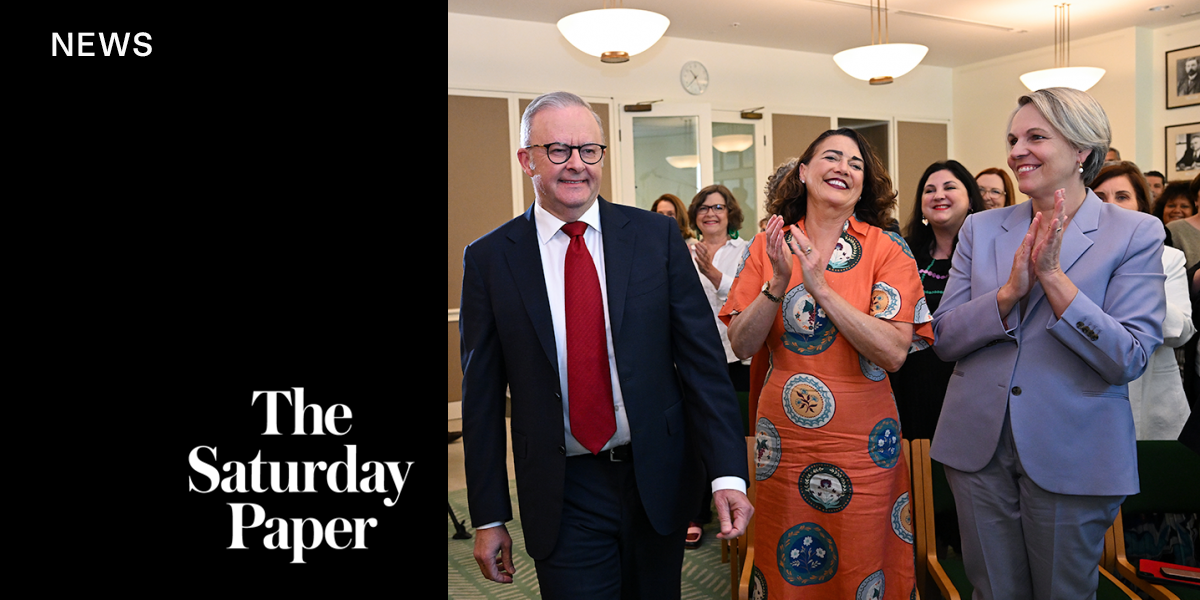
When one Labor member describes the relationship between caucus and the Prime Minister’s Office, the reference they reach for is Pyongyang.
“PMO is like North Korea, right? They’re like Pyongyang,” a Labor MP tells The Saturday Paper, before adding they understood the need for internal control.
“We formed government after a very, very long time in the political wilderness. Sometimes I feel that we don’t recognise our own mandate, but on the other hand, when I see actual outcomes in very big areas of policy reform, like housing or healthcare … it just affirms that we need to be a long-term government, because the policy changes we put in place are working now.”
There is an itch for more ambitious change within the Left-dominant Labor caucus, although significant, imminent reform is promised. Prime Minister Anthony Albanese has said next week’s budget will be bold and will tackle “intergenerational pressures”.
https://www.youtube.com/watch?v=2WDQYMf0Dj4
Leading up to the budget, The Saturday Paper spoke to ministers, backbenchers and party figures about how Albanese is managing his historic majority and how policy debate is functioning within the party.
A common theme is that the chaos and bloodletting that marked the Rudd-Gillard-Rudd years from 2007 to the loss of government in 2013 inflicted “trauma” on the party.
“It’s very much in my mind and I think a big feature of the Class of 2013, who are reasonably prominent in decision-making,” one minister tells The Saturday Paper.
“It’s also a huge part of the scar tissue of those who were involved in the previous government. I think we have worked out that disunity is death. But if you think about how the PM goes about his politics, he is someone who is possibly the most accessible of the ministers. That’s how he sees himself.”
Newer Labor MPs see and feel it, too.
“It was highly problematic. No one wants to go back to the Rudd-Gillard-Rudd years,” an MP says.
“Then before that is like ancient history, Keating and Hawke. Forget it. That’s ancient history. It doesn’t relate to… I can’t even relate to that period of time.”
Another Labor MP points out that the leadership dramas that plagued Labor’s last period in government were about “personality, not policy”. They lament that newer MPs are “not the best students of history”. Another impatient source points to Albanese’s considerable political capital, with a 94-seat lower house majority and the Coalition being a “complete fucking shit show”.
Albanese imposes strict control over his 123-member caucus. He made that clear in November, during debate over gambling reforms. “We are a political party, not a bunch of individuals,” he said. “We make decisions in our caucus that make a difference and, when we make decisions in our caucus, that results in action.”
There are policy-focused committees within caucus and all MPs The Saturday Paper spoke to reported that they have good access to ministers and to the prime minister as a “last lever”.
Albanese also rotates a group of MPs over for Sunday night dinners at The Lodge, to engage with caucus debate.
“Titles matter in politics. Give someone a title and they can be happy with you for quite some time. Even backbench interviews and op-eds are now often vetted at much higher levels prior to publication.”
What also keeps the caucus happy is that the leader is factionally entrenched – a prime minister of the Labor Left, governing as a centrist, well supported by the leaders of the Right.
“They are all getting what they need, and they are primarily working for each other,” says Scott Davies, a former senior Labor staffer.
There has been commentary about the absence of public policy debate from the Albanese government, but MPs explain this is more about culture than strict discipline being imposed from the top. A female MP suggests it is also a feature of a caucus that is 56 per cent women.
“I bring my experience to this, and I choose to be collaborative and work with people to get an outcome, not to get my face on TV,” she says.
“That’s how I think we achieve progress, which is what I’m here to do. And so I think it’s different to what I might have seen back in the Hawke years, where there were a bunch of blokes all jockeying for position. There’s a lot of women and there is a much greater sense of working in a collaborative way. And lots of us are from professional backgrounds, where it is outcomes-focused, not ego-driven.
“There are certainly ambitions … but I don’t think they’re restless yet.”
There has been criticism, previously reported in The Saturday Paper, that the government is top-heavy and overdue for renewal – that some ministers have not made way for the next generation of Labor talent.
It is a situation aggravated by Labor’s huge win in 2025, which created a factional rebalancing that led to the dumping of Ed Husic and Mark Dreyfus from the front bench.
https://www.youtube.com/watch?v=bXs8q2BrJI0
At the time of his removal, Husic said the demotion was at least partly due to his commentary on the war in Gaza. In that same ABC interview, Husic ripped into Deputy Prime Minister Richard Marles, describing him as a “factional assassin”.
Government insiders insist it was not an act of punishment; it was the maths of having too many people from Husic’s NSW Right faction in the ministry.
Husic has since become the most outspoken backbencher in the party, making interventions on gas policy and Gaza.
“The one that has walked up to the line without putting his toes over is Husic, but his mixture of calm, insight, intelligence and thoughtfulness should never have been lost to cabinet,” says Davies.
“Protecting those voices from ham-fisted assassinations is what really good governments do.”
One Victorian Labor MP regards Husic’s interventions as “Ed being Ed” and says, “We all are in different places.”
Ultimately, Labor is built on solidarity. Insiders say the unspoken acceptance is that those who speak out run the risk of being ostracised from “the flock” or having their ministerial ambitions cooled.
“Ostracising would be a word that is a bit further than I would go,” a minister offers.
“But I think there are plenty of other examples of people making arguments for positions and either shifting that position or being unsuccessful but continuing to go about their work.”
Caucus management is also evident through rewards. There has been an extra title or two for emerging talent as there is no room in the ministry.
“There is a greater central command and control culture in this government that now extends not just through the cabinet, and the outer ministry, but through the clever addition of assistant ministers and special envoys,” says Davies.
“Titles matter in politics. Give someone a title and they can be happy with you for quite some time. Even backbench interviews and op-eds are now often vetted at much higher levels prior to publication.”
Others dispute the characterisation of command and control, insisting the checks and tick-offs are normal political operations. The bubbling ambition within a very big caucus is well known.
“Obviously, there are plenty of people who would like to be having a different job to the one they have at the moment. I’m sure that’s true of any caucus at any time,” the minister says.
“There’s a lot of people who, I think, on the whole, are happy to be there. I think most of them are probably now starting to get to the stage of, ‘Okay, I’ve done my establishment phase, so what do I need to be doing next?’ Either they start to think about the next election or where they might be able to contribute or move up the ladder.”
Labor senator Michelle Ananda-Rajah says part of that ambition relates to the quality of the caucus. “These are people … many of them actually have left careers, they’ve entered politics in the prime of their lives, and it would be a travesty to not unleash their full talents in this role,” she tells The Saturday Paper.
“As people, as reformers, there’s always going to be a desire to do more and to go further. But as with anything, you’ve got to balance up the competing demands and the trade-offs.”
Two events of note are coming up for the ALP: the Labor conference in July and, later, the midway point for a likely three-year term.
“Labor’s Left faction controlling the caucus for the first time ever means that there’s some that have come to Canberra a little bit more idealistic and perhaps have bigger ideas about what they may or may not have the ability to do and influence,” a senior Labor source tells The Saturday Paper.
“That halfway point during the election cycle is when that really starts to kind of bite, I think, when people are kind of like, ‘What the fuck am I doing?’ Like, sitting here arguing for government policies which they don’t have influence on.”
Last month, Albanese told The Saturday Paper that Labor’s delayed gambling reforms came about because people had stopped pushing for them. “People stopped talking about it,” he said. “That actually helps.”
Backbenchers say that behind the scenes an “army” of Labor people “found each other” and worked “collectively and collaboratively” on “exercising influence” to bring about the reforms.
Although it was not the comprehensive gambling ad ban recommended by the Murphy inquiry, Labor MPs say Albanese went beyond the expectations they had as individuals.
“I was like, ‘Wow, that’s a lot more than what I thought we’d get,’ ” one said.
As the first anniversary of the 2025 election passes, Albanese has marked the moment in interviews, stating he is still energised to lead the Labor Party to seek a third term and beyond.
He is set to become the fourth longest-serving Labor prime minister on August 13, overtaking Paul Keating’s tenure of four years, two months and 20 days. Later, on October 30, Albanese will surpass Ben Chifley’s time in office.
Within the ranks, Albanese is regarded as “untouchable” and a “modern Labor hero”. Unprompted, an MP told The Saturday Paper that “there’s just no internal speculation about leadership change”.
Despite that, and also seemingly unprompted, there has been a flurry of stories boosting the future potential of Left faction cabinet minister Mark Butler.
Butler is the most senior factional ally of Albanese and from South Australia, an unusual state for a party leader but the same state as the Right faction powerbroker Don Farrell.
The sudden framing of Butler as a potential future leader has shone a light on the issue of succession, away from expected Right faction contenders Marles and Treasurer Jim Chalmers.
Left faction colleagues say they were surprised Butler hadn’t been mentioned more often as a future candidate, but they insist there isn’t an obvious successor to Albanese in place right now.
“Any talk about it externally is a bit of a surprise to us all,” a Left faction MP says, “because literally no one is wasting their time having that conversation when there’s so much work to do.”
This article was first published in the print edition of The Saturday Paper on
May 9, 2026 as “‘They’re like Pyongyang’: How Albanese controls Labor’s biggest caucus”.
For almost a decade, The Saturday Paper has published Australia’s leading writers and thinkers.
We have pursued stories that are ignored elsewhere, covering them with sensitivity and depth.
We have done this on refugee policy, on government integrity, on robo-debt, on aged care,
on climate change, on the pandemic.
All our journalism is fiercely independent. It relies on the support of readers.
By subscribing to The Saturday Paper, you are ensuring that we can continue to produce essential,
issue-defining coverage, to dig out stories that take time, to doggedly hold to account
politicians and the political class.
There are very few titles that have the freedom and the space to produce journalism like this.
In a country with a concentration of media ownership unlike anything else in the world,
it is vitally important. Your subscription helps make it possible.
Send this article to a friend for free.
Share this subscriber exclusive article with a friend or family member using share credits.

Used 1 of … credits
use share credits to share this article with friend or family.
You’ve shared all of your credits for this month. They will refresh on June 1. If you would like to share more, you can buy a gift subscription for a friend.
SHARE WITH A FRIEND
? CREDITS REMAIN
SHARE WITH A SUBSCRIBER
UNLIMITED
Loading…