
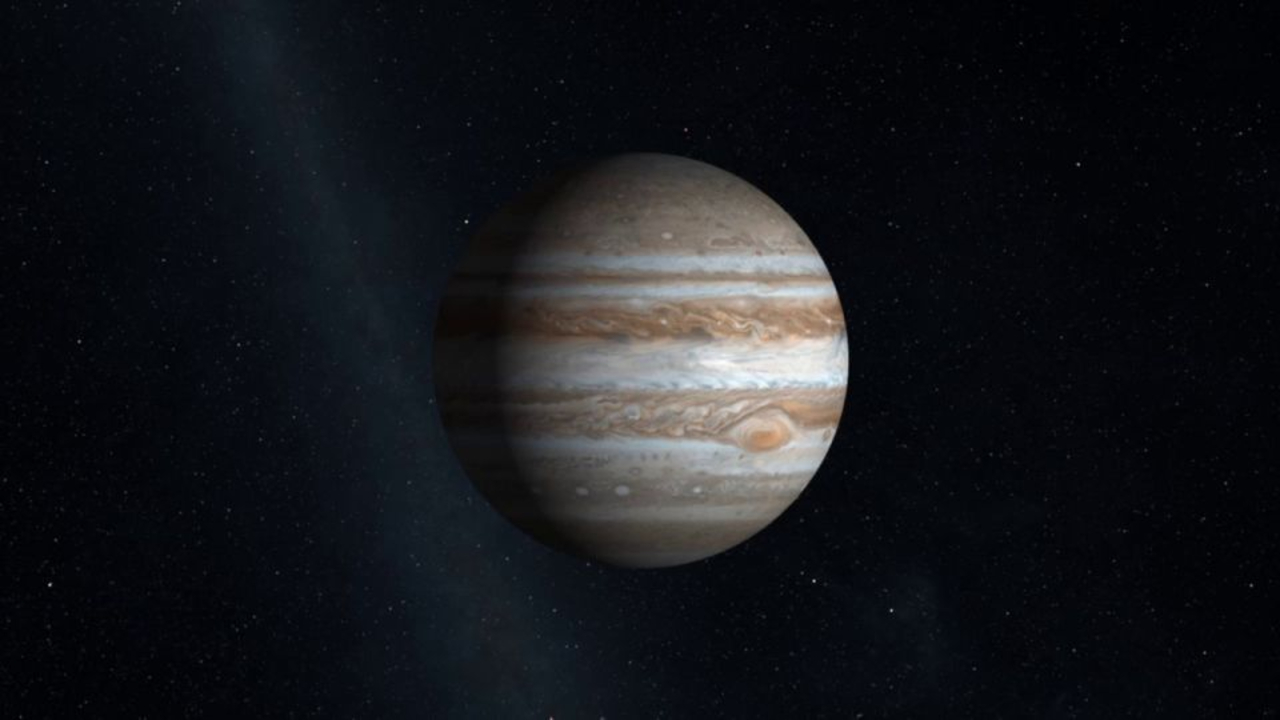
In the fall of 2025, University of Cincinnati astrophysics graduate Paul Smith discovered TOI-2031A, a gas giant that resides in a galaxy 901 light-years away, using the James Webb Space Telescope. By studying this planet, astronomers might be able to answer questions regarding gas giants in the universe.
Comparing Gas Giants TOI-2031A And Jupiter
Paul Smith, who discovered this exoplanet, said its “atmosphere is very similar to Jupiter’s.” The main similarities between the two planets are the presence of hydrogen and helium, and of water and carbon dioxide in their respective atmospheres.
Both planets are different in size, as exoplanet TOI-2031A is a quarter bigger in circumference than Jupiter but has 20% less mass. Combining its size with its atmospheric content, it is easy to conclude that exoplanet TOI-2031A is a gas giant.
Unlike Jupiter, this exoplanet discovered by Paul Smith and his team is the only planet in its solar system. After considering the data collected from the James Webb Telescope, Smith and his team concluded that this exoplanet sits closer to its star than Mercury to the sun, making its orbits four times faster.
Regarding gas planets, astronomers wonder how they came into existence, the uniqueness of their atmospheres, and why many of them orbit close to their stars. This recently discovered exoplanet might help provide answers to some of these questions.
More Details On Exoplanet TOI-2031A
This exoplanet, discovered by Paul Smith last year, was named after its star. It is classified as a Transiting Exoplanet Survey Satellite Object of Interest (TOI).
Smith presented the discovery of TOI-2031A during the American Astronomical Society meeting held back in March 2026. More research on this exoplanet will help astronomers not only understand it, but also gas giant planets around the universe, like Jupiter.