
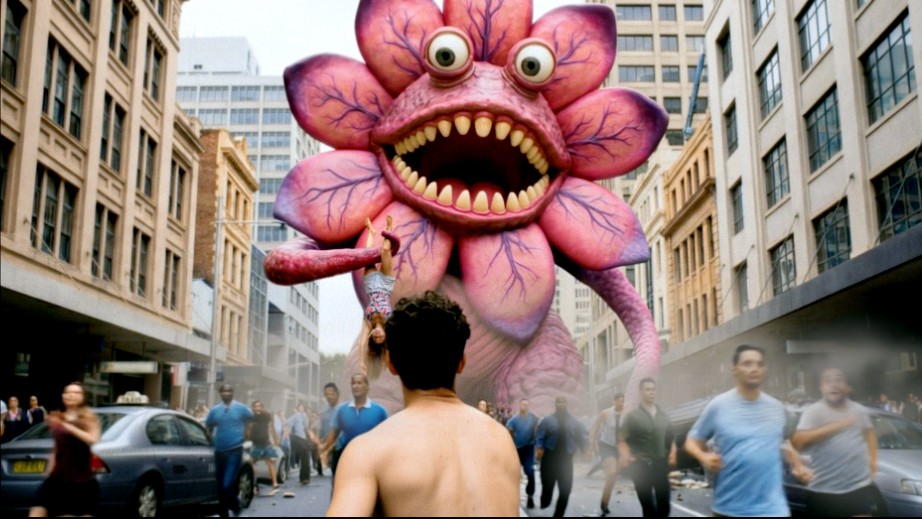
Four Seasons has tapped into nightmare fuel with a Godzilla-style campaign designed to spook Gen Z into using condoms.
Creative agency Emotive built the new Snapchat-led campaign for the condom maker, using artificial intelligence to generate a series of gigantic STI “monsters” terrorising Sydney.
Opening with the scene of a couple about to forgo using a condom, the film spirals into a larger-than-life spectacle as monsterised versions of gonorrhoea, chlamydia and syphilis wreak havoc across the city in a near two-minute cut.
Speaking to Mumbrella, Emotive chief creative officer Gavin McLeod said the work was sparked by growing concern over what he described as an “epidemic” of STIs, including chlamydia, gonorrhoea and syphilis, with rates rising sharply among Gen Z, alongside a reported decline in condom use.
ADVERTISEMENT
“We started looking at what’s been done in this space to address it, and sadly, a lot of it is very public service announcement-driven, and it just isn’t connecting with Gen Z at all,” he said.
McLeod said this pushed the team to rethink the approach entirely, particularly given both the need to break through with younger audiences and the constraints of advertising on platforms such as Meta.
That combination helped steer the idea toward a more entertainment-led direction, with Snapchat as the primary platform for content, with the full film shown on its “Spotlight” feature. Meta, Youtube, influencer partnerships and public relations will underpin the broader media strategy.
“That was what led us to a fairly crazy beginning of a script, and then the question became how we were actually going to produce it, whether we had the budget to do it in a traditional way,” said McLeod. “And that ultimately led us to AI. Done in a traditional way, the script would have been millions of dollars.”
In partnership with AiCandy Australia, Emotive developed a two-minute hero film, alongside a series of short-form social videos.
Funded “90% pro bono” by the agency, the production took six months in total, including an “eight-week stretch of continuous work”.

“One of the biggest challenges, particularly in longer-form content, is continuity,” McLeod said of the process.
“We had lots of conversations around maintaining continuity of characters, and even the scenes themselves, especially with some of the unexpected things AI tends to introduce into backgrounds.
“What’s fascinating is that it’s not a simple fix. If you want to change a small detail in the background, you often have to regenerate the entire scene.
“So you might fix one issue, but in doing so, you create another problem somewhere else.”

Unashamedly AI
A key part of the approach, McLeod said, was avoiding what he sees as a common mistake in AI-led creative work: trying to disguise it.
“One of the mistakes people are making at the moment is creating work that’s trying to pass itself off as something that wasn’t made with AI,” he said. “I think you’re seeing a huge backlash against that kind of work.
“If you’ve trawled the comments as I have on any AI films that have launched recently, there are a lot of people saying, ‘I hate AI’”
“We intentionally went in with: ‘this is AI’ — unashamedly,” he added.
Rather than try to mitigate that response, the team proactively leaned into the expected backlash by building a layer of reactive content designed to engage with it directly.
This included developing a series of GIFs and a suite of social media responses. For example, if a user comments, “I hate AI,” the response might read: “Hate spreads fast. Gonorrhoea spreads faster.”
Asked about lessons from the project, McLeod said the experience reinforced that AI is not a creative solution on its own.
“I’m a really big believer that it’s an incredible amplifier of human creativity,” he said.
“I like to think on this one, we as the creatives and the humans behind the scenes, we’re really driving it, and AI was a tool for our creativity, and in this instance, is a great example of being able to do something far beyond what we would’ve been able to do even 12 months ago.”