
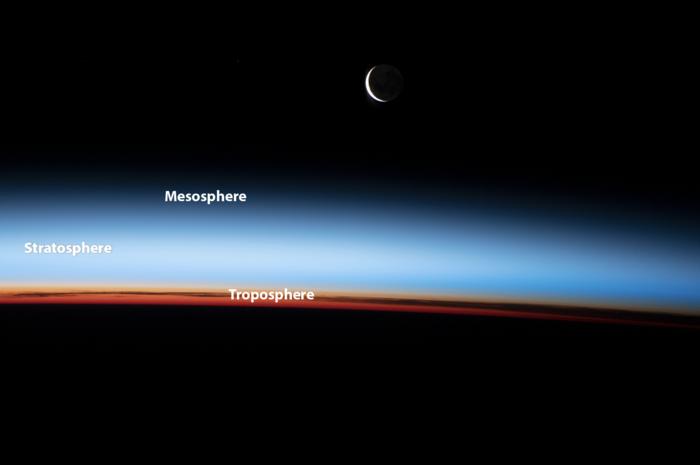
 View of Earth taken during International Space Station Expedition 66
image: ©Credit
NASA
Columbia University scientists have decoded the physics behind why CO2 warms the ground but cools the upper atmosphere.
By identifying a “Goldilocks zone” of infrared light, the study explains how CO2 acts as a radiator at high altitudes, shedding heat into space and cooling the stratosphere by up to 8°C per doubling of CO2, which in turn strengthens the greenhouse effect at the surface
Published in Nature Geoscience, the study provides the first quantitative mathematical theory to explain this “fingerprint” of climate change.
The radiator effect in the stratosphere
While we often hear about CO2 “trapping” heat like a blanket, that analogy only applies to the lower atmosphere (the troposphere). In the stratosphere—the layer 11km to 50km above us—CO2 behaves very differently.
Instead of just trapping heat, CO2 molecules in the thin upper air act like a radiator. They absorb infrared energy rising from the Earth and then “spit” that energy out into the vacuum of space. Because the air in the stratosphere is so thin, this energy escapes easily, leading to a dramatic cooling effect. Since the mid-1980s, the stratosphere has cooled by approximately 2°C—ten times more than it would have without human emissions.
The “Goldilocks Zone” of light
The Columbia team discovered that the cooling isn’t uniform across all light; it depends on how CO2 interacts with specific infrared wavelengths.
The theory:
The researchers identified a “Goldilocks zone” of infrared wavelengths that are particularly efficient at carrying heat away from the stratosphere.
The expansion:
As CO2 concentrations rise, this high-efficiency cooling zone expands, making the stratosphere a much more effective radiator.
The result:
Each doubling of CO2 in the atmosphere leads to a massive 8°C drop in temperature at the very top of the stratosphere (the stratopause).
A feedback loop for warming
The study also revealed a counterintuitive twist: the colder the stratosphere gets, the more it warms the Earth below.
Less escape:
Because the stratosphere is getting colder, it actually emits less total infrared energy back down or out to space than a warmer layer would.
Heat trapping:
This reduction in “outgoing” energy effectively plugs a leak in the Earth’s energy budget, forcing more heat to remain trapped in the lower atmosphere.
While ozone and water vapour also contribute to these layers, the researchers found that CO2 is the primary driver, dwarfing all other factors.