

Investors in the share market are undercompensated for the impact of inflation under current capital gains tax (CGT) settings, according to the budget.
As expected, the federal government will scrap the flat 50 per cent CGT discount for investments, a measure largely sold as addressing intergenerational housing inequality.
But the budget also highlighted the potential to shift investment away from existing properties and into stocks and new properties.
“The reforms to negative gearing and capital gains tax are expected to improve the efficiency of investment decisions, as they are more likely to be made for economic reasons rather than tax outcomes,” the budget read.
Stock investors had raised concerns about CGT changes ahead of the budget, including younger Australians who had invested in shares instead of property due to being locked out of the housing market.
Established private investor Liam Walsh holds $3 million of high-growth shares, chasing capital gains.
“I’m looking for some tissues to cry into because nearly all of my income that I derive comes from capital growth,” he told The Business.
Despite expecting to take a personal hit on the reform, Mr Walsh supports the policy.
“I think it’s a really good policy. It sucks for me because I’m going to lose money.”Loading…
Broadly, however, data in the budget showed that investors in the Australian share market have been undercompensated for the impact of inflation by the current CGT settings.
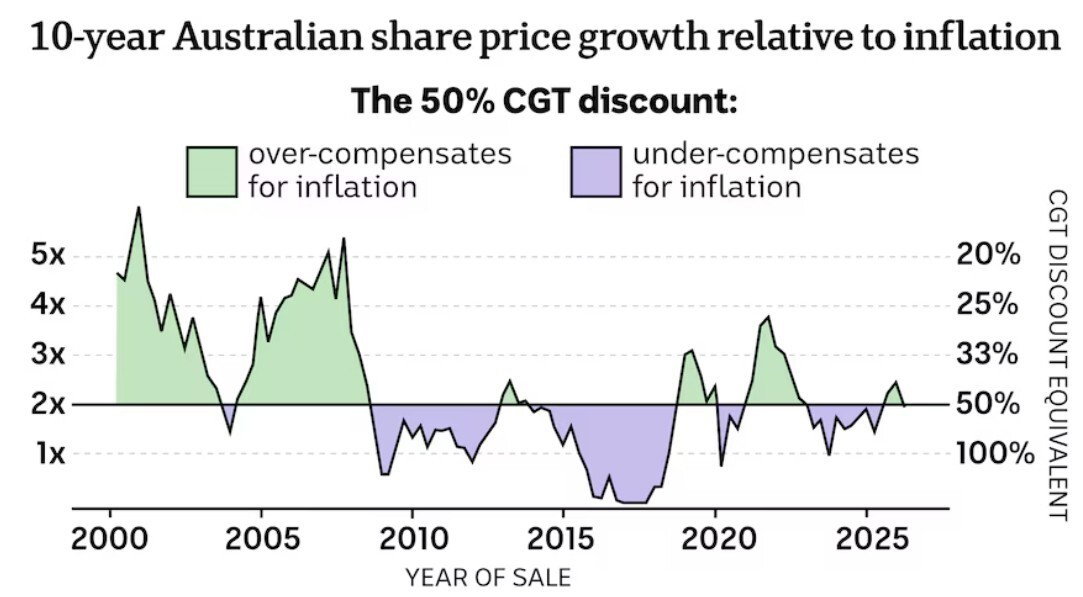 The CGT discount does not appropriately compensate investors in the share market, according to the budget. (Supplied: Treasury, ASX, ABS)
Devika Shivadekar, an economist at consultancy firm RSM Australia, said the CGT changes would likely incentivise people to think about other methods of wealth building outside of property.
“Australians’ obsession with building property portfolios has, over time, created an inequity between the haves and the hopefuls,” Ms Shivadekar said.
“In isolation, CGT changes might cost share investors, but it will likely encourage people to look for investments outside of property.”
Read more from myself, Jasper Wells and David Taylor: