
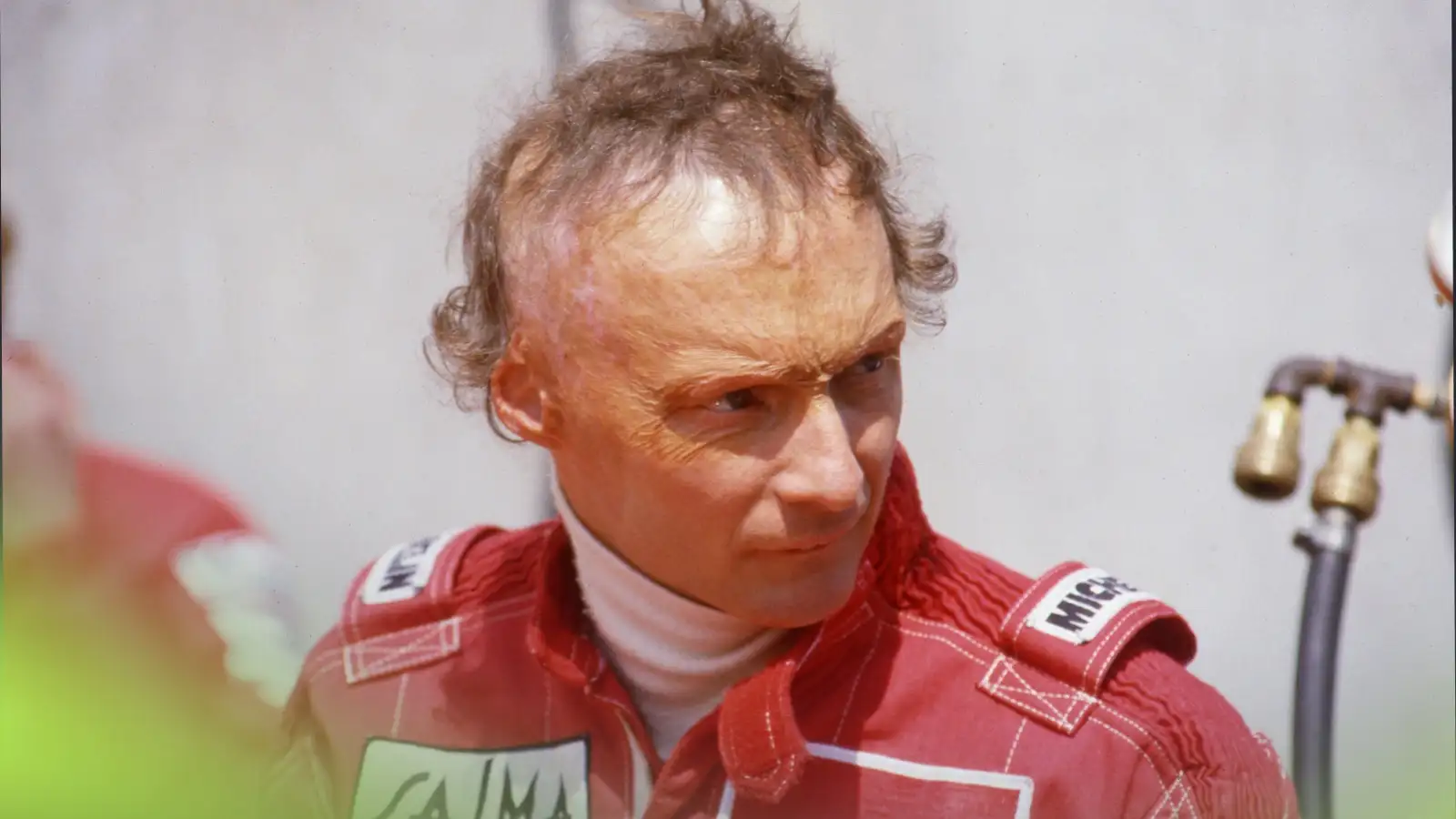
As Max Verstappen prepares for his Nürburgring 24-hour debut, we are looking back at one of the circuit’s and F1’s most memorable moments – the crash of Niki Lauda in 1976.
Niki Lauda was a three-time Formula 1 World Champion. He raced 171 times, won 25 races, stood on the podium 54 times and yet for many, the moment that defines his legacy more than anything else came in the fire of one of F1’s most horrific crashes.
Remembering Niki Lauda’s 1976 Nürburgring crash
Want more PlanetF1.com coverage? Add us as a preferred source on Google to your favourites list for news you can trust
The context
Born in Vienna in 1949, Lauda did not exactly come from a racing background. He was born into a paper-manufacturing family and although they had the money needed for a career in motorsport, they disapproved of their son’s chosen profession, later opting to cut ties with him as he continued with his pursuit.
Lauda’s racing career began with Minis in 1968 before a move to Formula Vee and Formula Three. In 1971, he took out a loan against his life insurance policy to buy his way into the March team and secured a seat as a Formula 2 driver in 1971.
Anyone who has ever seen the movie Rush will know Lauda’s talent both in the car and out of it saw him quickly rise up the ranks and he drove in his first Formula 1 race in 1971, the Austrian Grand Prix.
His first two full seasons in the sport were full of reliability issues and it was not until the Belgian Grand Prix in 1973 that he scored his first F1 points but his talent was already being noticed, particularly by Enzo Ferrari.
On the advice of Clay Regazzoni, Ferrari signed Lauda for the 1974 season and he finished fourth in his first season. The following year, he won the World Championship, securing five race wins and defeating rival James Hunt.
Heading into the 1976 season, those two were the clear title contenders and two wins in the opening two races gave Lauda the edge.
The Nürburgring
By the time of the 10th round of the Formula 1 season in Germany, Lauda was on double the points of his nearest competitor. Hunt was joint third on 26 and in desperate need of a change in fortunes.
The sport arrived at the Nürburgring with concerns already raised over the Nordschleife circuit.
Jackie Stewart described it as the “Green Hell” and five Formula 1 drivers had already been killed at the Nordschleife, most recently in 1969.
As well as the track itself, one of the key safety concerns was that due to the size of it, there would need to be five times the number of marshals and medical support there were for a normal race. The German organisers were unable to provide that and Lauda took exception to that.
With rain forecast, Lauda campaigned heavily for a boycott but his fellow drivers voted against him and so with Saturday’s running rained off, the grid on Sunday lined up in Friday’s qualifying order with Hunt on pole and Lauda behind him.
The crash
A delay to the start time due to the need to clean up from crashes of a previous race meant rain hit the circuit on the far side, prompting drivers to opt to start on wet tyres.
After the opening lap, almost all of them came in after a lap for slicks including Lauda, who did not have a great start. After he switched to dry tyres, he pushed hard to try and make up for the lost ground.
As he approached the Bergwerk right hand curve, Lauda’s Ferrari snapped to the right and spun through a fence into an earth bank.
Lauda left the circuit at a speed of 120mph, causing his fuel tank to rupture and burst into flames, engulfing both car and driver. Now helpless, Lauda was stuck in the middle of the track and although the next approaching car, Guy Edwards managed to avoid him, Brett Lunger could not.
“As I committed to the turn, I saw some dirt going up in the air and I knew something was wrong, and, sure enough, I came around, exited the turn, and he was sideways on fire in the middle of the track,” Lunger told the BBC. “I slowed, but my car still went into his and impacted his.”
Harald Ertl then crashed into Lunger and all three drivers rushed to help Lauda out of his engulfed car but could not release him from the cockpit.
More on the Nürburgring
The unseen Max Verstappen trick that has already stunned a Nürburgring legend
Nürburgring 24 Hours schedule 2026: Full timetable, qualifying and start time
How Lauda was saved
All three men are credited with helping save Lauda’s life but the role of a fourth, Arturo Merzario, was perhaps the most influential.
Merzario had driven for Ferrari in the past so when he approached the scene, he knew how the harness unclipped. With Lauda now free, Merzario pulled him from the car and to the grass verge on the side.
‘’At that time I was a small guy like him,” Merzario later said. “How did I manage to lift his entire body with my two arms? I don’t know. This proves that in times of danger miracles can always happen.’’
The other drivers assisted as Merzario then attempted to douse the flames with a fire extinguisher. In the crash, Lauda’s helmet had flown off leaving his face exposed to the fire. His wrists were also burnt along with broken bones and toxic fumes had filled his lungs from the burning fibreglass and fuel that he had inhaled.
Lauda was eventually reached by medical personnel who airlifted him to the Bundeswehr hospital in Koblenz and then on to the Trauma Clinic in Ludwigshafen.
He slipped into a coma, a moment that he recalled just a year later.
“When I came to the hospital… you are very tired, and you would like to go and sleep. But you know it is not just going sleeping, it’s something else,” Niki Lauda told the BBC in 1977.
The outlook was bleak. Lauda was read his last rites and had extensive scarring on his head, including the loss of his right ear and the hair around it. The scarring was so bad that he needed skin grafts and the only reconstructive surgery he permitted was for his eyelids to be rebuilt using skin from his ears.
Despite all initial assessments, Lauda pulled through and left the hospital just six weeks later.
Lauda’s return to racing
Lauda’s whole career was a story of persisting even when you were told no but his most defiant act came when he returned to the Formula 1 grid just six weeks after his accident.
He had missed just two races and appeared at a pre-race press conference in Monza with his face still bandaged. Lauda later admitted he was “rigid with fear.”
“I said then and later that I had conquered my fear quickly and cleanly,” Lauda wrote in his autobiography To Hell and Back. “That was a lie. But it would have been foolish to play into the hands of my rivals by confirming my weakness. At Monza, I was rigid with fear.”
He wore a specially adapted helmet to limit the pain as he drove. His eyes watered excessively due to damaged tear ducts. Blood would seep through his bandages and stick to his balaclava and despite all of this, he finished fourth at the Italian Grand Prix.
Jackie Stewart recalled: “I will never forget him putting his helmet on and he was suffering so much pain. When he came out from driving at the end, I was there, and the blood was running down out of his helmet.”
Lauda lost the 1976 World Championship by a single point and opted to retire after two laps in the final race due to torrential rain but that year came to define his legacy.
Lauda was already a title winner but the events in 1976 made him a legend of the sport. Two more championships came, but perhaps more impactful than all of that, his crash was the catalyst for F1 to stop using the Nordschleife which was a decision that undoubtedly saved lives.
When he died in 2019, his former team-mate John Watson described Lauda’s return as “the most courageous act of any sportsman I’ve ever seen in my life.”
Want to be the first to know exclusive information from the F1 paddock? Join our broadcast channel on WhatsApp to get the scoop on the latest developments from our team of accredited journalists.
You can also subscribe to the PlanetF1 YouTube channel for exclusive features, hear from our paddock journalists with stories from the heart of Formula 1 and much more!
Read more: Verstappen drops biggest hint yet over F1 exit amid Nürburgring debut