
Baseball, you may have heard, is a simple game.
You throw the ball. You hit the ball. You catch the ball.
Yet the rulebook that governs Major League Baseball games runs 57,991 words across a 192-page PDF I highly recommend as bedtime reading. For a simple game, there sure are a lot of rules. For instance, Rule 3.03(h): “Glass buttons and polished metal shall not be used on a uniform.”
After we ran a retrospective on the ban of the extreme infield shift, readers submitted rule changes they’d like to see. Some addressed structural changes to the sport (like abolishing interleague play). Others called for aesthetic or auditory tweaks (like ad-free outfield walls and less piped-in music). Many advocated for a return to former rules on designated hitters, intentional walks, shifts, three-batter minimums or pick-off attempts.
For this mailbag, I focused on proposals that would meaningfully impact the on-field product. Below are 10 suggestions ranging from the pragmatic to the outrageous. Submissions have been edited for clarity and brevity.
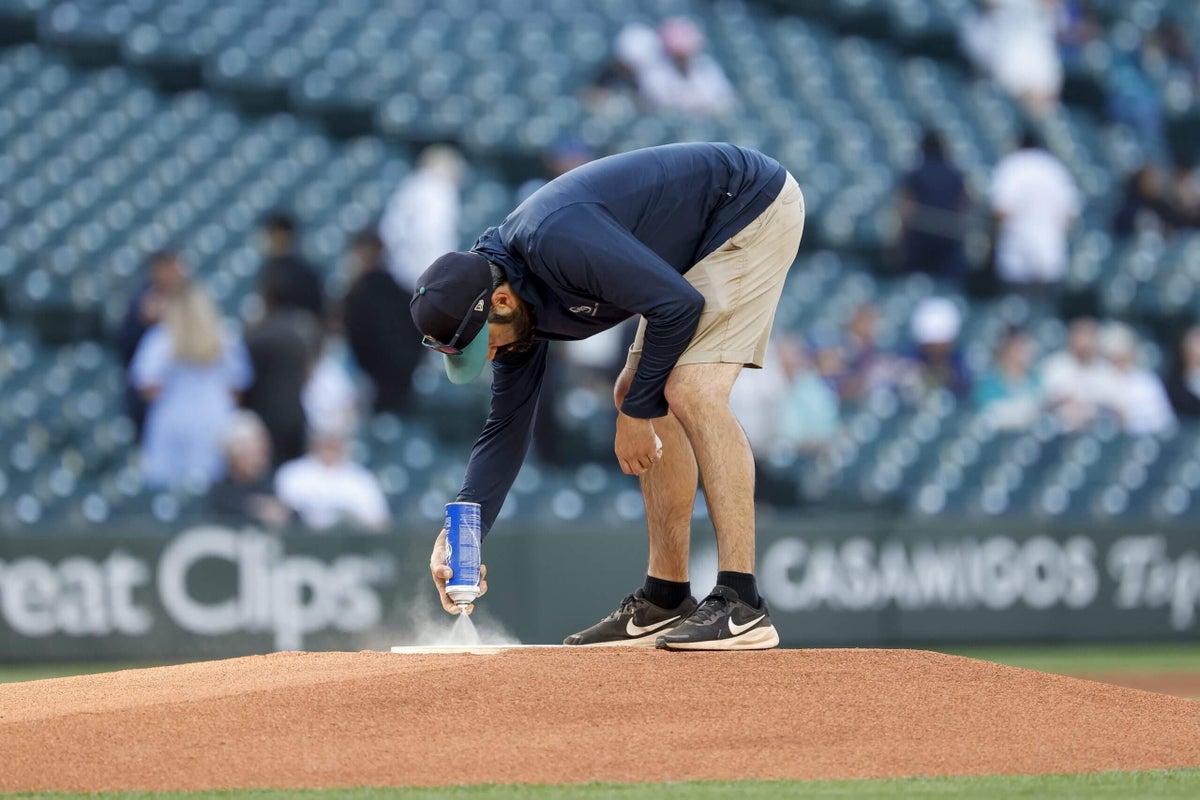
Lower the mound. — Les W.
It’s easy to imagine the league revisiting a solution it has already used to stimulate offense. In 1968, leaguewide ERA was 2.98. Seven qualified starters had sub-2 ERAs. It was “The Year of the Pitcher.” In response, MLB lowered the mound from 15 inches to 10.
A year later, the leaguewide ERA climbed to 3.61. Batting average jumped by 11 points. On-base percentage was up 21 points.
It’s tempting to translate those gains to today’s game. But there was a complicating factor: It wasn’t just the mound. MLB also tightened the strike zone in 1969. (Walk rate climbed 1.5 percentage points year over year.) We can’t definitively say how much lowering the mound impacted the offensive environment.
Still, this would be simple to implement. Halving the mound height to five inches would be nearly imperceptible to fans. Pitchers and hitters surely would notice — it would hurt pitchers’ ability to create depth with steeper attack angles. Some already complain about mound variance; several pitchers have talked about how low the mound feels in Cincinnati, even though it has been measured as accurate. The Arizona Diamondbacks’ Merrill Kelly said, “Our mound at home feels like a mountain compared to Cincinnati’s.” Another pitcher explained to me that because the field at Great American Ball Park is crowned and drains toward center field, it gives the perception you’re pitching uphill.
In 2017, an MLB-funded American Sports Medicine Institute (ASMI) study concluded throwing from a lower mound may slightly reduce shoulder and elbow kinetics, possibly reducing injury risk. But no significant effect on ball movement was detected. “[I]t might not give the advantages you’d think it would,” ASMI research director Glenn Fleisig told The Ringer’s Ben Lindbergh.
Moving back the mound is the one change that would deal with myriad issues without affecting the geometry and feel of the game. For fans, it would essentially be invisible. — Elisha S.
MLB studied this, too, backing an ASMI study that observed pitchers throwing from three distances: 60 feet, 6 inches; 62 feet, 6 inches; and 63 feet, 8.25 inches. Increased distance gives hitters more time to see the pitch, but pitchers see a trade-off: “It would make spin way more nasty,” an MLB starter told me.
When Driveline Baseball tested this in 2021, at Lindbergh’s request, it saw improved contact, pull and hard-hit rates when hitters faced a pitching machine placed two feet farther back than normal. Still, Driveline’s Kyle Boddy told Lindbergh, “Hitters also expect certain shapes on pitches, and increased distance gives the pitch more time to break. I strongly, strongly suspect increasing the distance will lead to increased walks, increased strikeouts, and fewer homers.”
That same year, MLB announced its latest Atlantic League experiment: Moving the mound back by a foot. The Athletic’s Jayson Stark wrote about it at the time. That experiment died quietly, abandoned after half a season. There was no meaningful uptick in contact. Pitchers lost some velocity but gained movement and couldn’t find the strike zone.
In theory, moving the mound makes sense. It’s been 133 years since the mound was set at 60 feet, 6 inches. Pitchers now are taller, harder-throwing and more athletic. It may be worth experimenting further at levels where pitchers have better command — granted, MLB’s walk rate in 2026 is already at a quarter-century high — but MLB hasn’t revisited the idea since the Atlantic League trial flopped.
Allow teams to concede a game instead of having a position player pitch. Don’t talk to me about the integrity of the game and give me this nonsense. What used to be a once in a decade event is now commonplace. — Jeff S.
Many readers agreed. David D. wrote: “If you’re putting in position players to pitch, you’re no longer really trying to win the game, so there’s no reason to keep playing.” Hans V. added, “Watching an 11-1 game in the eighth inning is like Sominex.”
Folks …
They’re right. No one wants to watch a snoozer. It’s time for a major-league mercy rule.
The problem with position players pitching is that they aren’t. Under orders from the manager to get the game over without getting hurt, they lob the ball rather than show why they were an all-county pitcher in high school. There are position players who could throw triple-digits fastballs. Others who could carve with breaking balls. But they’re not permitted to try. It’s not fun. It looks bad. And we’re counting the stats? The game’s stats are sacred, yet it allows noncompetitive behavior?
It’s buffoonery, Jeff. It sullies the sport. Let them concede.
Put the kibosh on all electronic technology in the dugout during games. (OK, keep the phone to the bullpen.) Players and coaches should be using their own physical senses, experiences, and communicative abilities in real time to figure out what’s going on. — Andrew M.
It is disconcerting to see a hitter return to the dugout after a strikeout or home-run trot and go straight to a tablet to consult video.
But it would be relatively complicated to ban tech. Even if tablets weren’t permitted in the dugout, players could retreat to the clubhouse or video room to review footage of their at-bat. If MLB managed to ban even that access, it’s unlikely the no-tech approach would significantly impact gameplay; if anything, it would put pitchers at even more of an advantage. It would just look better. And that does matter.
Draw an imaginary line from first base to second and extend it all the way to the outfield wall. Do the same from third base toward second. Only the center fielder can line up in the triangle created by those lines. — Mitchell W.
This is an expanded version of the “pie-slice rule” Stark wrote about that would prevent middle infielders from playing behind second base — eliminating the last bastion of the infield shift — and a cousin of the “arc” rule that would keep outfielders from playing no-doubles depth.
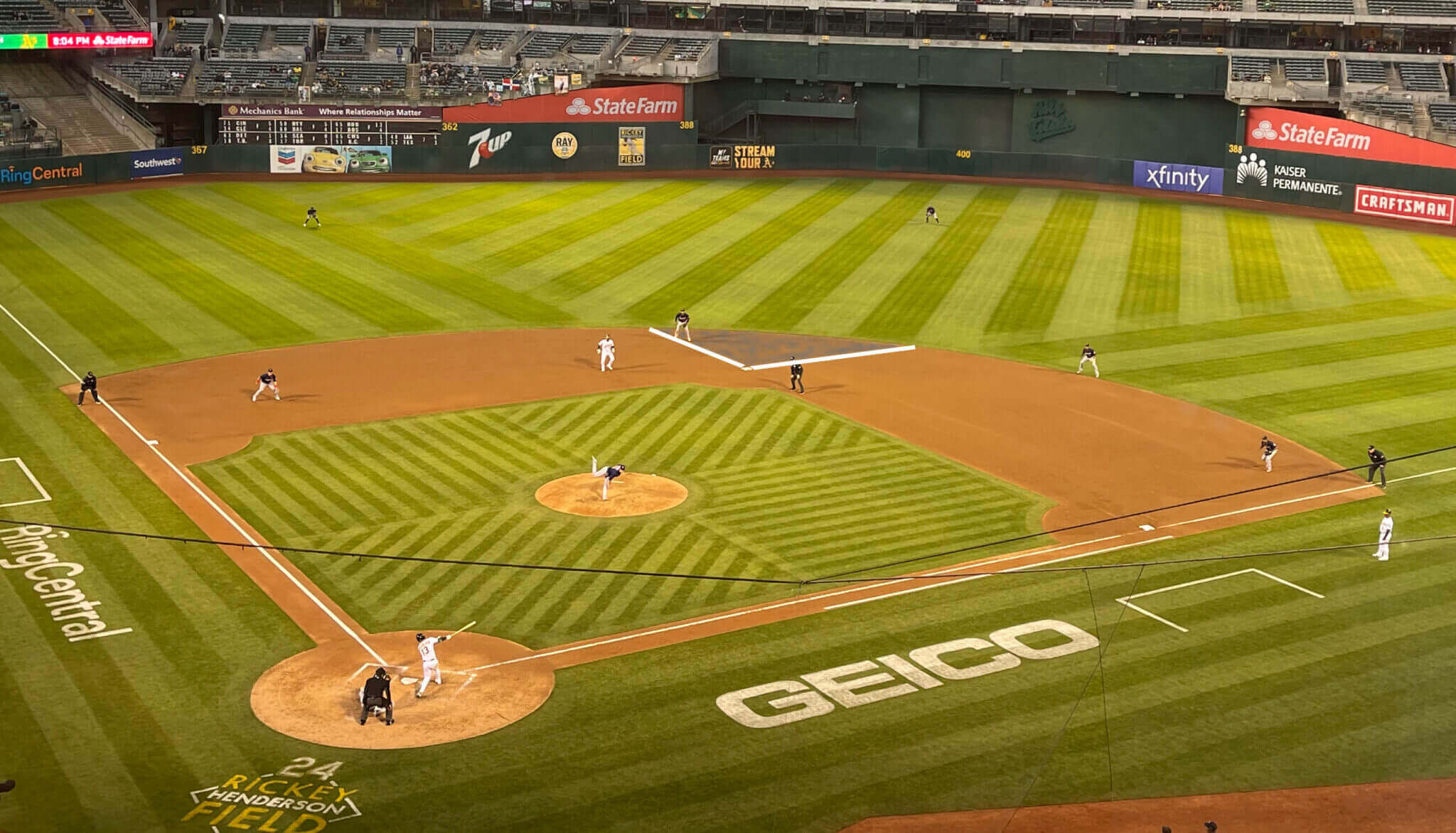
A visual approximation of the new no-infielder zone created by the “pie-slice rule.” (Eno Sarris / The Athletic)
This proposal allows outfielders to play as deep as they want but restricts them from shading the gaps. It’s unclear how often corner outfielders shift that far toward center, but I’d expect this rule would bring back some extra-base hits and more singles up the middle.
Policing the positioning could be a headache. How do you mark these lines without making the grass look like a parking lot? Two painted lines extending to the wall would look atrocious.
Starting pitchers can only be relieved under these conditions: Pitch five innings, throw 80 pitches or allow five runs. — Adam C.
Reviving the starting pitcher is so popular with fans that it has placed considerable pressure on the league to make it happen. But how? Adam’s rule proposal was one of many that attempted to halt the parade of high-octane relievers. Others suggested MLB further restrict the size of pitching staffs, institute a Double Hook rule, or limit the number of active relievers each game.
The conflict at the center of today’s game: What fans find eminently reasonable and how players and clubs operate remain at odds. Max effort versus max enjoyment.
If the league were to step in, forcing starting pitchers to go five innings or 80 pitches seems like a modest starting point. No more openers or bullpen games. You would need some sort of injury exception, like requiring a player to go directly to the injured list if they are removed for injury before any of the conditions are met.
Standardizing and shrinking the infield dirt by removing a few feet of dirt toward the outfield edge all the way around. — Don K.
Once again, Stark is already all over this oddity! MLB has now standardized its dimensions — Rule 2.01(a): “The grass line of the outer boundary of the infield dirt shall be a 95-foot radius from the center of the pitcher’s plate” — but allows a foot of leeway in either direction. So, a perfectly legal MLB ballpark could be two feet larger than others.
Why not shave off a few more feet?
Infield defenders, like their outfield counterparts, are playing farther back over time, particularly at the corners. Shrinking the amount of dirt available to them would, as Don wrote, increase BABIP by forcing defenders closer to the hitter, and could be done without impacting the visual look of the game.
Get rid of the batting order. — Ethan K.
Here’s where the wild ideas begin.
Under Ethan’s plan, all nine hitters must bat before any can step in again — and a baserunner can’t be chosen to hit. This proposed rule permits the manager to reshuffle the order each time through. Do you burn Aaron Judge with a runner on and no outs or wait for a higher-leverage moment? What if that moment never comes?
This idea is pure chaos. It would incite revolt. But it’s fun to think about. It’s the “Golden At-Bat” idea on steroids. If a manager played his cards right, he’d have his best hitters ready in the biggest situations, and would force the other team’s bullpen to be getting multiple arms hot at once. You could give the opposing manager one veto per game, too: You’re down to Yordan Alvarez and Christian Vásquez with two outs and the bases loaded? Vetoing Alvarez!
From two weeks before Opening Day until one week after the World Series, no trades whatsoever. You could sign a player who had been waived outright, or who was entirely outside the current system (maybe a semi-pro phenom), but otherwise you would have to work with your roster. — Phillip J.
This would end the trade deadline as we know it and rob us of witnessing these wheelin’ and dealin’ executives work. No more moves, Jerry Dipoto. In fact, you can take most of the summer off!
Phillip wants team chemistry and an organizational identity. He proposes 52-man MLB rosters with unlimited movement between the majors and minors. While it could be attractive for those tired of the revolving door of MLB rosters, I’m not sure it would be that impactful. Teams don’t trade that much during the season. Good teams are prevented from strengthening weak spots — I do see the potential fun in that! — and bad teams are unable to get value for their rentals.
Decide extra-inning games with a one-inning “Showdown” — Tony M.
Before we end, let’s acknowledge the “Manfred man” in the room. Many of you detest the extra-innings runner rule. It has succeeded in getting extra-innings games over quickly and making fans fume. Readers proposed banning the extra-innings runner, modifying the rule to start later or on a different base, or removing a defensive player instead.
But the extra-innings rule change I highlighted came in the form of a 631-word missive from Tony. It boils down to this: The game is decided in a half-inning.
The home team chooses to pitch or hit. Any player can return to the game. The hitting team starts with a runner at first base, no outs, and selects five batters. Ballgame’s over after one run or three outs.
This showdown is less gimmicky than a swing-off, Tony wrote. I’m inclined to agree. There’s strategy. A manager might save his best reliever in the ninth inning of a tied game, planning to send him out to secure three deciding outs in extra innings. You’d want to make your best baserunner the man on first, but what if he’s also one of your top five hitters? And what if your top hitter is a double-play threat?
According to FanGraphs, a runner on first base with no outs carries a run expectancy of 0.48. That’s a pretty fair position to put the sides in. If I had my closer available, I’d probably choose to pitch. What about you?