
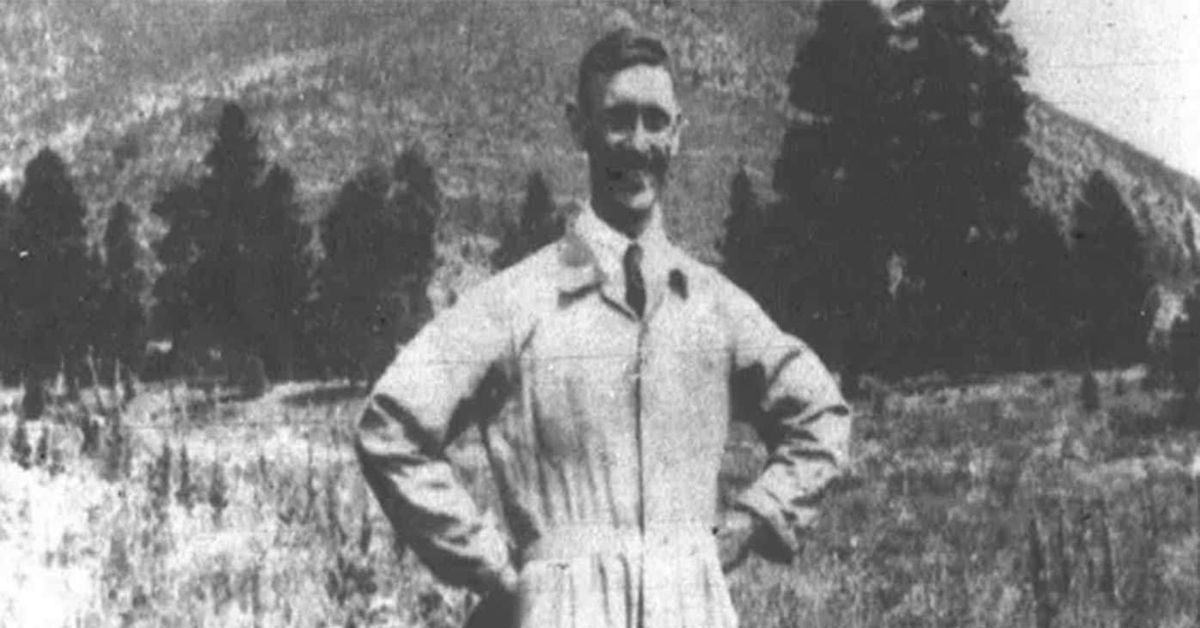
A house painter with a terminal cancer diagnosis was given the highest dose of radiation ever received by a human on May 14, 1945.
Albert Stevens was told he was being given an injection to help address his terminal stomach cancer.
 Albert Stevens was never told he didn’t have cancer. (Public Domain)
Because Stevens was going to die, the scientists at the University of California saw no harm in using him for the macabre experiment.
“Albert Stevens got many times the so-called lethal textbook dose of plutonium,” scientist Kenneth Scott said.
It was then the researchers made an alarming discovery – Stevens had been misdiagnosed.
Instead of having a malignant tumour, Stevens instead had an inflamed gastric ulcer – unpleasant but benign.
This had been missed during a previous operation. Because it was believed the cancer had spread, Stevens had had his spleen, ninth rib, lymph nodes and parts of his liver and pancreas removed – all for nothing.
But the ever-secretive scientists at the university decided they would not tell Stevens that he had never had cancer.
 The Manhattan Project studied the impact of radiation on humans, in addition to building atomic weapons. (Corbis via Getty Images)
Instead they paid him to stay in San Francisco so they could collect daily stool and urine samples from him.
He died of heart disease 21 years later, at the age of 79.
Stevens had been experimented on as part of the Manhattan Project studies into radiation, conducted in the lead-up and aftermath of the atomic bombing of Hiroshima and Nagasaki.
Seventeen other people were also unwittingly injected with plutonium, just to determine the results.
The first, Ebb Cade, was a construction worker in Tennessee who was taken to hospital after fracturing his leg in a traffic accident.
His fractures were untreated for 20 days before he was injected with plutonium.
In order to measure plutonium spreading through his body, 15 of his teeth were removed.
Eventually Cade escaped from the hospital.
 Joseph Hamilton lost confidence in the morality of human subjects. (Public Domain)
Another subject was a four-year-old Australian boy called Simeon Shaw.
Shaw was flown to the US ostensibly for treatment for his bone cancer.
Instead scientists just wanted to test the plutonium on him. He died two years later.
None of the subjects died from radiation exposure, but few lived long after the experiment.
But the lead scientist behind the tests, Joseph Hamilton, did die as a result of radiation exposure, dying at 49 of leukaemia.
A report into the radiation experiments was not released until October 3, 1995.
But because the report came out on the same day as the OJ Simpson verdict, it did not attract much media attention. The moment OJ Simpson was found not guilty in the death of his ex-wife Nicole Brown Simpson and her friend Ron Goldman. (AP)
NEVER MISS A STORY: Get your breaking news and exclusive stories first by following us across all platforms.