
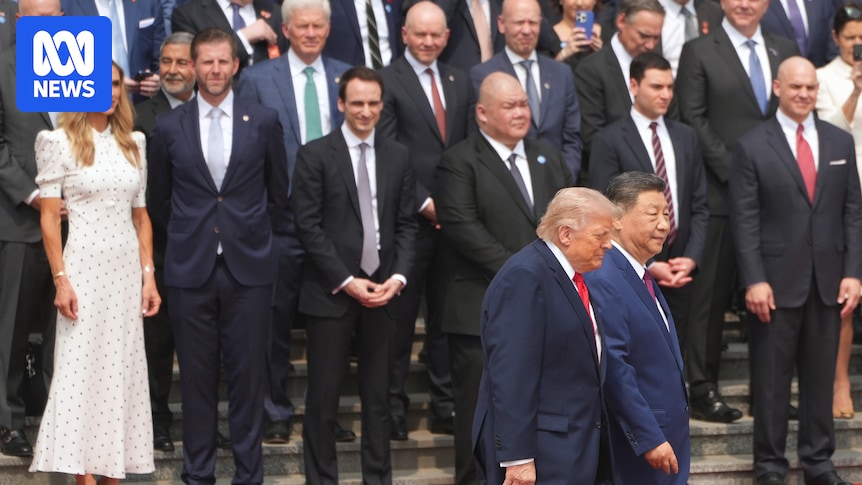
US President Donald Trump and Chinese leader Xi Jinping are meeting in Beijing this week for a high-stakes two-day summit.
The “America-first” Republican has brought a select group of business titans, who have been snapped on the periphery of welcome events.
Here is what to know about who makes up the US delegation and why they’ve made the trans-Pacific trip.
Why is Trump in China?
Trade will be at the top of the summit’s agenda.
Trump’s “Freedom Day” tariffs sparked a tit-for-tat trade war with China last year.
The leader with the upper hand in Trump-Xi meeting
The US blocked shipments of the most advanced computer chips to China, and Beijing blasted back by periodically cutting off supplies of rare earth minerals crucial for batteries, medical devices and weapons manufacturing.
China stopped buying US soybeans, delivering a targeted blow to Trump’s supporters in rural America.
Purchases resumed after talks between the US and China in October, but American soybean exports to China still dropped by 75 per cent in 2025.
Now, the two leaders are meeting to repair some of the damage.
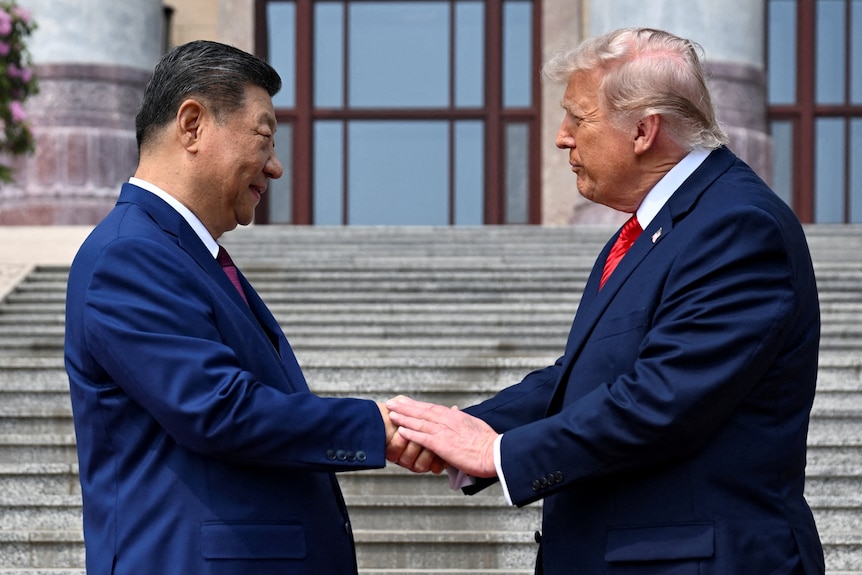
Xi Jinping and Donald Trump will look to smooth trade relations during the summit. (Reuters: Kenny Holston/Pool)
Trump says he will be talking with Xi about trade “more than anything else”.
Still, some other key issues are expected to dominate the agenda.
China is unhappy with US plans to sell weapons to Taiwan, a self-governing island the Chinese Communist Party claims as its own territory.
On Monday, Trump told reporters he would discuss the $US11 billion ($15.16 billion) weapons package.
The funding was authorised in December, but no money’s been spent.
The arms package is the largest the US has ever approved for Taiwan.
With the world awaiting an end to the war in Iran, the conflict has already surfaced in the talks.
China offered a veiled criticism of the US-led conflict in the Middle East back in April, urging the world not to revert to the “law of the jungle”.
Given its close political and economic ties with Iran, there have been suggestions it could influence Iranian leaders in ongoing peace talks.
But China’s cautious approach to the conflict indicates it would prefer to not get involved, according to experts.
“I don’t think China has any interest in solving the problems the US has created for itself in the Middle East,” said Henrietta Levin, a senior fellow for the Freeman Chair in China Studies at the Center for Strategic and International Studies in Washington.
A few days before the trip, US Treasury Secretary Scott Bessent called on China to pressure Iran to open the Strait of Hormuz, and said that by buying Iranian oil, Beijing was funding terrorism.
“Let’s see if China — let’s see them step up with some diplomacy and get the Iranians to open the strait,” Bessent said on Fox News.
“Iran is the largest state sponsor of terrorism, and China has been buying 90 per cent of their energy, so they are funding the largest state sponsor of terrorism.”
But on his way to board Air Force One to fly to Beijing, Trump told reporters he did not think he needed help from Xi to end the war.
“We have a lot of things to discuss,” he said.
“I wouldn’t say Iran is one of them, to be honest with you, because we have Iran very much under control.
“No, I don’t think we need any help with Iran. We’ll win it. We’ll win it peacefully or otherwise.”
Who is joining Trump in China?
When the president’s private jet took off from Joint Base Andrews in Maryland on Tuesday, local time, Trump was not alone.
In addition to Secretary of State Marco Rubio, Secretary of Defense Pete Hegseth and Trade Representative Jamieson Greer, Trump was joined by a handful of business executives.
Eric Trump, the president’s second-eldest son and the executive vice-president of the Trump Organization, was onboard Air Force One.
He manages the company’s global real estate portfolio, golf courses, and luxury hotels, alongside his older brother, Donald Trump Jr.
The Trump Organization said the younger Trump was only in China to support his father, and there was no indication he would pursue business talks, according to the New York Times.
Lara Trump, Eric’s wife and the former co-chair of the Republican National Committee, was also on the flight.
Trump personally invited Nvidia CEO Jensen Huang to board Air Force One during a refuelling stop in Alaska on the way to Beijing.
It comes just months after Nvidia received conditional approval to sell one of its powerful AI chips, the H200, to China.
Those conditions allow the export of H200 chips, provided there is adequate supply in the US, and the H200 chips must undergo a third-party review before being exported to China.
But these rules, set by the Commerce Department’s Bureau of Industry and Security, lower the bar for chip exports to China.
China won’t be allowed to use the chips for military purposes and is not able to import more than 50 per cent of the chips sold to US customers.
The H200 is not Nvidia’s most advanced product. Those chips, called Blackwell and the upcoming Rubin, are not approved for export.
Elon Musk, the CEO of Tesla and SpaceX who led Trump’s Department of Government Efficiency before it was shuttered in November, was on Air Force One, according to a White House official who spoke to the Associated Press on the condition of anonymity.
Just last year, the billionaire was in a war of words with Trump and claimed, without providing evidence, that the president was concealing information about his previous association with paedophile Jeffrey Epstein.
Musk eventually said he regretted some of his comments. He has since refocused his energy on Tesla and his other companies.
Brett Ratner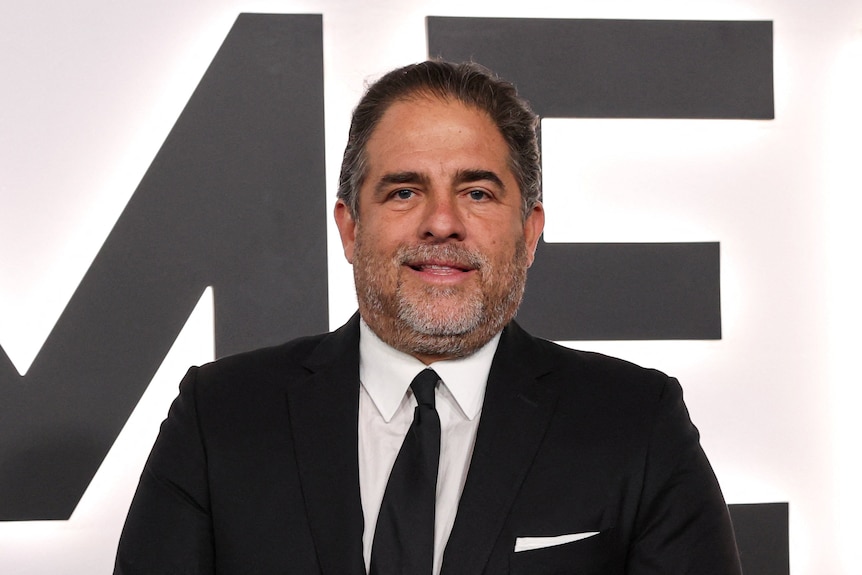
Film director and producer
Reporters spotted Brett Ratner — who directed the Amazon documentary Melania, about first lady Melania Trump — on Air Force One.
The filmmaker was effectively blacklisted from Hollywood, after multiple women accused him of sexual assault or misconduct in 2017.
He has denied the allegations.
Trump said the following people were also among the group of business executives in China for the talks.
Apple CEO Tim CookBlackrock chairman and CEO Larry FinkBlackstone chairman, CEO and co-founder Stephen SchwarzmanBoeing CEO Robert “Kelly” OrtbergCargill chairman and CEO Brian SikesCiti chairman and CEO Jane FraserGE Aerospace chairman and CEO H Lawrence CulpGoldman Sachs chairman and CEO David SolomonMicron chairman, president and CEO Sanjay MehrotraQualcomm president and CEO Cristiano Amon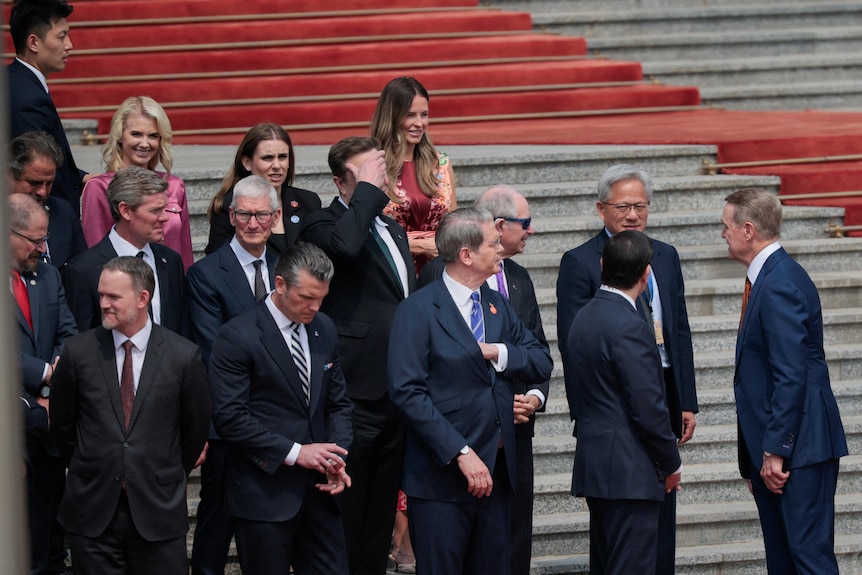
The US delegation awaiting the arrival of Donald Trump for a welcome ceremony at the Great Hall of the People on Thursday. (Reuters: Evan Vucci)
Why are the business executives there?
They will likely be seeking to negotiate investments and broker deals.
It’s not unusual for business heads to tag along when US presidents make diplomatic trips, and major business deals or purchases are often announced during summit meetings between China and the US.
During his first term, Trump brought a delegation of corporate leaders on a trip to Beijing in 2017, and companies from the two nations signed trade and investment deals worth more than $US250 billion while there.
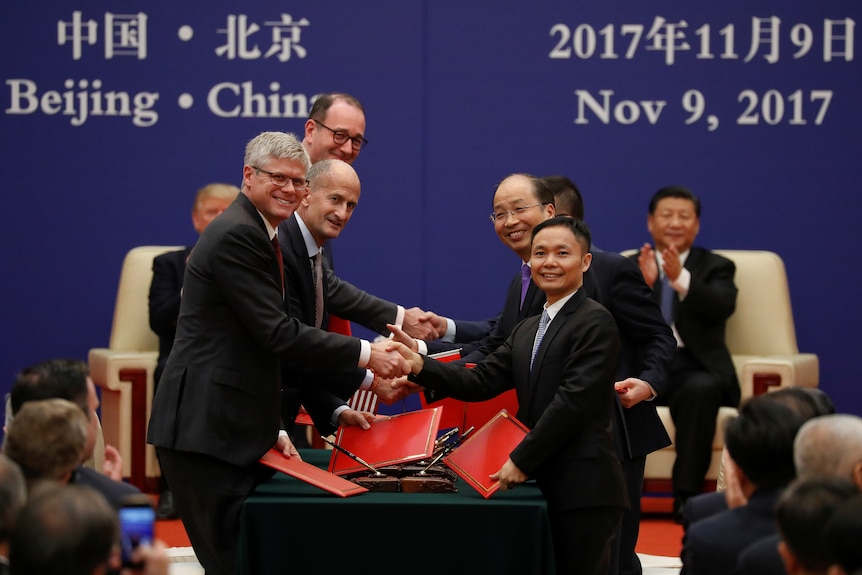
A signing ceremony during Donald Trump’s visit to Beijing in 2017 saw the finalisation of $US250 billion in commercial agreements. (Reuters: Damir Sagolj)
Trump said he would ask Xi to give US firms greater access to the Chinese market, urging his Chinese counterpart to “‘open up’ China so that these brilliant people can work their magic”.
Trump and Xi’s AI talks will be critical for humanity
“In fact, I promise that when we are together, which will be in a matter of hours, I will make that my very first request,” he wrote on Truth Social while travelling to Beijing.
“I have never seen or heard of any idea that would be more beneficial to our incredible Countries!”
As expected, the US and China have established a formal dialogue to guide their partnership over the coming years.
The two countries will establish a ‘China-US Constructive Strategic Stability’ as the new positioning of our relations,” Xi said.
“This will provide strategic guidance for the next three years and beyond, and I believe it will be welcomed by both our peoples and the international community,” according to a readout published by the Chinese Foreign Ministry.
ABC/AP/Reuters