
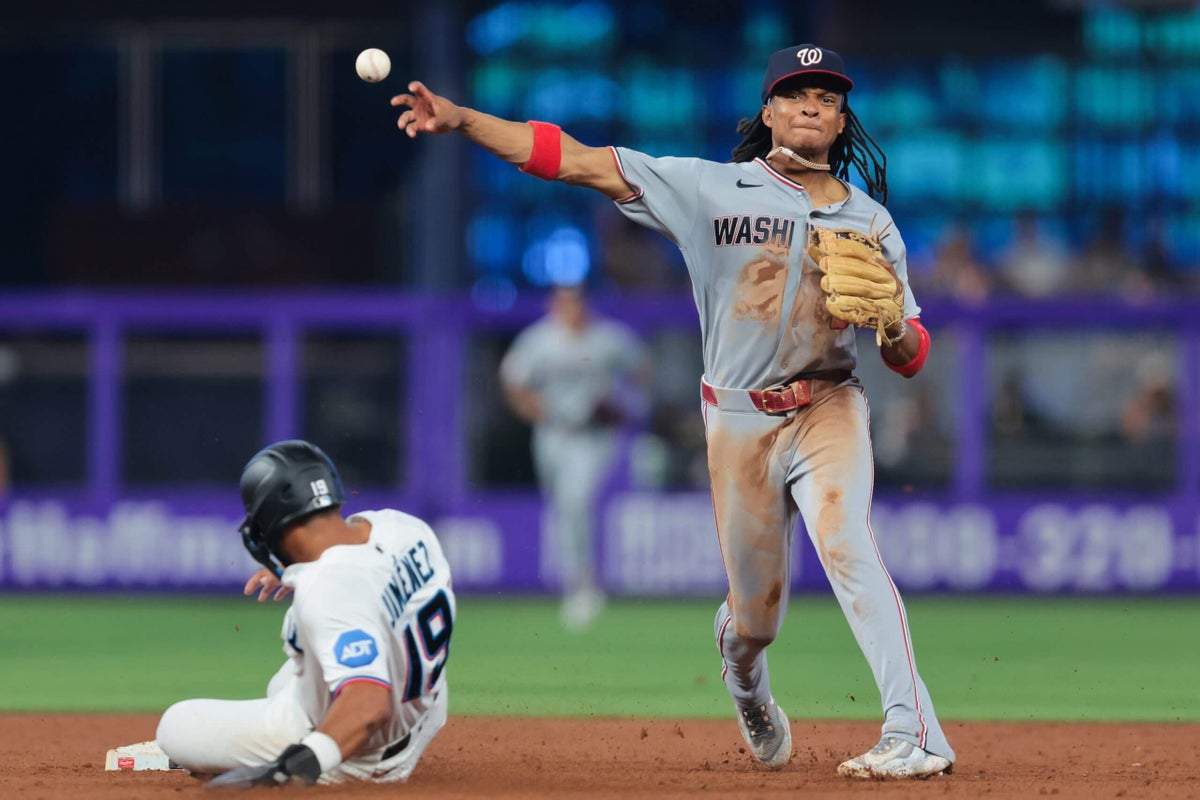
CINCINNATI — The Washington Nationals understand the situation as well as any of us do. CJ Abrams is a preternaturally gifted player. He has a good shot at a 30-30 season and has been one of the best offensive shortstops in MLB this year.
It’s the shortstop part that complicates matters.
Since Abrams debuted in 2022, no player has committed more errors (82) or registered fewer Outs Above Average (minus-53). The highlights are there, but the consistency is not where he or the Nats need it to be. Even under new instruction, the issues have persisted.
This season has put a microscope on his predicament. His new manager is a stickler for crisp defense. His availability at the trade deadline is a talking point for teams around baseball. And his grip on the position has displaced Nasim Nuñez, a fixture in the lineup and the organization’s best defensive shortstop, who, for now, is stuck at second base.
Wednesday night gave the dilemma a platform.
In Washington’s eventual 8-7 win and with the game tied in the third, Nuñez flipped a potential inning-ending double-play ball to Abrams, who tried to make a quick throw, but it sailed right into the Reds’ dugout. The play brought the go-ahead run home. On the very next play, Nuñez lunged to his right and ripped a 107.3 mph screamer out of the air to save a run and end the inning.
Still, the solution is not as simple as having Abrams and Nuñez swap positions. Not when money and trade value are on the line; and not when both Abrams and the Nats believe there is still more they can do to make him a better shortstop.
“It could be better,” Abrams said this week when asked about his defense. “But today was good. We’re going to put in good work and keep building.”
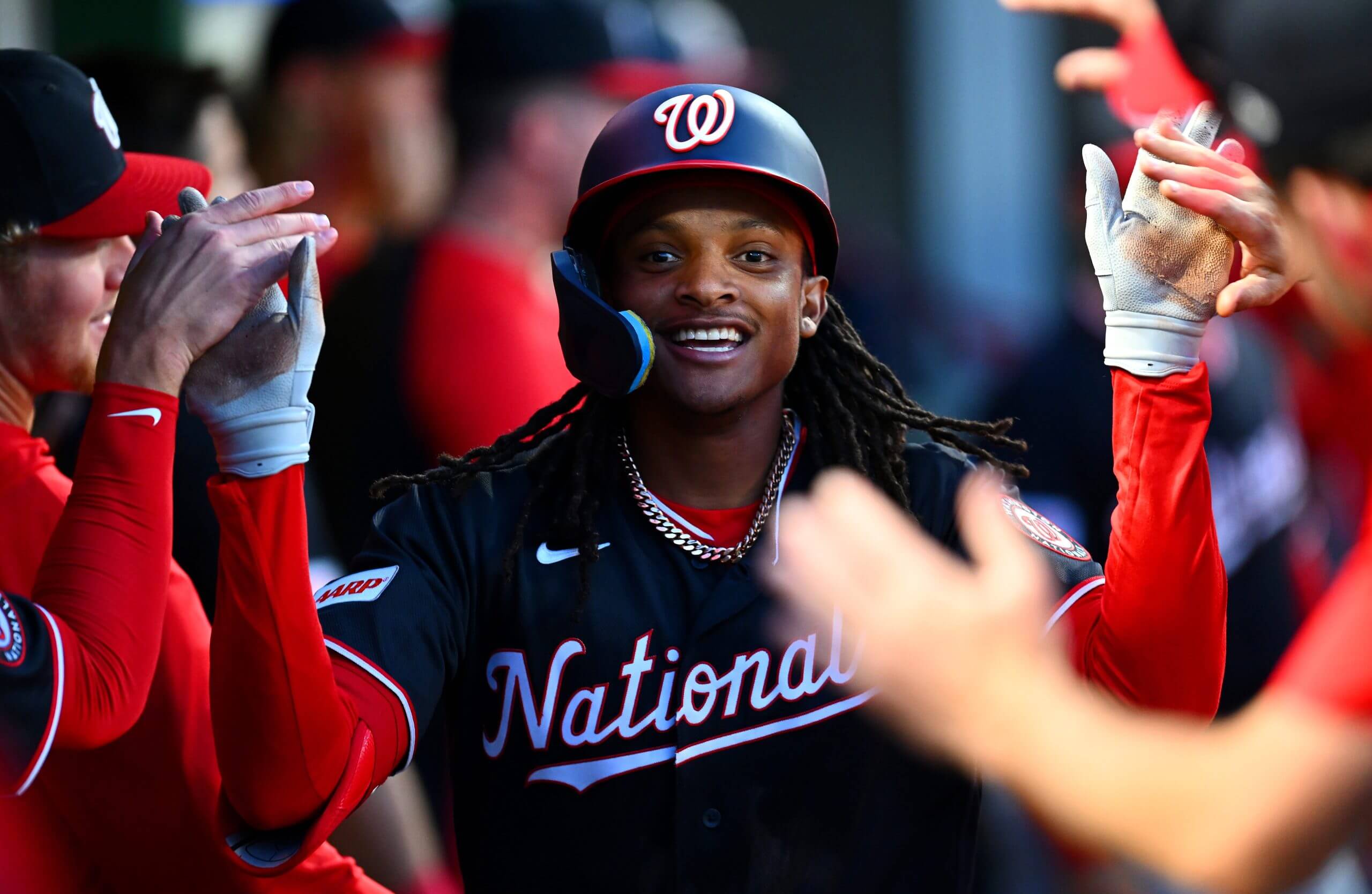
Entering Wednesday, CJ Abrams led all shortstops in wRC+ (157). (Joe Sargent / Getty Images)
There’s too much money (and too many prospects) on the line
Any scout or analyst could tell you this, but it’s worth stating: It’s in everyone’s best interest for Abrams to make those strides defensively. A shortstop who can steal 30 bases and hit 30 homers will make the valuation formulas do whatever their equivalent is of a backflip.
Evaluators around MLB are divided when it comes to Abrams’ defensive future. Some would put him at shortstop right now. Others believe he belongs at second base or in the outfield. Most officials around MLB who spoke to The Athletic looked at his age, athleticism and range and believed there was a capable shortstop inside Abrams.
Were Abrams to make significant strides at shortstop, the Nats could ask for better prospects in a trade. Abrams could ask for more money in free agency or extension negotiations. The team that employs him could more effectively construct its roster.
The Nationals see the middle of the season as an important checkpoint to gauge Abrams’ defensive development. This does not necessarily mean they will trade him. It also coincides with a realistic timeline for the defensive work to take hold. But it is relevant to note that the possibility of a deal is on their minds.
If the Nationals want to trade Abrams over the summer, they may be able to wait until July to see significant improvement. If they choose to wait until the offseason, that would give Abrams even more time to improve.
How much do you really want to mess with one of the best offensive shortstops in MLB?
Remember when Chicago Cubs manager Craig Counsell pulled his hitting coaches aside and told them not to mess with rookie sensation Moisés Ballesteros? The same logic applies here.
Teams that employ shortstops who have an OPS over .900 usually encourage those players to stick with their routine. The Nationals haven’t tweaked Abrams’ routine so much as they have established a better line of communication with him, and given him more tools to work with like the Trajekt pitching machine.
Consider the alternative. Teaching Abrams a new position could alter his plans and take his focus away from the bat. There’s a lot to learn at a new position, from reads off the bat to positioning on relay throws to his own throws. Asking him to focus less on his offense and significantly alter his pre-game preparation is a risk the offense can’t afford.
Equally important is what that ask might do to his confidence. Abrams has an amenable personality, but there is pride and money associated with playing shortstop in the major leagues. Moving him off of that position risks creating a rift. If the door to sign an extension is open at all — and at the moment, there’s no reason to believe it’s totally latched shut — why take that risk?
The numbers might disagree, but the eye test says he can figure this out
During pregame drills before Saturday’s game in Miami, the Nationals put both Nuñez and Abrams at shortstop. Though it wasn’t the intention, the back-to-back reps invited comparison. Nuñez looked like a natural as he delivered zippy, accurate throws to first base on the run. Abrams seemed as though he was still figuring out what his body could do.
That’s because he was. Abrams is not limited by athleticism, as some other middle infielders disliked by advanced metrics are. Instead, the Nationals have asked Abrams to change his mindset and mechanics.
On Sunday, third base coach Victor Estévez said the best infielders in MLB attack the baseball at aggressive, direct angles and make smooth throws on the run. The idea is for Abrams to be more aggressive and learn the mechanics required to throw on the run. Waiting for the ball leads to cluttered mechanics and cluttered minds.
That’s what Abrams is dealing with right now.
“When I use one hand to get the ball, I’m using my athleticism,” Abrams said. “When I’m not, I can kind of get away from my body. My arm gets long. So it’s kind of about staying compact.”
They’re also working on his hand positioning. Take his error last Saturday, for instance: The ball tailed out of his hand like a sinker and pulled first baseman Luis García Jr. off the bag. The Nats want him to get his hand on top of the ball so it moves more straight, like a four-seamer.
“He’s been working his ass off,” Estévez said. “It’s only a matter of time.”
Some of the instruction has already clicked. Abrams’ first step and reaction time have improved. He’s become more focused in the field, manager Blake Butera said. Throwing on the run, getting on top of the ball and being more aggressive are skills that take time to develop.
Given how the clock is ticking, it’s at least plausible that the Nationals may start to push him harder during early work before games. They have poured too much time, thought and effort into his defensive development to give up now.
They can take time that other organizations do not have
On Tuesday, Butera brought his team out more than five hours before first pitch at Great American Ballpark and told them how he felt. Their pitchers get fewer strikeouts than other clubs, and their defense commits more errors than any other team in MLB. That is a losing combination.
With how many runs they’ve scored and how effectively they run the bases, the team is too fast to be this bad defensively.
Butera said he needs the team to stop worrying about mistakes and to start playing free. He needs their athleticism to take over. He needs them to keep buying into this early work, even if the results haven’t taken hold yet.
“Just continue to hammer the vitamins, as we call it, the stuff we do every day,” Abrams said.
Though they are prioritizing the future, the Nationals still care about competing this season. It’s why they’re promoting and demoting players so aggressively. And why they’re spending more time game planning and in pregame work. And why the clubhouse is so quiet after losses.
Almost anyone would tell you that, in a vacuum, Nuñez can play a better shortstop than Abrams right now. It would be fair to argue that Abrams’ play at shortstop contributed significantly to a loss as recently as last weekend. But there’s always more to the decision than meets the eye.
That’s why Abrams will keep getting penciled in at short.