
ST. PAUL, Minn. — Make no mistake, when Minnesota Wild general manager Bill Guerin pulled off the Quinn Hughes blockbuster, he had every intention of trying to take one more giant swing before the trade deadline for a top-six center.
It never materialized, but after seeing how the Wild were outmatched up the middle in their second-round Stanley Cup playoff series against the Colorado Avalanche, you can bet he’ll go to work this offseason trying to make it happen.
Free agency is weak, so the best bet will be the trade market.
One big issue is the Wild have traded a lot of assets the last few years — Marco Rossi, Zeev Buium, Liam Ohgren, Marat Khusnutdinov, their 2026 first- and second-round picks and their 2027 and 2028 second-round picks — so they’ll have to decide how much more of the future they’re willing to mortgage.
Young assets include Jesper Wallstedt, Danila Yurov, Bobby Brink, Daemon Hunt, Charlie Stramel, Hunter Haight, Riley Heidt and Adam Benak and, of course, future first-round picks.
The Wild do, at least, have more trade flexibility with a number of their core pieces than they have in eons.
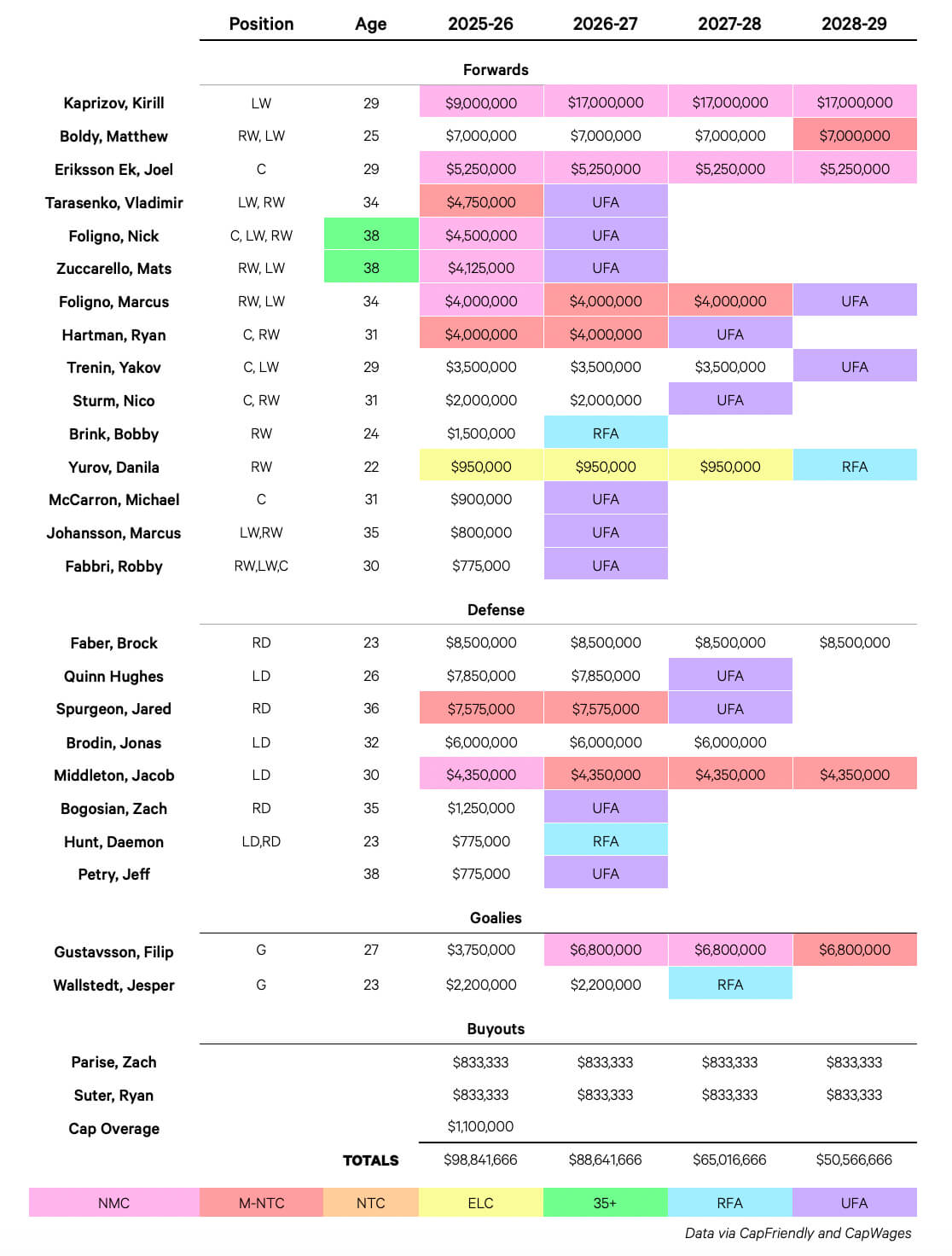
Ryan Hartman, Joel Eriksson Ek and Jared Spurgeon have 10-team no-trade clauses, and Marcus Foligno and Jake Middleton have 15-team no-trade clauses, although both have no-moves until July 1.
Jonas Brodin, Nico Sturm and Yakov Trenin don’t have trade protection, nor do the team’s youngsters.
Heading into the offseason, the Wild have $88.86 million of cap space committed to eight forwards, five defensemen and two goalies, giving them $15.358 million worth of space to add up to eight players internally (for instance, re-signing restricted free agents Brink and Hunt, any of their unrestricted free agents or youngsters such as Haight or Stramel potentially making next year’s roster) or externally.
It will be a busy offseason. Let’s take a look at the to-do list.
UFAs — who stays, who goes?
There’s an argument to re-sign most of the Wild’s eight UFAs. The problem is, there’s just under $16 million of cap space to spread around, and if you’re talking about Guerin going shopping for a top-line center, that’ll squeeze it even more. Let’s go one by one:
Mats Zuccarello: The 38-year-old feels as if he still has some years left playing hockey, and there’s value in bringing him back. He’s Kirill Kaprizov’s right-hand man and a team leader. Guerin said there’s “always interest in Zuccy” and they’ll take care of this over the summer. It seems like if Zuccarello plays, it’ll be here, and it’ll just be a matter of the term. He’s coming off a two-year deal with a $4.125 million average annual value. Would he take less, both in money and in role?
Marcus Johansson: He was a bargain at $800,000, and it’ll be interesting to see what he says at Friday’s exit interviews about his future. He was noncommittal about his future earlier this season, and last offseason, it sounded as if he was entertaining only a return to the Wild (despite the fact he could have made more elsewhere) or returning to his old Swedish Hockey League team, Farjestad. The 35-year-old did say when he hit the 1,000-game milestone that he feels he has a lot of hockey left. The issue with bringing Johansson back is that the Wild must get better in the top six, but Johansson always ends up as the second-line left wing. The Wild said he’d be a bottom-six winger last year when he signed — and that’s where he started until it didn’t work with Vladimir Tarasenko. Johansson is so trusted that his presence gives the Wild an easy way out rather than upgrading the top six.
Michael McCarron: He’s big, wins faceoffs, can play up and down in the lineup, and you can bet the Wild would love him back. But there was enough interest in him at the trade deadline that it cost the Wild a second-rounder. And with few good centers on the market, he may be able to get a $4 million or $5 million payday, which could be too steep.
Vladimir Tarasenko: Acquired for “future considerations,” Tarasenko was a good buy-low bargain, putting up 23 goals in a bounce-back season, mostly in a third-line role. His production dropped in the playoffs, with two goals in 11 games, but he wants to keep winning, feels Minnesota’s a fit and was a good mentor for Yurov, so a reunion could be explored if the price is right.
Nick Foligno: What a story this was, with the Foligno brothers reunited in Minnesota to chase the Stanley Cup. Nick, the former Columbus Blue Jackets and Chicago Blackhawks captain, was an instant hit in the room (and with reporters hoping to fill their notebooks) and became a regular on the fourth line. He also scored two goals in Wednesday’s Game 5 loss. Considering how much the Folignos enjoyed this, Nick likely has interest in returning. It’s just a matter of the price. The Wild would likely want him back at a league-minimum deal and could be better-served giving prospects such as Stramel and Haight a look.
Zach Bogosian: Bogosian is 35 years old and had an inordinate number of ankle issues this season on both legs, but he’d be a simple buy-low option if he wants to keep playing and would take a league-minimum deal. Guerin loves him, and his brother, Aaron, works in the front office.
Jeff Petry: He was a good insurance policy but seems likely to move on, especially if Bogosian re-signs.
Robby Fabbri: Fabbri provided veteran depth and was a cheap waiver claim, but he played in just six games, none in the playoffs, so they’ll probably part ways.
Extend Hughes
Hughes is eligible to sign an extension July 1, when he’ll be a year away from unrestricted free agency. It’s a top priority for the Wild.
Guerin took a calculated risk in acquiring Hughes without any promises that the 2024 Norris Trophy winner would sign an extension. There seemed to be good signs from the start, such as Hughes saying he’d always remember how much Guerin gave up for him. The Wild hope that’s the case when it comes to staying.
Every time we talked to Hughes during the season, he mentioned how much he enjoyed the team and staff. He talked about how good the Wild can be once he, Matt Boldy, Kaprizov and Brock Faber build chemistry, and it showed as Hughes was one of the team’s best players in the playoffs.
We’ll know more about how Hughes feels after exit interviews, but it didn’t seem like all of his good feelings about the Wild were wiped with one series loss to the Presidents’ Trophy winners.
“This one stings. Love the guys. Love the coaching staff. The whole organization,” Hughes said. “Yeah, I mean this one really stings. I just felt like we had a really good team. You get through these guys, you never know. But if we had to lose, you want to lose to these guys. These guys are the best.”
It wouldn’t be a surprise for Hughes to sign a three-year extension this summer or next season, which would give him four years of his prime to chase the Cup with Minnesota — and align his contract’s expiration with his brother Jack’s in New Jersey.
Hughes shattered the Wild’s regular-season and playoff record book, and the Wild mortgaged the future to get him, so they’ll be motivated to give him a payday. Cale Makar is also extension eligible this summer, so either one could reset the market for the other. This will be spendy, but the 2027-28 cap is set to increase to an estimated $113.5 million.
Decide on the coaching staff
Hynes guided the Wild to their first second-round appearance in 11 years, their second consecutive postseason under his tenure and their seventh 100-point season in 25 years. He’s almost certainly safe for now.
That said, he is entering the last year of his contract, which will ramp up the pressure if he isn’t signed to an extension this offseason.
Our gut: He will be.
The rest of the staff could get a look. The penalty kill has now been a problem for several playoff runs. It showed promise as the league’s best from the Olympic break on (and Hynes’ U.S. PK was 18-for-18 at the Olympics), but still, this should be evaluated. Whether it’s bringing in a veteran coach or a change in personnel, the Wild can’t keep doing the same thing and expect different results.
This isn’t a coaching staff decision, but director of amateur scouting Judd Brackett has six weeks left on his contract and has yet to be promoted or extended. The Wild have amateur scouting meetings coming up, and Guerin presumably will address this delicate situation around that time, but as of now, Brackett and many scouts are unsigned past July 1.
Get a No. 1 center and/or top-six forward
We all know how difficult it is to get top-six forwards, especially centers, and the trade market isn’t quite clear yet. But the Wild will do everything they can to get one … within reason. (Like, they’re not trading Faber or Boldy, and Kaprizov has a no-move clause in his new contract.) Whom should they make calls on?
Auston Matthews: New Toronto Maple Leafs GM John Chayka has to show his captain this summer the team has a serious and executable plan to return to contender status. Matthews, a 60-goal scorer two seasons ago, holds all the cards as he’s two years from unrestricted free agency. If he’s not convinced, he could go the Hughes route and dictate the terms of his departure, and the Wild could jump in the bidding. It’s hard to know if the Wild have enough pieces to acquire Matthews, but Wallstedt looks like a calm and confident goaltender who could handle the market if that’s the ask.
Jack Hughes and Nico Hischier: Everybody knows the Hughes brothers want to play together. Maybe Jack wants to come to Minnesota now to join forces with Quinn rather than wait or have it the other way around. It would be complicated, though, because it’s hard to believe Jack would leave their youngest brother, Luke, behind with the New Jersey Devils. That may be why, per league sources, the Wild made a pitch to former Devils GM Tom Fitzgerald to acquire Luke this past season. Still, it seems unlikely that new GM Sunny Mehta’s first move will be trading Jack Hughes. The same could be said for Hischier, though he’s extension eligible this offseason. And if the Devils get the impression the captain won’t extend, you can bet they’ll put him on the market.
Dylan Larkin: There’s no indication the Detroit Red Wings captain wants out, but you never know unless you call GM Steve Yzerman. Larkin is going to be 30 this summer and has to be sick of early offseasons. He has five years left on a contract that pays him $8.7 million annually, but at some point, he’s going to lose his patience. If Hughes stays in Minnesota, and with U.S. teammates Boldy and Faber here, the Wild could be in the inner circle of places he’d waive his no-trade to go. Guerin adores him, and Hughes and Larkin share an agent.
Robert Thomas: The Wild made a pitch for Thomas at the deadline, per league sources, dangling Wallstedt and Yurov as part of a package. The St. Louis Blues said no. With Alexander Steen taking over for Doug Armstrong as GM on July 1, you can bet Guerin will try again for the high-end offensive, right-shot centerman who can win draws. Plus, Thomas is another one of Hughes’ plethora of childhood pals. He has five years left on a deal that pays him $8.125 million.
Brady Tkachuk: He’s not a center, but Guerin believes you can win with play-driving wingers such as Boldy and Kaprizov. And Tkachuk — Hughes’ forrmer billet roommate — can take draws. He has two years left at $8.2 million per. At some point, does he use the Hughes template and tell Ottawa well in advance of being extension eligible that he’s unwilling to extend? If so, Guerin almost certainly would jump in feetfirst.
Vincent Trocheck: The Wild were in conversations at the deadline with the New York Rangers, who were asking for a pretty steep asking price, per league sources. Guerin clearly decided to punt, not wanting to squander all of his remaining chips when he could take a bigger swing at a true No. 1. But Trocheck could remain their best, most prudent option. He’d still fill a serious need up the middle in the top six and provide a security blanket for another Eriksson Ek injury, and he’s a proven veteran who can win faceoffs and kill penalties. It’s just a matter of the cost. The Wild likely wouldn’t give up Wallstedt for him, for example. He has three years left at $5.625 million.