
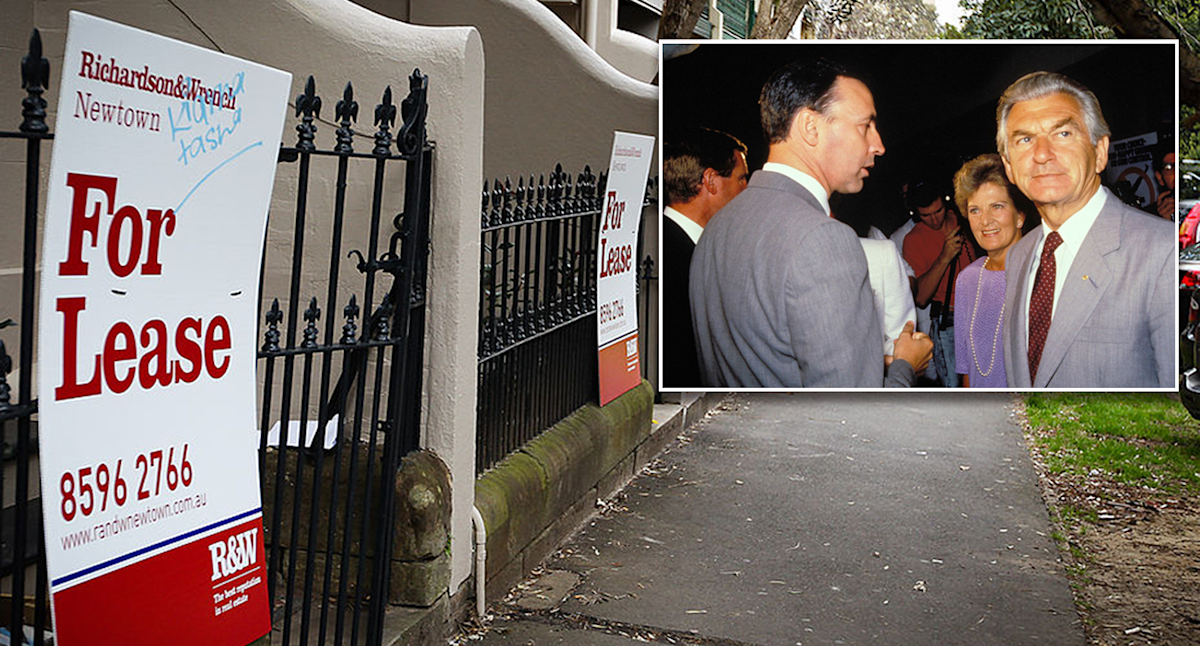
 What happened the last time Australia got rid of negative gearing? · getty
The Australian government has confirmed it is killing the “sacred cow” of property investing. Except, of course, for those who are already benefiting and for future newly built homes.
In the wake of Tuesday night’s budget which included details about the phasing out of negative gearing, arguments are coming thick and fast that the move could drive up rents and result in a reduction in new housing supply coming to market.
There is a great deal of mythology wrapped up in the investor tax concession that has been around since the 1930s, fuelled by tales of the impact of its 1980s era removal. But what does the data say about the last time we removed negative gearing for property investors?
Let’s take a good look.
RELATED
The Treasury perspective
According to estimates from the federal Treasury, the impact of the proposed changes to negative gearing and the capital gains tax discount on rents will see rents approximately $2 per week higher than the baseline estimate a decade from now.
A recent analysis from the Commonwealth Bank came to a broadly similar conclusion.
Senior Economist Trent Saunders concluded:
“Given the strong relationship between housing supply and rents growth, we expect the overall impact on rents to be muted. Treasury estimates that rents could increase by around $2 per week for a household paying the current median rent, which is broadly in line with our estimates.”
The Hawke/Keating Era removal of negative gearing
Over the last 40 years a popular mythology has arisen the impact of the Hawke government’s removal of negative gearing which was in place between July 1985 and September 1987, with claims that it resulted in rents rocketing.
As you might imagine some perspective is required.
In the final available data point prior to the changes, which details the proportion of investment properties running at a loss which stems from 1982-83, only 8 per cent of properties were negative geared.
Between July 1985 and September 1987, the lowest headline reading for the annual CPI was 7.6 per cent. So, it’s true that rents were climbing fast, but so was the overwhelming majority of the CPI basket during that era.
The performance of rents in inflation adjusted terms during this era was vastly different depending on locale.
In Perth and Sydney, inflation adjusted rents surged, by 11.6 per cent and 8.8 per cent respectively. At the other end of the spectrum, in Brisbane they fell by 6.9 per cent and by 1.8 per cent in Adelaide, while in Melbourne total real growth was a relatively flat 1.3 per cent.
Story continues
 Negative gearing · ABS/Grattan
In Sydney and Perth, vacancy rates fell to rental crisis level before the change was enacted, while vacancy rates in Melbourne, Adelaide and Brisbane provided much less market leverage for landlords.
The impact of local influences was the defining factor in the view of the Hawke cabinet at the time, not the removal of negative gearing, despite the policy being reintroduced at the time of this conclusion being written.
“With the notable exception of Sydney, conditions in the residential rental property market are not unusually tight. The evidence suggests that local influences, rather than tax measures, dominate in metropolitan rental markets,” Cabinet papers of the era read.
Following negative gearing’s reintroduction, the divergence in inflation adjusted rental growth by capital city continued.
The Sydney market in particular saw a similar degree of growth in real rents regardless of whether negative gearing was in place or not, in the midst of protracted tightness in the rental market.
Negative gearing · ABS/Grattan Collapsing investor demand
Between January 2017 and December 2019, the share of new mortgages flowing to property investors underwent one of the largest falls in Australian history, dropping from 40.5 per cent to 27.6 per cent.
This coincided with the era of tighter lending stemming from the impact of the Banking and Financial Services Royal Commission and attempts by banking regulator APRA to rein in growth in interest only mortgages.
(Source: Saul Eslake) · ABS/Grattan
But did the dramatic reduction in demand from property investors relative to overall new mortgage volumes put significant upward pressure on rents?
According to Cotality, across the three years between January 2017 and December 2019, asking rents at a national level grew by a total of 3.6 per cent or approximately 1.2 per cent per year.
While there is evidence from the Australian Institute of Health and Welfare that suggests the proportion of occupied housing stock held by property investors fell during this time, the rental market was no worse for wear as rental price growth remained benign.
The takeaway
Going forward changes to negative gearing are tipped to significantly impact demand for property from investors, but to what degree that will have an impact on rents is another question.
While the example of the Hawke government removing negative gearing is a popular one for its claimed impact on rents, the vastly different outcomes in markets across the country and similar surges in inflation adjusted rents in some locales for years after its reintroduction paints a different picture.
Negative gearing is also not being removed for existing users, it is being grandfathered, so if there is to be an impact it would theoretically occur much more slowly and a significantly smaller scale, as anticipated by Treasury and CBA.
Declining levels of property investment has also shown to not necessarily results in rental prices going higher, as it depends a great deal on the underlying conditions such as population growth and housing formation trends.
Ultimately, this is a complex issue with a lot of different variables, chief among them the human psychology of the nation’s property obsession.
While an analysis based on cashflows and ranked investment priorities may produce one set of results, what the reality actually looks like in a country that has turned property investment and negative gearing into something of a national sport may be another thing entirely.
Get the latest Yahoo Finance news – follow us on Facebook, LinkedIn and Instagram.