
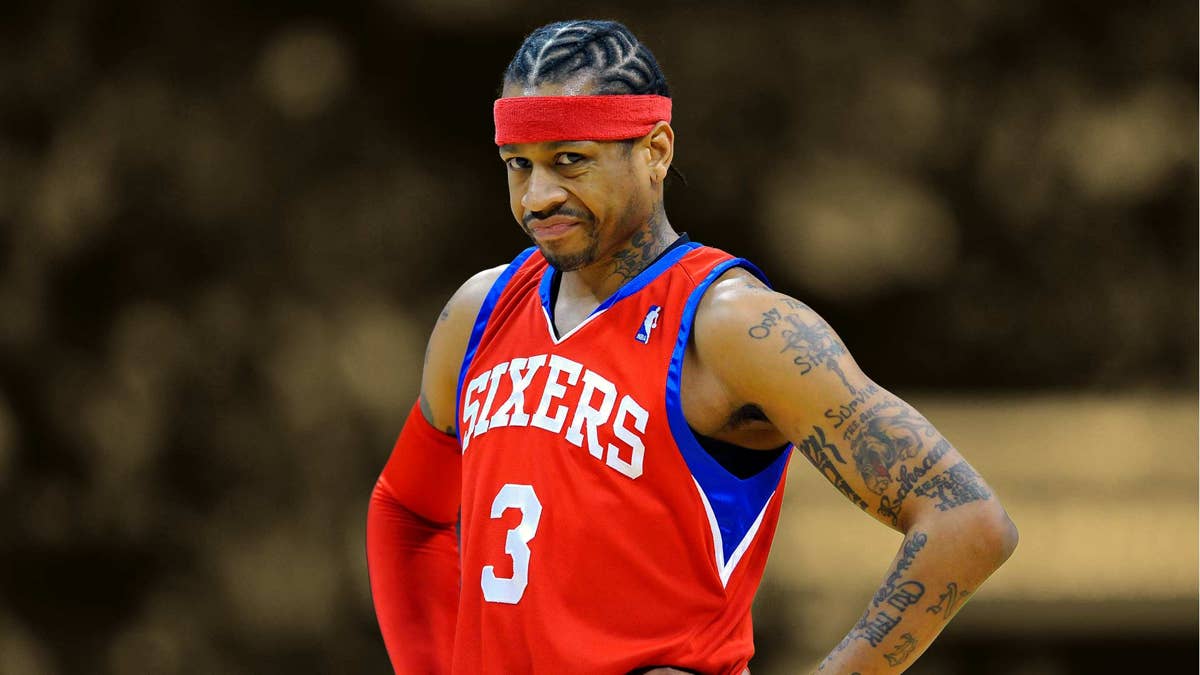
From the moment Allen Iverson arrived in the NBA as the first-overall pick of the 1996 NBA Draft, he made many people uncomfortable. For one, the defenders who were tasked with staying in front of Iverson felt absolute dread at the thought of falling down and getting humiliated by one of his vicious crossovers.
In addition, many within the NBA’s ivory tower felt that Iverson would ruin the white-collar image the league had worked so hard to promote in America and around the world. In a way, they felt he would become Neo and destroy the NBA’s matrix.
Advertisement
And so, as the Answer appeared on the cover of the 1999-2000 holiday issue of the league’s official publication, “Hoop” magazine, somebody with enough clout decided to alter Iverson’s image, removing the diamond earrings from his ears, his necklace, and the tattoo on his neck.
Obviously, the altered image on the cover did not sit well with the Philadelphia 76ers superstar, who said it didn’t represent his authentic self, something he took great pride in despite all the criticism he received for being himself.
Advertisement
The tattoos were more than just images
In an interview with “Playboy,” Iverson asserted that the images he had placed on his body weren’t there for just posterity. Rather, each one represents something significant in his life, whether it was a person or a moment worth remembering.
From the “RA Boogie” that honors his late friend, Rahsaan, to “Cru Thik” that pays homage to the group of friends who stayed by his side through thick and thin, Iverson explained how much those tattoos mean to him.
Advertisement
“It was stuff I really meant and really felt, and I just put it on my body. And then the NBA airbrushed my tattoos off the cover of some magazines that upset me,” A.I. said. “I have my mom’s name on my body, my kid’s, my grandmother’s, who passed away. Things that mean something to me.”
Although the NBA didn’t explain how A.I.’s image was altered, the damage had already been done. To Iverson, it felt like the NBA was fine with him playing well and helping raise the league’s profile worldwide. Yet at the same time, they weren’t fine with who he really was.
“For that to happen, it was kind of tough. But they didn’t look at the meaning of my tattoos — they just saw that they were tattoos, and they were of me. But they’re a part of me,” Iverson remarked.
Advertisement
Related: 5 NBA stars who’ve claimed to have slept with an absurd number of women
Staying true to himself
The NBA that Iverson joined was one dominated by Michael Jordan, who portrayed himself as the ultimate personification of class, with his expensive suits and Ferrari supercars.
Iverson, on the other hand, had sleeveless, ribbed cotton tank tops and hoodies on as well as humongous gold chains and diamond earrings. As much as some people wanted him to assimilate corporate America’s look, Iverson fought hard to stay true to himself.
Advertisement
“People used to always tell me to wear a suit, look this way, look that way, cut my hair, stuff like that. But those things don’t make you the person you are — the person inside does,” he declared. “I’ve never been any bad type of person — it’s just that people didn’t want to even try to understand me. They looked at the tattoos, the baggy clothes and the jewelry and judged me on all that.”
“I mean, I was 20, 21, 22 years old, going through a phase in my life. I wanted to grow as a person, but having this talent, they expected me to act like I was 30 or 35 years old. I was in this learning process, and they were rushing me.”
Iverson was spot-on. He entered the league when he was only 21 and a few years removed from the troubles that hounded him during his high school days. In essence, he was only a young man trying to find his way in the world of professional basketball, yet many were pressuring him to become someone he was not.
Advertisement
This story was originally published by Basketball Network on May 16, 2026, where it first appeared in the Off The Court section. Add Basketball Network as a Preferred Source by clicking here.