

Google has returned fire at its AI competitors with an impressive array of announcements and launches at its annual developers conference in Mountain View, California. The most immediately impactful for media and marketing is a powerful new video generator, further integration of AI into its base search experience and a standard language model chock full of agentic integrations.
With announcements just hours old and the conference still underway, Mumbrella has trawled the releases and spoken to our contacts to make sense of what’s coming.
The shiny one: Gemini Omni
So many bubbles: Example still from an Omni-generated video (Google)
Google’s language around its new generator Gemini Omni is bold: it will eventually be able “to create anything from any input”.
ADVERTISEMENT
For now, we’ll have to settle for generating video from text, image and video inputs. The examples provided in the presentation indicate Omni can change camera angles, remove objects, change backgrounds and edit videos with natural language.
Vinne Schifferstein Vidal, co-founder of AI video production house MC&V, already has a good idea of Omni’s capabilities and says it’s comparable to Bytedance’s Seedance video generator.
“It’s on par with Seedance from an output perspective, but probably more encompassing across different styles. Seedance is incredibly strong in photo-realism, though less so in areas like character development or more stylised formats such as animation.”
Google says Omni is “grounded in Gemini’s real-world knowledge”. This seems to stop short of a complete world model, but may prevent obvious physical absurdities from being generated by mistake.
“The physics [of Omni] have definitely improved as well,” Schifferstein says.
Omni is available immediately to the top-end of Google’s AI users: AI Plus, Pro and Ultra subscribers within the video production tool Flow and the Gemini app.
“From a workflow perspective, having it integrated into Flow makes consistency across shots much easier to maintain. The agent functionality is probably the biggest novelty here and will make the experience far more intuitive for users. You can move back and forth within shots, refine moments, and iterate without completely changing the shot itself.
“More importantly, this is pushing things further toward multi-shot agentic filmmaking, which is clearly where all of this is heading. That said, it’s still very early days in terms of testing.”
The critical one: search interface changes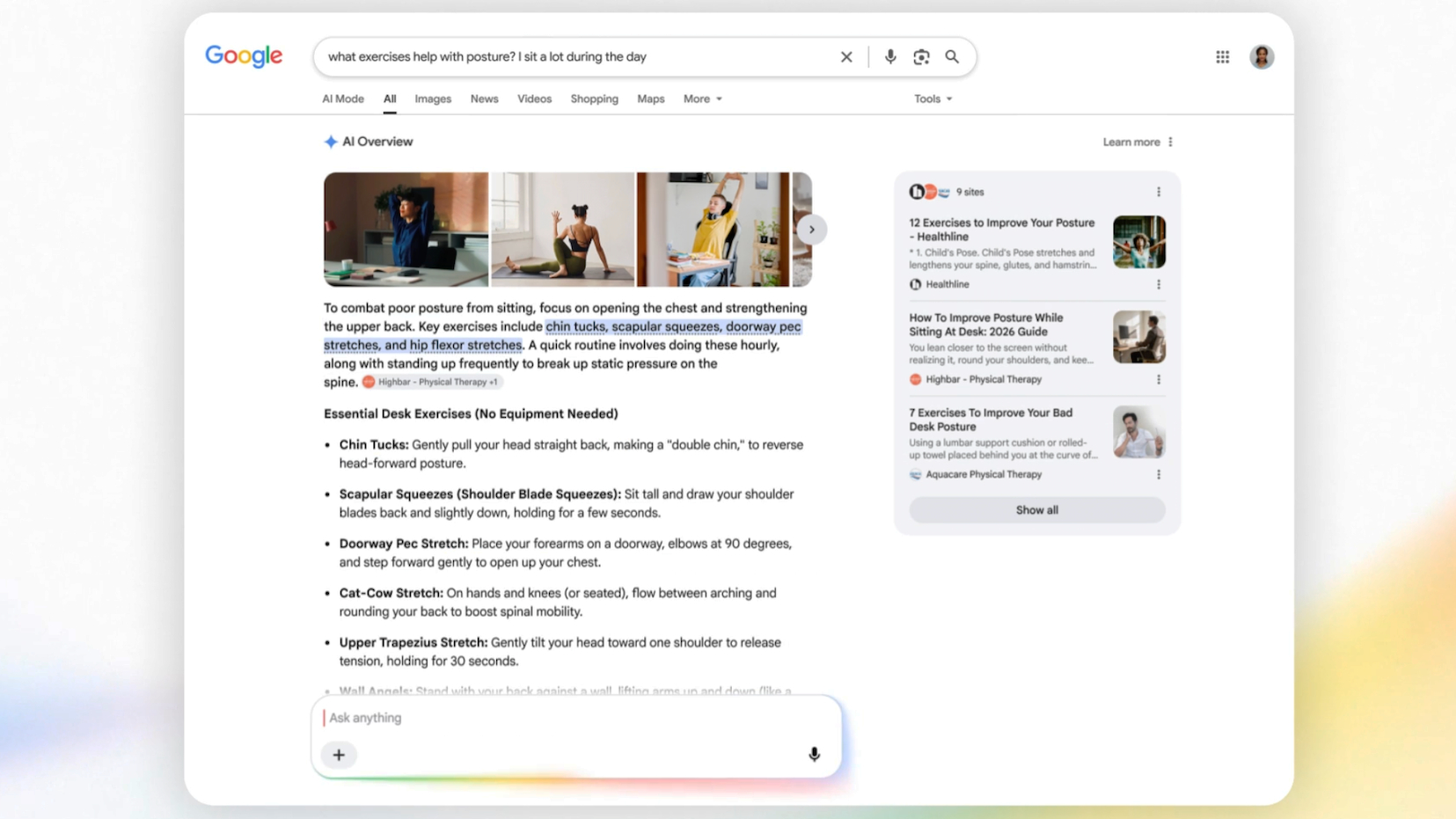
The new search interface (click to expand)
Google is further tightening the integration between its search engine and its AI products, unveiling a flurry of new AI-powered updates to Google Search.
Until now, AI has only shown up in Google Search as AI Overviews and a separate AI Mode that is not dissimilar from talking to a chatbot. Google’s refreshed search engine runs on its new Gemini 3.5 Flash model (see below) and represents a big shift toward AI.
Paul Hewett, CEO of In Marketing We Trust, says the changes are “the biggest search box redesign in 25 years, plus a significant shift with information agents.”
“This will affect the way search works,” he says.
“AI overviews and AI mode now chain together with context preserved. The unit of brand visibility isn’t being cited once, it’s being cited and surfaced in the follow-ups.”
“This is good.”
The renovated search field capabilities allow for longer, more complex enquiries that feel more conversational in the form of their new “intelligent search box” which appears to resemble the likes of the Gemini chatbot. The move follows progress from Google’s AI overviews to AI mode, and now a holistic AI search journey. The new engine will also accept uploads in the form of PDFs and photos, auto-generates nuanced prompts and agentically accesses and monitors research topics on its own.
Google will now automatically create visuals and lightweight apps (called “widgets”) in response to specific prompts, such as creating a travel planner that combines your location, upcoming calendar events and real-time conditions to produce a personalised plan.
The transition between AI Overviews and AI mode has also been streamlined: you can have a conversation with the AI that has provided your search results to get the answers you want. Google also describes their move into an “agentic” era where AI assistants can help book services, send alerts, or monitor live events. These capabilities will not be available until later this year.
The solid one: Gemini 3.5
From today, Google’s base-level AI experience will be powered by its new model Gemini 3.5 Flash, which apparently is just one in a series of coming Gemini 3.5 models. Google’s AI branding confusion continues.
Google says Flash has been built with agentic tasks in mind. Data provided with the presentation shows that Flash wins on some benchmarks, but is bested by Anthropic’s Claude and OpenAI’s ChatGPT 5.5 on several others.
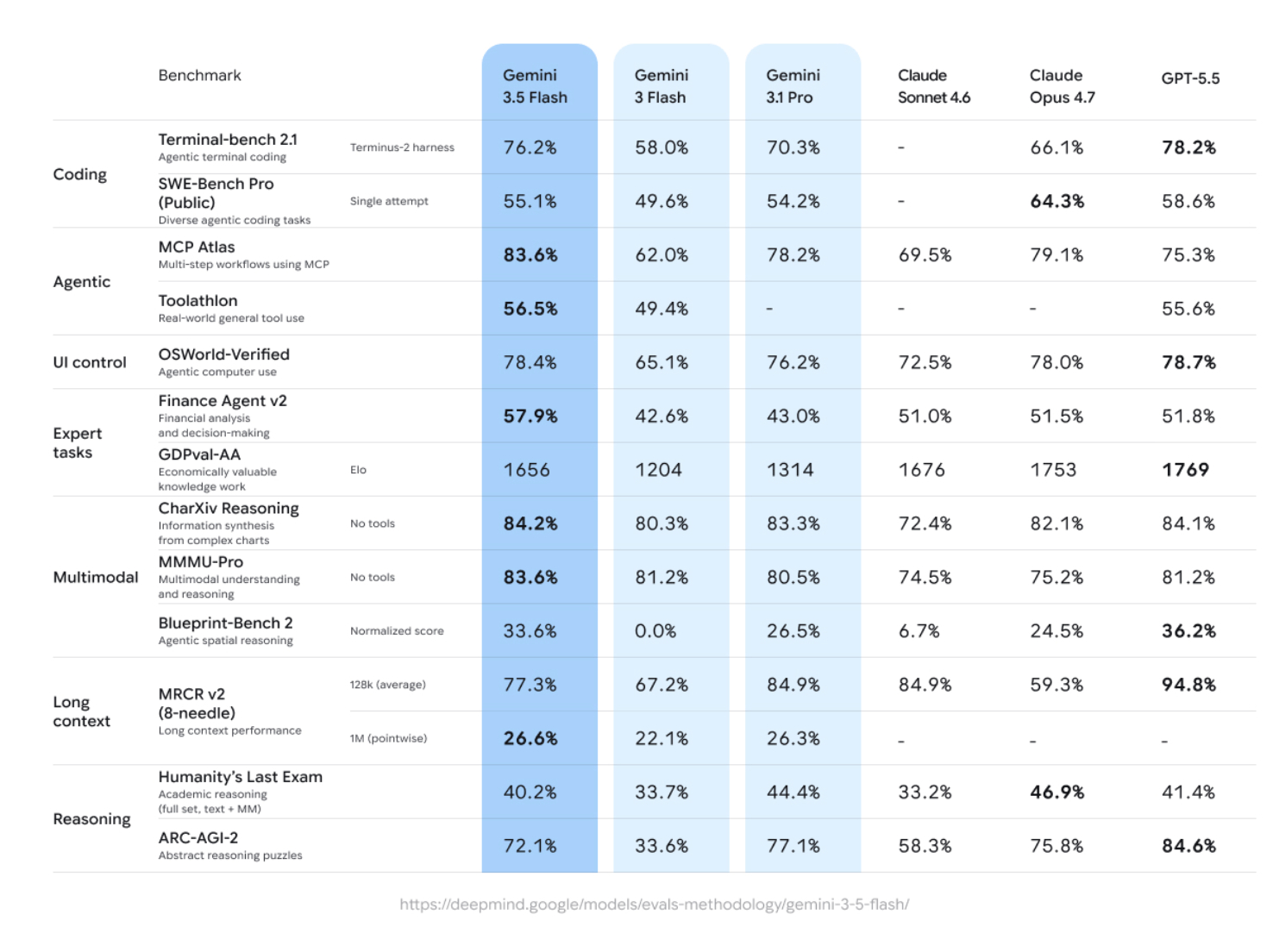
Google’s own benchmarking data (click to expand)
Where Google does claim a big edge for Flash is on speed (and presumably therefore cost): “3.5 Flash delivers frontier-level intelligence at exceptional speed”. It says this makes it good at “long-horizon agentic tasks”.
AI-powered shopping
Google’s “Universal Cart” announced at the conference was presented as a unifying shopping experience, integrating multiple merchants into a single streamlined shopping experience.
The foundation is Google’s Shopping Graph, which it describes as the most comprehensive product directory worldwide, comprising over 60 billion updating product listings.
The system promises to track price changes over time, notify when a product is restocked, and flag compatibility issues between purchases (if you mistakenly added a device and an incompatible accessory at the same time).
Suresh Ganapathy, Google’s senior director of consumer shopping, told reporters before the conference he hopes to make shopping more fun.
“We keep hearing from shoppers that they really enjoy the fun aspects of shopping, but would love to delegate the more tedious parts to AI,” he said.
The shared language UCP, developed with online retailers, allows agents and shopping sites to operate in tandem across the purchaser’s journey. Another tool, Agentic Payment Protocols (or AP2), gives agents the ability to buy on a shopper’s behalf.
Paul Hewett believes that the Universal Cart could reshape retail.
“The coverage isn’t reflecting that yet, probably strategically so … the cart is the visible bit.
“Underneath Universal Cart plus UCP plus AP2 gives Google the infrastructure to own the whole shopping journey. Discovery, recommendation, checkout, payment, fulfilment. All inside Google’s surfaces, with Google holding the data on every step. Scary stuff …”
Hewett says Google may have “underplayed it deliberately.”
“Google already knows what you searched, clicked, watched, where you went. Add Universal Cart and they know what you considered buying. Add AP2 and they know what you actually bought, from whom, at what price. The inference layer over the top can predict intent and price sensitivity at a level no retailer can match with their own data. There needs to be a sensible conversation about this.”
Everything else
No more Glasshole: The new glasses are designed by The Gentle Monster (left) and Warby Parker (right).
There are also a flood of other new announcements. Google is expanding its AI content detector beyond the Gemini app, meaning watermarked AI-generated videos, images, and audio can now be detected in Google Chrome and Google Search as well. The feature was first launched late last year exclusively in the Gemini app.
Youtube’s search capabilities are also getting an upgrade. The new feature called Ask Youtube injects Google’s AI-powered search abilities into the video platform, promising users they will able to make more complex enquiries with more specific results. Ask Youtube will also be able to cut to the exact section of a video that answers your specific query. The function is available now for Premium users in the US and will roll out broadly soon.
Docs Live is the newest feature of Google Docs, giving users the ability to transform voice recordings into cohesive streams of generative text. If permitted access, it can also rummage through connected Google accounts and the web to refine the result.
Intelligent Eyewear is Google’s answer to Meta Ray Bans (etc), created in partner with Samsung. Google provided the software, Samsung brought the hardware — they will be available for both iOS and Android, although prices remain a mystery for now.
Project Genie is an experimental AI system that can generate and let users explore interactive 3D environments from simple prompts, now updated to incorporate real-world imagery from Street View.
This integration allows users to base virtual scenes on actual locations, then modify or reimagine them creatively, producing short, explorable simulations that blend AI-generated content with real geographic data and are gradually rolling out to premium subscribers, with broader expansion planned.