
This weekend’s Canadian Grand Prix will herald the return of Formula 1 after a two-weekend break — and the bickering over its engine regulations and the sport’s direction.
Despite having had just one grand prix over the last seven weekends, the debate over the 2026 power unit — and what comes next — has continued unabated.
A commitment to make changes for 2027 is being worked on at frenetic pace, with engine manufacturers eyeing agreement on some fundamental changes that they think could save the formula and return the driving challenge to qualifying.

Fox Sports, available on Kayo Sports, is the only place to watch every practice, qualifying session and race in the 2026 FIA Formula One World Championship™ LIVE in 4K. New to Kayo? Join now and get your first month for just $1.
But in parallel is a fascinating discussion about what comes next.
Already FIA president Mohammed Ben Sulayem is insisting that Formula 1 return to V8 engines by 2031 at the latest.
“It’s coming. At the end of the day, it’s a matter of time,” he said in quotes reported by Reuters.
“In 2031 it’s done anyway. It will be done. V8 is coming.”
It doesn’t get more explicit than that.
It’s clear that Formula 1 will be moving away from heavily hybrid engines at the end of this rules cycle, which expires after five seasons, at the end of 2030.
The fact F1 CEO Stefano Domenicali has been openly declaring as much gives it an air of being a fait accompli, not least because no manufacturer has pushed back against it despite having between them invested billions on technology that has raced in just four grands prix.
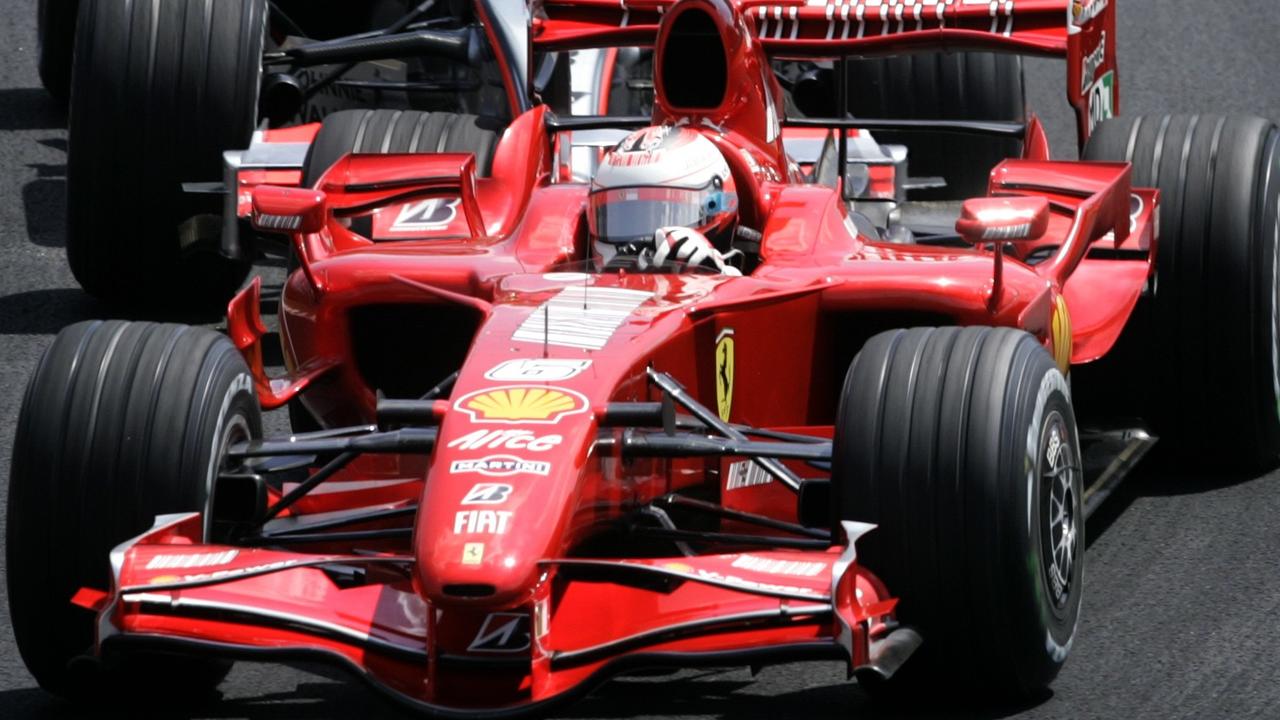
But those dreaming of a return to the screaming V8 engines of the late 2000s — of Fernando Alonso and Kimi Räikkönen and Lewis Hamilton title-winning vintage — might do well to wake up.
Nothing is ever so simple in Formula 1, and there’s still plenty of contentious decision-making to come before rules are agreed for 2031.
Jorge Martin FUMING after crashing out | 00:13
WHY ‘V8 IS COMING’
Change is certain; the sport is open about this.
Though there was controversy at the introduction of the previous engine rules in 2014, their impact on the spectacle was, in retrospect, limited. They still behaved largely like a normal engine, even if their sound was a dramatic departure from the V8s of the year before.
The controversy this year, however, comes from all sides.
There’s the way the engines neuter the qualifying challenge, turning it into a game of energy management rather than of daring and bravado.
There’s the heft, with the total unit weighing a chunky 185 kilograms, up 40 kilograms on last year, without fuel.
There’s the cost, with a capped US$190 million (A$266 million) spend per annum, not including concessions for underperforming engines due to be doled out after this weekend’s race.
But there’s also the matter of relevance.
These heavily hybridised engines, with an almost 50-50 split between electric and combustion power, were designed when the auto industry was convinced it would stop producing combustion cars sooner rather than later, with many brans pledging EV-only vehicles around the end of the decade.
But in the years between locking in the rules and the engines making their debut this season, all those goals have been pushed back. Electrification hasn’t been abandoned, but it’s been postponed enough that F1 finds itself wedded to technology representing nothing in particular.
The sport has been clear that it will not feel compelled to listen to the manufacturers so intently when writing its 2031 regulations.
Instead the goal will be dictated by the sport’s own needs: cheaper, louder, lighter and simpler.
The ‘cheaper’ element is self-explanatory. Even in an era of cost controls, every manufacturer will listen to an argument about why it should pay less to compete in F1.
The others, however, are more complex.
Marquez hospitalised after horror crash | 01:15
THE NOISE
Almost every F1 fan above a certain age has a story about the first time they heard a naturally aspirated grand prix car up close.
It was a visceral experience, as loud as a fighter jet and with a sound that rattled the rib cage.
For years it was the sport’s business card.
When the turbo-hybrid engine was introduced in 2014, the absence of that ear-splitting roar was one of the chief criticisms not only among a section of fans but also of Bernie Ecclestone, the then F1 CEO, who was never afraid — for better or worse — the publicly criticise his own product.
There was an appeal to the sound of the hybrid engine, particularly in the early years, when each power unit had an audibly different character, but even proponents of the motor would admit it wasn’t the sort of stuff that would make your hair stand on end.
It’s why so many rejoiced hearing Ben Sulayem declare that the V8 engine would return by 2031 at the latest.
But the Formula 1 of today is dramatically different to the Formula 1 of 2013.
The sport has boomed in popularity during the hybrid era and particularly in the last five years. There is a generation of fan that has never experienced a naturally aspirated engine, and considering how much bigger F1 is today, that generation could be the majority of the sport’s constituency.
Would these new fans — so many of them children and families — embrace such a radical change?
It’s impossible to say without further research, but it would be foolish to deny the magnitude of the change to F1’s character.
In 2013 and in the decades before it, it was mandatory to wear ear protection any time Formula 1 was on track. With engines screaming at 145 decibels, to do otherwise would mean permanent hearing damage.
With ear protection and 20-odd cars circulating at speed, it’s impossible to hear anything else — to have a conversation, to hear trackside commentary.
One must wonder how that would line up with F1 pushing every promoter to improve their off-track offerings, with bars and stalls and exhibitions and the like. Some of these may not be feasible or as attractive when the cars become considerably louder.
It is, quite simply, a totally different spectacle — perhaps embraced by the majority fans, but perhaps not.
The effect a noisier F1 would have on the calendar would also be a critical consideration.
A common objection by locals to street races in their city is the noise generated by motorsport, but the turbo-hybrid era has minimised this as a compelling issue.
Returning to a screaming V8 changes the proposition.
The Miami Grand Prix, as just one example, went through an excruciating local approval process centred on noise. Could that race be put at risk if the sport got louder?
The Azerbaijan Grand Prix, which is contracted until the end of 2030, joined the calendar during the hybrid era, as did Las Vegas. Would this change their eagerness to host a race?
And what might it mean for the sport’s newest street track in Madrid, set to debut later this year, or for prospective street races in Bangkok and Seoul?
Of course there are ways to muffle engine sound. Little has been said about whether the 2031 V8 will be turbocharged or not, but forced induction will automatically dim noise, and if that weren’t enough, mufflers do exist — but that seems very anti-F1, to misquote Max Verstappen.
All this serves to emphasise how much one element of the V8 change is immensely complicated.
By comparison, F1’s contemplation of the damage its current off-balance engine rules might do its massive popularity seems almost trivial.
‘Crazy where Martin was 12 months ago!’ | 08:44
THE COMPLEXITY
That acquits the debate around ‘louder’.
The issues with ‘lighter’ and ‘simpler’ are no less complex.
Let’s start with weight.
It’s long been a bugbear among drivers that F1 cars have become heavier with each regulation change until this year.
Minimum weight peaked at 800 kilograms last year before being pegged down slightly to 768 kilos this year.
As a comparison, in 2013 — the last year of V8 engines — minimum weight was 642 kilograms.
Not all of that increase is due to the engine, however. Some of that is the cars getting larger in all dimensions, and some of it is improving safety infrastructure.
But in 2013 the V8 engine weighed just 95 kilograms — plus another 35 kilos for its nominal hybrid element — compared to today’s 185-kilo behemoth.
However, according to BBC calculations, in 2013 cars would start a race with, on average, around 160 kilograms of fuel, whereas today the starting fuel load is down to just 90 kilograms given the increased efficiency of the engine.
That means total engine-plus-fuel starting weight was heavier in 2013 (290 kilos) than it is today (275 kilos).
In fact the previous generation of hybrid engine was lighter than both, weighing in at 145 kilograms and with a maximum fuel load of 110 kilos (255 kilos).
Of course the 2013 package was lightest of all in qualifying and at the end of the races, when most of the fuel was burned.
But nonetheless, it demonstrates the weight trade when talking about the hybrid motor. Engine efficiency isn’t just about green credentials; it can also influence weight and, of course, power.
That brings us to ‘simpler’.
Simpler, of course, will mean cheaper and probably lighter — notwithstanding the above — but is a dumbed-down engine what the sport is about?
And while the connection between F1 and the automotive world is more tenuous than ever, are they far enough apart for Formula 1 to completely ignore where road cars are going?
If the answer is yes, then F1 has to be prepared to lose manufacturers.
After all, before it moved heavily towards hybrid engines for this year, it was at one stage looking as if it would be left with only Mercedes, Ferrari and perhaps Red Bull Powertrains supplying power units, with Renault and Honda withdrawing and Audi uncommitted. Ford, which partnered Red Bull initially to assist with the electrical components, also may not have become involved.
That would also mean that Audi wouldn’t be racing as a constructor. It’s unclear whether General Motors would be involved also.
McLaren are back!? 1-2 sprint triumph | 00:46
Formula 1 would continue of course, but it derives a certain glow from having these big spending, internationally recognised brands competing.
The idea, then, that Ben Sulayem can unilaterally write the 2031 rule book and tell the teams and engine builders to love it or leave it is improbable. It’s powerful leverage, but it’s unlikely to end up that way.
Instead the question will be what amount of hybridisation is acceptable for the sport to guarantee a competitive spectacle while also keeping the manufacturers happy to continue spending.
As a reference, in 2013 the KERS element supplied less than 10 per cent of the total engine output.
In 2014–25 the hybrid systems were boosted to between 15 and 20 per cent.
This year electrical output is around 47 per cent of total power output — close enough to half, at least when the battery is full.
That will be reduced to 40 per cent next year if the proposed rule changes are agreed in time.
The 2027 season, then, could be a crucial test of finding the balance. A ratio of 60-40 is probably still too generous, but could 70-30 be a workable compromise to give auto manufacturers something to sell while guaranteeing the spectacle?
“How do we give it enough energy from the battery side to not lose a connection to the real world?” Mercedes boss Toto Wolff mused. “If we swing 100 per cent to combustion, we might end up looking a bit ridiculous in 2031 or 2030.
“We need to consider that and make it a mega engine. Maybe we can extract 800 horsepower from the [combustion engine] and put 400 on top of it, or more, in terms of electric energy.
“If it’s well planned and executed, count Mercedes in to come back with a real, real racing engine.”
For what it’s worth, Wolff’s theoretical power breakdown is 67-33. That might be worth keeping in mind.
And while V8 seems like the most agreeable architecture — there are no V10s in production, though V12s persist in some high-end performance cars — the question of turbochargers has been left unasked so far. Given the efficiency benefits, it would be surprising if F1 returned to natural aspiration, but that’s still to be argued.
So while “V8 is coming”, when and how and in what form and how loudly is still to be decided.
There’s a long way to go to 2031.