
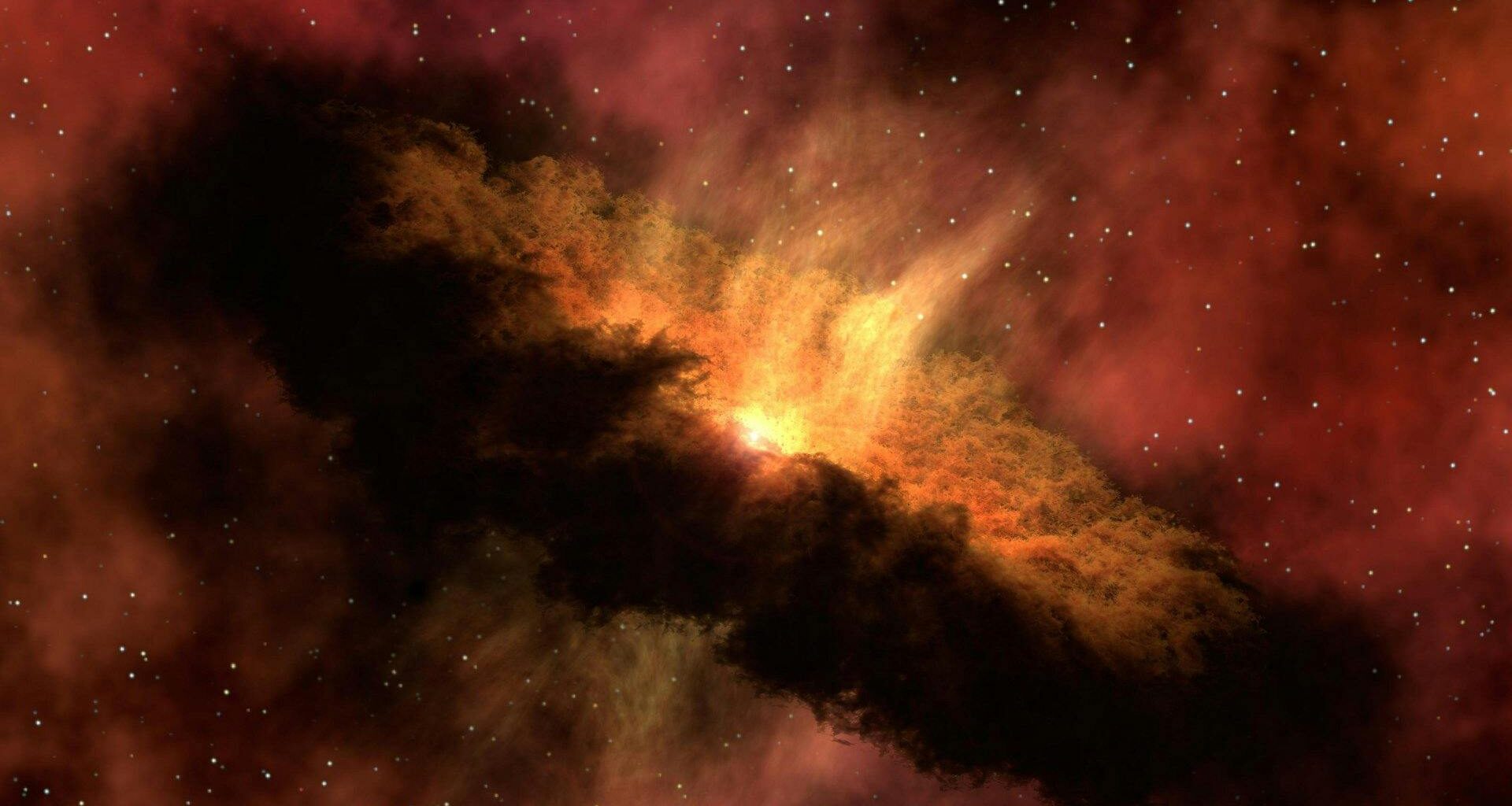
Scientists may have uncovered one of the most intriguing clues yet in the search for dark matter. A recent study examining a strange ripple in spacetime suggests that unusual gravitational-wave signals could carry evidence of invisible matter surrounding black holes. While researchers are still cautious about the findings, the discovery has sparked major interest across the astronomy community because it could represent the first detectable dark matter fingerprint ever observed through gravitational waves.
What Scientists Detected in the Ripple in Spacetime
The discovery centers on an unusual gravitational-wave signal detected during the merger of massive cosmic objects. Gravitational waves are ripples in spacetime caused by violent events such as black hole collisions or neutron star mergers.
Researchers noticed that this particular signal behaved differently from standard models used to predict black hole mergers. Small distortions in the wave pattern appeared to suggest that something surrounding the objects may have influenced the signal before it reached Earth.
According to researchers discussed in a recent report from ScienceDaily, one possible explanation involves dense concentrations of dark matter near the merging black holes.
Scientists studying gravitational waves and dark matter interactions believe invisible matter could slightly alter how black holes orbit each other before colliding. Those tiny disturbances may leave behind detectable signatures in spacetime ripples.
Why Dark Matter Remains One of Science’s Biggest Mysteries
Dark matter cannot be observed using ordinary telescopes because it does not emit, absorb, or reflect light. Despite this invisibility, scientists estimate it makes up roughly 85% of all matter in the universe. Evidence for dark matter comes from several major observations:
Galaxies rotate faster than visible matter alone can explainLight bends around galaxy clusters more strongly than expectedCosmic structure formation requires additional gravitational influenceMeasurements of the early universe suggest missing mass
Researchers have spent decades trying to identify dark matter particles directly. Massive underground experiments have searched for interactions between dark matter and ordinary atoms, but no confirmed detection has emerged.
This is why many astrophysicists are increasingly turning toward indirect detection methods, including gravitational-wave observations.
How Gravitational Waves Changed Modern Astronomy
The first confirmed gravitational-wave detection occurred in 2015 through LIGO. The discovery confirmed a prediction originally made by Albert Einstein in his theory of general relativity.
Gravitational waves occur when massive objects accelerate through space. The strongest waves usually come from:
Black hole mergersNeutron star collisionsSupernova explosionsPotential early-universe events
These ripples travel across the cosmos at the speed of light, carrying information about their source. Modern gravitational-wave observatories can detect distortions in spacetime smaller than a proton. That extraordinary precision has opened an entirely new field of astronomy focused on observing the universe through gravity instead of light.
Facilities currently involved in gravitational-wave research include:
Virgo CollaborationKAGRALIGO
A feature published by Space.comnoted that gravitational-wave astronomy may eventually help scientists “hear” the influence of dark matter rather than directly observe it.
How a Dark Matter Fingerprint Could Form
Researchers believe dark matter surrounding black holes may slightly affect their movement before they merge. Those effects could then alter the resulting gravitational waves.
Potential dark matter fingerprint signals include:
Tiny delays in wave timingDistortions in wave frequencyUnusual energy loss patternsChanges in orbital behavior before collision
Although these changes are extremely subtle, advanced detectors may now be sensitive enough to identify them.
Some scientists compare the process to detecting wind by observing how it moves nearby objects. Dark matter itself remains invisible, but its gravitational effects may leave measurable traces in surrounding cosmic events.
The recent signal examined by researchers appears to match several theoretical models involving dense dark matter environments. However, scientists stress that additional evidence is necessary before drawing firm conclusions.
Primordial Black Holes and Early Universe Theories
One reason the discovery has attracted attention is its possible connection to primordial black holes. These hypothetical objects may have formed shortly after the Big Bang rather than from collapsing stars.
Some cosmologists believe primordial black holes could account for part of the universe’s dark matter. If true, unusual gravitational-wave events might provide indirect evidence for their existence.
According to discussions published by Live Science, increasingly powerful gravitational-wave detectors are allowing scientists to test extreme cosmic theories more accurately than ever before. The possibility that spacetime ripples could reveal information about the earliest moments of the universe has become one of the most exciting developments in astrophysics.
Why Researchers Are Still Cautious
Despite the excitement surrounding the findings, scientists are careful not to overstate the discovery. There are several reasons for caution:
One signal alone cannot confirm dark matterDetector noise can sometimes mimic unusual patternsAlternative explanations may existMore observations are needed to establish consistent evidence
Scientific discoveries involving cosmology often require years of verification before gaining broad acceptance.
Researchers will now search for additional gravitational-wave signals showing similar distortions. If multiple events reveal the same patterns, confidence in the dark matter interpretation could grow significantly.
Future observatories may also improve the accuracy of measurements.
Upcoming projects include:
The Einstein TelescopeCosmic ExplorerThe Laser Interferometer Space Antenna (LISA)
These next-generation instruments are expected to detect weaker and more distant spacetime ripples, potentially allowing scientists to study dark matter environments in greater detail.
Why This Discovery Could Change Physics
If gravitational waves eventually confirm the presence of dark matter, the discovery could reshape several areas of science at once. It may help researchers better understand:
The composition of the universeThe evolution of galaxiesConditions shortly after the Big BangThe relationship between gravity and particle physics
For decades, dark matter research focused mostly on particle detectors and underground laboratories. Gravitational-wave astronomy introduces an entirely different strategy by studying how invisible matter influences massive cosmic events.
This approach could transform astronomy over the next several decades. Some physicists believe gravitational waves may eventually reveal phenomena that traditional telescopes can never observe directly. That possibility is one reason why the strange ripple in spacetime has captured global scientific attention.
The Search for Dark Matter Is Entering a New Phase
The recent discovery does not prove dark matter has finally been found, but it may represent one of the strongest clues yet that invisible matter can leave detectable marks on the universe.
As gravitational-wave detectors become more advanced, researchers may uncover more evidence connecting spacetime ripples to dark matter environments surrounding black holes and other massive cosmic objects.
For now, scientists remain focused on gathering additional data and testing competing explanations. Even so, the possibility that a ripple in spacetime could contain the first dark matter fingerprint marks a major moment in the continuing effort to understand the hidden structure of the cosmos.
Frequently Asked Questions1. What is a ripple in spacetime?
A ripple in spacetime is another term for a gravitational wave. These waves are disturbances caused by massive cosmic events like black hole mergers or neutron star collisions.
2. Why do scientists think this signal involves dark matter?
Researchers observed unusual distortions in the gravitational-wave signal that may match theoretical predictions involving dark matter surrounding black holes.
3. Has dark matter been directly detected?
No. Scientists have strong evidence that dark matter exists because of its gravitational effects, but no direct detection has been confirmed yet.
© 2026 NatureWorldNews.com All rights reserved. Do not reproduce without permission.