
By this point in the MLB season, it would be reasonable to expect that most hitters would have faced roughly the same quality opposing pitchers. But the schedule always contains quirks, and it’s impossible to have every team face every starting pitcher the same number of times. Even within divisions, the math of a five- or six-starter rotation and a three- or four-game series means that there’s some luck involved when it comes to the quality of opposition for each batter.
Does it matter? Of course it does. Hitters generally do their biggest damage against pitches with poor stuff and poor locations. Against pitches with better than average Stuff+ this year, the league’s weighted on-base average (wOBA) is .243, set against a league-average .317 wOBA. Over the past three years, that’s the difference between batting like Gavin Sheets versus being worse than the worst qualified hitter over that time span (Ke’Bryan Hayes, with a .254 wOBA).
It’s hard to thrive against the very best stuff in the league. Even this list of the players who have done the best against pitches with 100 Stuff+ or better (with a 175 plate appearance minimum, through Monday’s games) includes a few that have seen, among those pitches, at least poorly located high-stuff pitches. (L+ is Location+, a stat that judges location quality.)
Best hitters against top stuff this year
PlayerS+L+P+woba
130
82
90
0.391
134
107
120
0.361
131
131
144
0.353
137
126
143
0.347
130
127
134
0.346
123
87
92
0.345
128
123
139
0.340
129
112
124
0.338
133
118
129
0.337
131
105
118
0.336
125
126
134
0.336
131
111
115
0.332
134
74
91
0.331
124
116
117
0.330
128
106
106
0.329
Power hitters do coax worse locations out of pitchers, so there’s a backwards effect there. It’s been demonstrated, for example, that Mike Trout is so imposing that pitchers throw further from the center of the zone and provide him the chance to produce with a walk even if he doesn’t hit. Regardless, we can say that these batters have done well so far against big-stuff pitches. It’s the sort of stat that can make you feel a little better about the breakouts from Iván Herrera, Miguel Vargas and TJ Rumfield.
There’s a flip side to this, too. There may be some good hitters who are just struggling a little more than normal right now because they’ve faced a ton of high-stuff pitchers. Let’s take a look at the hitters who have faced the highest Stuff+ in the league so far (with the same thresholds as above).
Highest stuff faced so far this year
Huh. Heliot Ramos. It can’t be easy when you’ve faced the equivalent of Dylan Cease so far this season, while the rest of the league is facing the equivalent of Nick Martinez. That has to tell some part of Ramos’ story this year.
Using any one stat to look into a struggling hitter misses a lot of context, though, so let’s highlight a few players who deserve a closer look.
Manny Machado, 3B, San Diego Padres
The Padres’ best three hitters are in a real funk right now. Though it doesn’t seem to be affecting Sheets, the heart of the Padres’ lineup (Machado, Fernando Tatís Jr. and Jackson Merrill) hasn’t gotten going. We’re nearly a third of the way through the season. Frustration is high, but maybe the schedule will help ease things. The 10 teams with the best stuff in baseball so far are the Brewers, Phillies, Marlins, Yankees, Rays, Dodgers, Mariners, Blue Jays, Red Sox and Pirates. Among that group, the only teams the Padres haven’t faced so far and will face in the next two months are the Phillies, Blue Jays and Marlins. Even then, the luck of the schedule will have something to do with the quality of opposing pitching they see.
It’s worth noting that Machado has never seen fastballs this fast, on average, in his career.
This reflects the general pattern in baseball, and also the fact that opposing teams use their best relievers against Machado. It’s also just some pure (bad) luck. He’s faced Shohei Ohtani, Jacob Misiorowski, Logan Gilbert, Kyle Harrison and Chase Dollander — gas after gas after gas.
He’s not even struggling that badly against velocity or anything; this is just an indication of who he’s faced. His .431 SLG on four-seam fastballs this year is low, but he’s had lower seasons, and his expected slugging (xSLG) is more than 50 points higher. He is letting the ball travel a couple of inches more than usual, perhaps because he’s seeing so much gas. The bat speed, hard-hit rate and swinging-strike rate are all within his career norms. Age will come for Machado eventually, but there appear to be better days ahead for him this year.
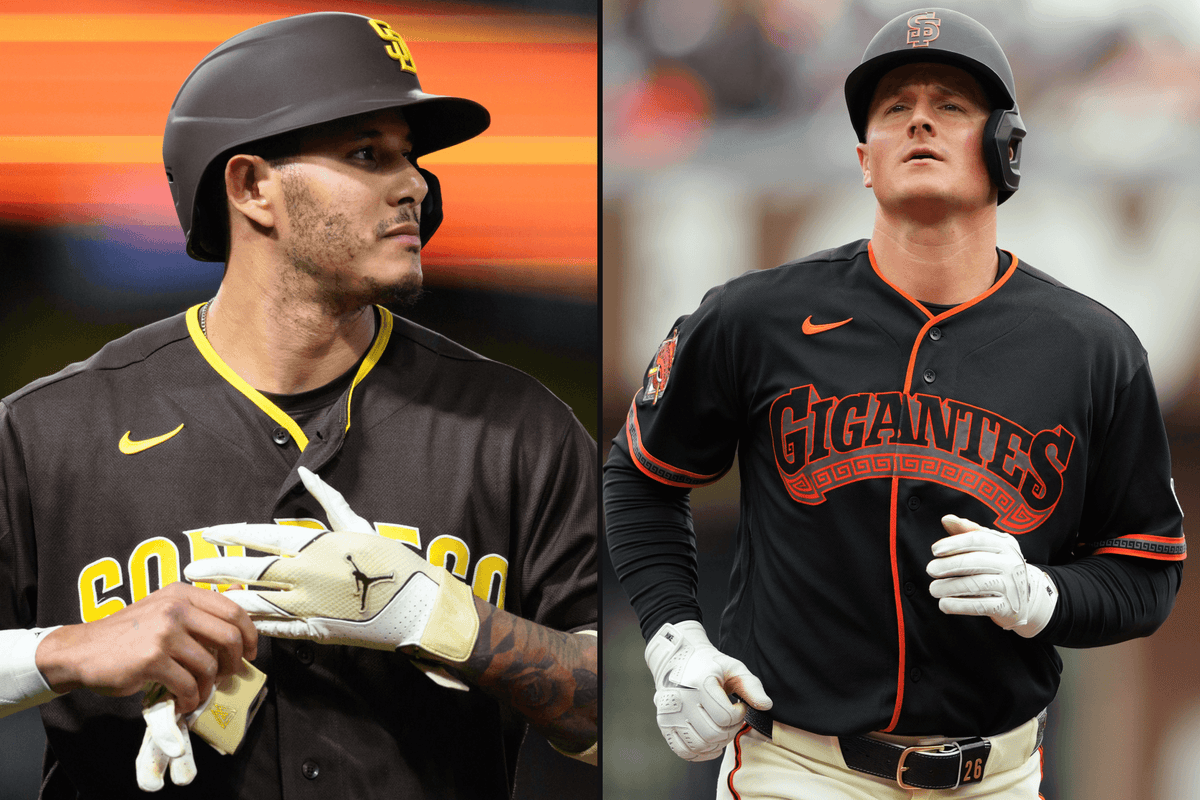
Matt Chapman, 3B, San Francisco Giants
Just take that whole last blurb and rewrite it for Chapman, although with a lower ceiling, and with a less obvious increase in velocity faced. The average velocity of fastballs Chapman is seeing is only up to 95.1 mph this year, but it’s a career high. And he’s letting the ball travel more — perhaps as a result — and that’s led to a complete lack of power. This bit is more important for Chapman than for Machado, though. Chapman has a very flat swing — only 10 qualified batters have flatter swings — and it’s very important for those with flatter swings to get the ball out in front. Out in front, the batter’s swing starts going upwards, which can impart more lift on the ball.
Chapman is not hitting the ball in the air, and it might be because of a more passive approach due to the quality of stuff he’s seen. The league’s only adding stuff, so maybe this becomes more of a problem every year, but a run of easier opponents might let Chapman get out in front more and lift the ball better. He has three straight series against bottom-half teams before the Giants go to Milwaukee at the beginning of June. Now’s the time.
Salvador Perez, C, Kansas City Royals
Bat speed is a result stat as well as a process stat. Pitchers can impact it, even if we haven’t publicly figured out exactly how they suppress bat speed. Part of it might be throwing faster pitches that require letting the ball travel more, which doesn’t let the bat get up to full speed. Like many of the others on this list, Perez is seeing the best velocity of his career (95 mph). He’s slugging OK on those fastballs — .449 with a .531 xSLG — but those numbers are down below his career norms. He’s also not letting the ball travel more than usual.
Most worrisome is that he’s 36. By the time a player hits 36, his projections become less reliable. When you add in that his bat speed has dropped from above-average to below-average with no change in shape or contact point, and that he’s never had a really great approach in terms of not chasing outside the zone, the worry about Perez’s ability to rebound might be the highest among these players. Sure, his division opponents might not be as tough as others going forward (the AL Central has no top-10 teams by Stuff+), but you never know about players at this point on the aging curve.
Pete Alonso, 1B, Baltimore Orioles
The bat speed is down for Alonso, but it’s still plus. He’s hitting the ball really hard, just whiffing a little more and hitting fewer fly balls. Nothing in the bat tracking really stands out, and you could easily assume that his schedule will equalize and he’ll get to the homers as the weather warms. That’s a safe assumption. But in terms of division, he’s not in an easy one. Here are the staff Stuff+ ranks in the AL East:
• Yankees: 4th
• Rays: 5th
• Blue Jays: 8th
• Red Sox: 9th
• Orioles: 18th
Welp. That last one doesn’t help any. It’s tough going in the AL East. You’re going to see the best stuff in baseball the most often. So the good news is that he’s not that far off from his career stats, because the road might not get much easier in terms of pitchers he’s facing.