
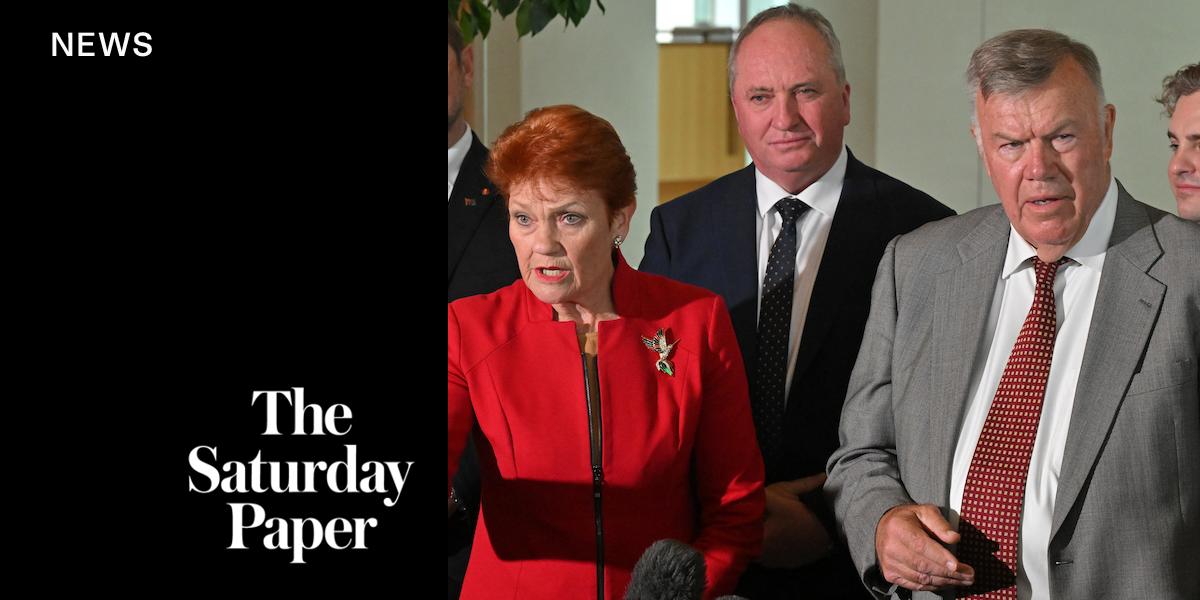
Two years out from the next federal election, the Labor Party machine is effectively in campaign mode, ramping up a new strategy to repel One Nation, acknowledging that the far-right party is now its all-but-official opposition.
A senior Labor insider says the electoral map has changed in the year since the last election, and they’re taking the scale of the challenge “very, very seriously”. While they won’t be drawn on specific seats at risk, pollsters indicate there’s concern over swathes of regional Victoria and the New South Wales Central Coast and Hunter regions.
The landscape for the 2028 federal election is going to be “volatile”, the source says. Labor’s organisational wing and key ministers are aware of major vulnerabilities in areas such as regional electorates where One Nation is currently polling primary votes in the low to high 40s.
Says another senior figure, in cabinet: “We will need to do some very good research about who our primary opponent is in each seat and that’s probably a different approach to what we’ve had to take in the past.
“We’re two years away and things can change, but if things continue as they are, it is going to be a seat-by-seat contest.”
This month’s historic Farrer byelection win for One Nation and the March 21 South Australian state election, which saw the party secure seven seats across both houses of parliament, have been catalysts for Labor’s campaign strategists. One Nation is currently polling better federally than it was in Queensland in the late 1990s, when it won 11 seats in the state election.
Related Reading
Labor is working on the expectation that a significant number of battles in 2028 will be Labor versus One Nation, starting with some of its outer metropolitan regional seats that previously saw National Party contests. There was only one final match-up between Labor and One Nation in 2025: the mining-heavy seat of Hunter, NSW.
A Labor stronghold since 1910 and currently held by Olympian and Special Envoy for Men’s Health Dan Repacholi, Hunter has seen Labor fight off Hanson’s party since 2019. Last year, One Nation was the runner-up after the right-wing vote was split and the party passed the Nationals.
“Labor’s opponent is no longer the Liberal Party,” RedBridge pollster and former Labor strategist Kos Samaras tells The Saturday Paper. “I wouldn’t rule out post the next election, you’re going to have an orange opposition and a red government.”
He’s not seeing Labor derailed, but it’s “vulnerable in certain parts of the country versus One Nation. The Liberal Party’s vulnerable in terms of its existence.”
This government, he says, “doesn’t stay and wait for the wrecking ball to hit.
“They know they’ve got a problem with certain constituencies around the country, particularly in their regional electorates.”
A focus is voting record and candidate research, as well as voter and electorate profiling to locate the highest concentrations of Labor voters who are thinking of turning to One Nation.
The playbook will draw on state election campaigns in Western Australia in 2017 and Queensland in 1998, 2001 and 2017, and especially the latter two in which One Nation polled strongly but was unable to translate voter intention into wholesale success at the ballot box.
“People who are currently voting or considering One Nation, 60 per cent of those people identify as working-class. Labor is in a contest for the working-class vote.”
Multiple Labor sources say they are focusing on working-class voters, on One Nation’s consistent failure to back workers’ rights, and on the party’s internal chaos and the rupturing influence it brings to the Coalition.
The idea is to run One Nation down in potency, as Labor has repeatedly done at the state level, well before the next election in 2028.
The senior minister describes the vision of a three-way governing coalition between the Liberals, Nationals and One Nation as particularly helpful, “both in terms of really locking in some of those urban seats that we won last time off the Liberals or the Greens and potentially even picking up extra seats from the Liberals in urban areas”. They point to Berowra in Sydney, held by Julian Leeser, and Alex Hawke’s nearby seat of Mitchell.
“If we do see the Liberal vote continue to fall beyond what it was at the last election – which is highly possible on the back of One Nation – but also some Liberals repelled by that kind of growing coalition between the three right-wing parties, I think that potentially moves more votes to us as well.”
The union movement is also mobilising. It ran very effective public campaigns such as “Your Rights at Work” from 2005 to 2007, opposing the Howard government’s controversial WorkChoices laws.
In social media posts, Australian Council of Trade Unions secretary Sally McManus has already highlighted One Nation’s parliamentary record of voting “every single time” against improvements to workers’ conditions, including its opposition to penalty rates, criminalising wage theft and bans on toxic engineered stone products.
Related Reading
McManus also emphasises the role of One Nation donor Gina Rinehart, saying Australia’s richest person was among the big business leaders who fought laws to give pay rises to labour-hire workers.
“What did One Nation do? They sided with the wealthy elite and not the struggling Aussie worker,” the union leader says over vision of Hanson boarding a luxury Rinehart plane.
Such campaigns have proved effective, says Samaras. “We know that, through extensive research, that actually does hurt Pauline Hanson.
“It did in the 2017 Western Australian election, where One Nation was threatening Labor there, and Labor collapsed the vote by basically running a narrative about her early industrial relations history.
“That is the group that is more likely to come back to Labor off the back of Hanson’s history on industrial relations.”
Labor insiders also point to pushing back One Nation in Queensland over a series of state elections since the party’s high-water mark in 1998, of getting 11 MPs elected to the Legislative Assembly.
“We have had some experience in this,” the senior minister says. “And we have had some experience in what works to hold Labor voters back from going to One Nation.
“I do think that we have done more than people may acknowledge when it comes to pitching for working-class voters.
“I mean, the budget we’ve just handed down, you couldn’t really argue that it was aimed at upper middle-class people. It was aimed at younger people and more traditional Labor-voting people to make sure that they have opportunities to get a house, so I think that we do more of that than we may be given credit for.”
Post-budget polling by Resolve, Newspoll and Roy Morgan all have One Nation ahead of the Coalition on primary vote. Both Resolve and Roy Morgan have a small drop for Labor, to 29 per cent and 29.5 per cent respectively, attributed to the “broken promises” campaigns against the negative gearing and capital gains discount changes. Newspoll has Labor steady at 31 per cent.
The major polls haven’t published two-party preferred figures for months, as One Nation’s rise makes it difficult to distribute preferences. The Sky News Pulse has Labor 52 to 48 against the Coalition and 53 to 47 versus One Nation.
One Nation’s primary vote is as high as 27 per cent in Newspoll, but its strength is overwhelmingly in conservative regional electorates. Its primary vote weakens in urban settings where the electorate is more diverse and Labor is strong.
Of Labor’s 94 seats, recent polling suggests those most at risk to One Nation in 2028 include Hunter, Robertson and Paterson in NSW, Bendigo and Hawke in Victoria, Oxley and Blair in Queensland and Hasluck in Western Australia. One Nation MP Barnaby Joyce has also declared that Western Sydney is the party’s “next stop” – despite the obvious challenge of selling its proposed ban on Muslim migration in suburbs where as many as 60 per cent of residents follow Islam. Its best chance is deemed to be the Liberal-held seat of Lindsay.
Paul Smith, the director of public data and affairs at polling group YouGov, says federal Labor should focus on workers’ rights to reassure voters who are thinking about One Nation.
Whereas Labor was seen as the party of workers and the working-class in the past, many of those voters are heading to One Nation, he says.
“The underrepresented political base in Australia is working people,” says Smith.
“Our polling shows that people who identify as working-class are the majority of people in the majority of federal electorates. People who are currently voting or considering One Nation, 60 per cent of those people identify as working-class. Labor is in a contest for the working-class vote. We find that 59 per cent of people who say they’re currently voting Labor identify as middle-class.
“This is a wealthy country and people want to see a benefit from that. This is not about giving people $200 off their energy bill, it’s whether the energy company should actually be publicly owned or not.”
Related Reading
While Labor decided against a popular proposal to increase taxes on the profits of gas exporters in its latest budget, One Nation on Thursday announced it would scrap the current petroleum resource rent tax and replace it with a 10 per cent wellhead royalty on all offshore gas and oil production.
The proposals were quickly rejected by both Labor and the Coalition.
Meanwhile, in Hunter, One Nation has been making serious inroads since 2019, when former Labor cabinet minister Joel Fitzgibbon last ran. The margin of Repacholi’s 2025 win was 59 per cent to 41 per cent for One Nation’s two-time candidate Stuart Bonds, who received strong preference flows from a group of right-wing parties.
One Nation’s climate denial adds to the pressure on Repacholi to square Labor’s net-zero stance with his voters in the coal industry.
The cost-of-living crisis, made worse by the Middle East war, is front of mind, and so are their jobs.
“I’m all for coalmining, I’m all for mining, I’m all for resources, I’m all for workers’ rights. It’s exceptionally hard for [One Nation] to target me, because I’m very open and upfront about what we’re going through in the Hunter,” Repacholi says.
“The Greens side of the people hate it when I say this, and it’s usually a trigger warning for them. I tell them, we have the cleanest coal in the world.
“If they don’t burn our coal for their power generation, they’re going to burn other coal, which is shit, and they’re going to burn three to four times as much and … get the same output from what you get from the Hunter Valley’s clean, clean green coal.”
He takes heart from the view that incumbency should help.
“I’ve been told ever since I started running for the seat of Hunter in 2021 that ‘One Nation’s coming’, ‘One Nation’s going to beat you’, ‘You’re going to lose to One Nation’, and this and that. We haven’t lost.”
With Hanson’s party now polling far better, Repacholi remains in campaign mode.
“[We are doing] mobile offices, we’re having the street stalls, we’re doing the doorknocking, we’re doing the phone banking,” he says.
“There’s much smarter people than me involved in this that are in head office and in all those right areas that get all the data. What I know works is being on the ground, having the conversations, and just being active and available for people.”