
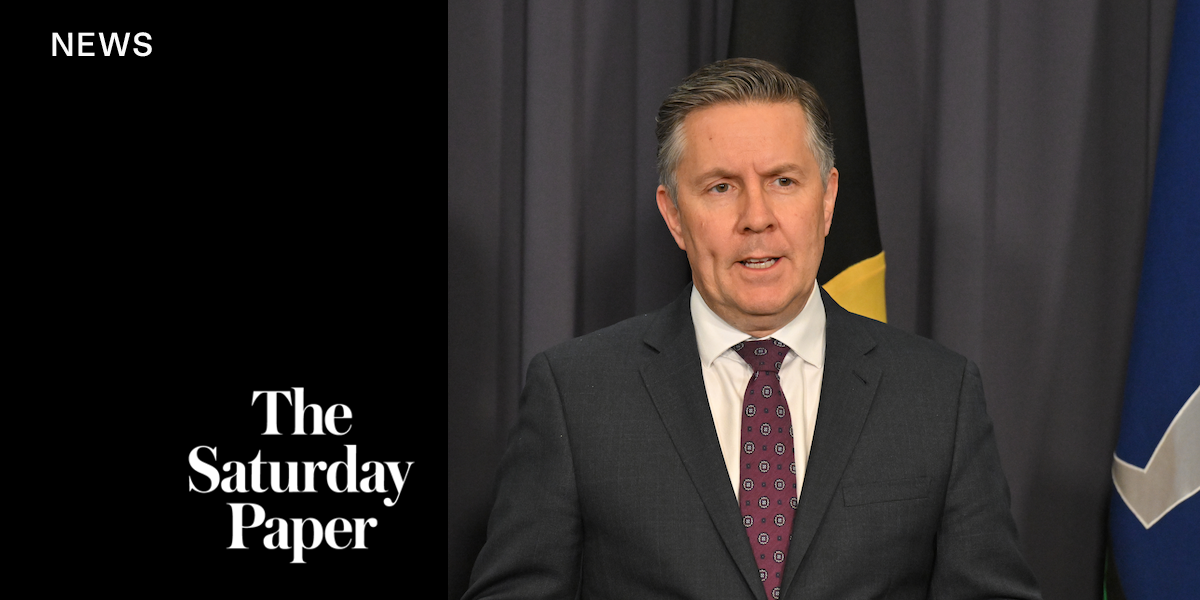
This week, Mark Butler introduced a bill that would subject all current and prospective users of the National Disability Insurance Scheme to a test of their ability to perform daily activities. It also paves the way for thresholds that would disqualify disabled people from joining.
This marks the implementation phase of the plan the NDIS minister announced to the National Press Club in April, intended to cut the number of participants from 760,000 to 600,000 by 2030 – to slash $37.8 billion from the scheme.
It has caused ripples of panic throughout the disability community. Like many other NDIS participants, I was forced to contemplate the suddenly urgent question: where can I turn for support?
The government has proposed “foundational supports” as a sweetener for a bitter pill. The NDIS Review coined the term in 2023, recommending all governments invest in an ecosystem of disability services beyond the scheme.
Foundational supports are meant to offer people who don’t qualify for the NDIS an alternative way to access assistance, as well as resources and advice. The program would be delivered by state and territory governments.
“No one will be removed without somewhere for them to go,” the prime minister has promised. Can we count on it? There are many reasons why we fear we cannot.
The first is the number of people who will be affected by these changes. The media has largely reported that one in five participants will need to be removed from the scheme to meet the government’s target. The reality is worse.
There is a never-ending stream of people being born with significant disabilities, suffering catastrophic injuries or developing disabling medical conditions. Disability is a minority group that anyone can join at any time. In the year to mid 2025, the number of NDIS participants grew by 78,000.
Let’s speculate that over the next four years, the National Disability Insurance Agency that runs the scheme somehow manages to reduce entrants to 20,000 per year. The target would still only be achievable if almost a third of current participants were dropped.
Butler has tried to justify such cuts by saying people have been funnelled into “a scheme that was never designed for them”. Only a true cynic could believe nearly a third of today’s NDIS participants were never meant to be there.
“There is a never-ending stream of people being born with significant disabilities, suffering catastrophic injuries or developing disabling medical conditions. Disability is a minority group that anyone can join at any time.”
When the NDIS began rolling out in 2013, state and territory governments closed most of their disability services. Many metaphors have been used to describe the situation that followed. The scheme became the only “oasis in the desert”, “lifeboat in the ocean” or “port in a storm”. It all amounts to the same thing: it was the NDIS or nothing.
The eligibility threshold for the NDIS is already high: people must have permanent disabilities that “substantially” reduce their functional capacity. Under the legislation introduced to parliament on May 14, the criteria will become even tougher. A disability will only be considered permanent if the person has tried all “appropriate” treatments, regardless of whether those treatments are affordable or available in their area.
The government is also establishing a technical advisory group to help select a standardised functional capacity assessment tool. Advocates have raised concerns about whether a single assessment can accurately capture the experiences of a diverse range of people with disability.
“Disability does not present in one way, and it cannot be understood through a single assessment tool,” says Sophie Cusworth, chief executive of Women With Disabilities Australia. “For women, girls and gender-diverse people with disability, this can mean our needs are overlooked, underestimated or not properly understood, especially when our disability experience is so heavily shaped by chronic illness, trauma, violence, caring responsibilities and fluctuating conditions.”
Currently, the NDIS supports only 22 per cent of Australians aged under 65 with a disability. It’s crucial to create a support system for the remaining 78 per cent. People who don’t meet the NDIS access criteria often still need some level of assistance.
Funding also needs to be shored up for disability services that are not suited to the NDIS’s individualised funding model, such as information and advice hotlines and programs that support local community sports and arts groups to include people with disability.
The Thriving Kids foundational support initiative will provide some of these services for children under the age of nine, including advice hotlines, online resources and playgroups. However, there’s no indication of what services the government intends to deliver for other age groups.
While the theory behind foundational supports might be sound, the program is severely underfunded.
All jurisdictions have signed a $10 billion agreement that shares costs 50-50 with the federal government. Here’s the small print: it’s $10 billion over five years – $2 billion a year.
To describe $2 billion as not a lot of money sounds ridiculous, but this is a nationwide program intended to support hundreds of thousands of people. The NDIS cost more than $54 billion last financial year.
State and territories delivering foundational supports will also have their own operating and overhead costs, leaving even less money for actual services.
The total funding commitment for foundational supports is capped, as per the national agreement, which states that after five years a new cap will be negotiated, “at a level consistent with the initial funding envelope”.
What can’t be capped is the demand. Where else can people turn?
It also seems unlikely the supports will be ready anytime soon. According to the government’s timeline, changes to NDIS eligibility rules will come into effect in January 2028. Afterwards, prospective and current participants must undergo a functional capacity assessment and meet the stricter definition of permanent disability.
Butler has said people won’t be removed from the NDIS until “there are other systems of support in place”. Yet in the first quarter of 2025/26 the NDIA nearly doubled the number of eligibility reassessments it had done in the same period the year before, according to data from Senate estimates. And at this stage, only one foundational support has even been proposed: Thriving Kids.
Thriving Kids will be an early intervention program for children aged 8 and under with mild-to-moderate developmental delays and autism. The initiative promises to provide national screening programs, parenting support, playgroups, information and advice and, for some children, allied health therapy and equipment. It has meaningful ambitions, but not the funding to achieve them.
Moreover, even its future remains in doubt. Queensland has still not signed the necessary bilateral agreements, despite the program being due to roll out in October.
Thriving Kids has been allocated $4 billion of the $10 billion earmarked for foundational supports. No plans have been announced for the remaining $6 billion.
The federal government only managed to persuade the states and territories to sign up to Thriving Kids by committing an extra $25 billion to public hospitals. What will it take to get the remaining foundational supports rolled out by January 2028?
The question of who stays on the NDIS is a personal one for me. I joined in 2020, after a long battle that ultimately ended in what was then the Administrative Appeals Tribunal.
The word traumatising can be overused, but it’s the most apt description of my experience. I still get anxious recalling attempts by NDIA delegates to persuade me my disability had minimal impact on my life. The application process is deficit-focused. The agency needs minute details about everything you can’t do because of your disability, and your personal strengths are held against you.
If there had been another option, I would have welcomed it.
In a society that values independence and self-reliance, it’s a vulnerable thing to ask for help. It’s hard to accept needing support.
Most people will only apply for the NDIS if it is truly necessary. The scheme isn’t a luxury, it’s a never-ending bureaucratic nightmare. Even if you have a well-funded plan, you live in constant fear of it being taken away. That is the paradox of the NDIS. For all its many, many, many problems, it’s also something of a miracle.
Applying might have been soul-destroying, but accessing it was life-changing. I joined at a time when I was uncertain how long I could stay in the workforce. The NDIS allowed me to keep my job, maintain social connections, and live a somewhat ordinary life despite my unordinary disability.
It feels inevitable that I will lose my NDIS funding. But I am also lucky; I have a supportive community of friends and family, and now feel able to maintain a regular income. When the government safety net dissolves, I’m in a position to weave my own to soften the fall.
Many people don’t have the privileges I have. Hundreds of thousands of people will have to fight for the services that have made it possible to prepare meals, use the bathroom, get out of bed, organise medication, attend appointments, work, leave the house, have meaningful relationships, learn new skills and do all the things that make up a life.
Are we really willing to make people live without them?